GUNNS TROUBLE WITH The Independent Auditor, the ASX, GUNNS half yearly profit AND Gunns SHARE PRICE.
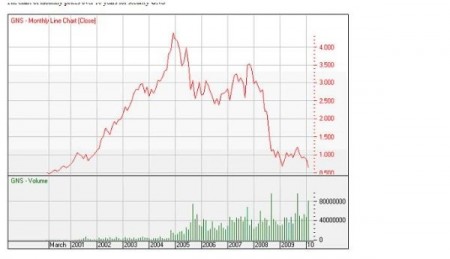
Gunns share market decline comes as no surprise. It took over Boral’s woodshipping interests in 2000 and commenced a five year period of growth, its share price climbing to somewhere over $4.30 [actually think it might have been $4.75] in late 2004. Then, as its share price peaked, the company made two big mistakes: it confirmed its intention to initiate a pulpmill project EIS and it took the Gunns 20 to court. From this moment, its shares began to fall and though propped up by government support in 2007, they are now back to where they were 10 years ago. This article concludes with:
1. The concerns expressed by the independent auditor in his review of Gunns latest half yearly Director’s report.
2. ASX Issuers Senior Advisor, Gonzalo Valencia on Tue asking Gunns’ company secretary Wayne Chapman for an explanation relating to the fall in share price, 98.7% drop in half yearly profits and what if any disclosures Gunns made to the ASX prior to releasing its half yearly report.
BEGINNING:
Text of Chairman John Gay’s address to the Gunns AGM 28 Oct 2004:
“The company has a clear vision for achieving long term growth and value through maximising the value of the forest resource. On 25 June 2004 the Company announced its intention to undertake a feasibility study into the commercial viability of the development of a pulp mill in Tasmania. Substantial progress has been made in the study and the initial results have been considered by the Board. Based on these result the Board will be advising the State Government of the Company’s intention to initiate a detailed project EIS. This study will involve an assessment of environmental impacts of a pulp mill, specifically considering mill size, technology and location. It is expected that this study will take up to twelve months to complete. Our managed investment business continued to expand in 2005 with over $47 million of …” [http://www.asx.com.au/asxpdf/20041028/pdf/3nfpg12704x7h.pdf]
A number of things happened around the time of the peak price which occurred in November 2004.
1. John Gay in his Chairman’s address accompanying the AGM announced that following initial results from the company’s pulp mill feasibility study, the Board would advise the state Government of the Company’s intention to initiate a detailed project EIS. [see above]
2. The company initiated a share subdivision in which for every share an investor held, they then became holders of four shares, taking effect on 5th Nov 04. Accordingly All directors as a result of the subdivision, increased their holdings fourfold.
3. David McQuestin, a then Gunns Director, took advantage of this and sold 200,000 – roughly a quarter of his new holdings – for over $4 each, giving him just over $870,000 cash and still a tripled shareholding. Did other investors do the same? Volumes traded (the green bars in the bottom portion of the chart) increased. But perhaps this was basically in line with the share division.
4. Gunns announced the ‘Gunns 20’ case. I need not comment on this, except to ask was it ‘hubris’ that was ultimately the self-destructive element in the Greek tragedies? With all the pain and cost that was borne by the 20, this despicable company has finally abandoned all of its claim. It began in ignominy, with a Victorian judge twice to my knowledge tossing out the company’s statement of claim, telling them to go away and see if they could find someone who could put together something worthy of consideration.
Maybe someone else can fill in the gaps. I’m leaving plenty out of the story, I suppose. Tasmanian readers will know better than me the many events of the last five years.
SHARE PRICE FALL
You can see from the chart above what happened next: having climbed steadily for five years, Gunns share price began falling and did so for the next year – so much so that by Dec 2005, Standard and Poors removed Gunns from their ASX top 100 Companies Index (the S&P/ASX 100). This was followed by two years of up and down between $2 and $3 per share – July 2006 had led to the lodging of the draft IIS, the selection of John Holland to construct the mill, and even though profits in that years were down 9% and revenues down 5%, Gunns were upbeat that things were going well – the mill was their ‘clear priority’. They made another share issue (FORESTS had been the previous). The pulp mill was now a ‘Project of State Significance’. Gunns share price began moving up.
Then the cataclysmic events of the RPDC walkout.
ASX RELEASE 14 MARCH 2007:
“Gunns Limited advises that it has today notified the Tasmanian Resource Planning and Development Commission (RPDC) of its decision to withdraw the Bell Bay Pulp Mill project from the RPDC assessment process. The Company has referred the project to the State Government.”
There is no apparent conscience in money and GNS share price continued to move back up, strengthened by the libs, the labs, and Independents like Ivan Dean. I am referring not just to the abandonment of the RPDC but also to the passing of the PMAA 2007 and then the approval of the pulp mill permits. Gunns were riding high and their share price began to pick back up because of it. However it would never get back to those heady days they had enjoyed before the company announced that they would prepare a draft IIS. The company next gained an extension on the assessment from the Feds and in the fullness of their glory, they continued on, taking over Auspine, and in Oct 2007 gaining a form of Fed approval for their project. The Heads of (wood supply) Agreement followed.
However, Gunns’ star had already set. They had reached their zenith. The world financial crisis that began in late 2007 returned them to the downhill trend that had begun with the pulp-mill dream. There has been no let up ever since. The approval from Turnbull, if I recall correctly, placed 24 (?) conditions on the project. Garrett required further studies. Various bodies took legal actions, the Premier was compelled by unpopularity to resign. And much more. The project was unravelling. It still is. And it is taking the company with it. It will not be given a marked grave, nor will the project. As I write, Gunns share price has dropped below the disastrous low of 12 months ago when:
‘shares in woodchipper Gunns Ltd fell sharply after the federal government declined full approval for Gunns’ $2.2 billion pulp mill in Tasmania’s Tamar Valley.’ (Age Jan5 2009).
During the ensuing year they have tried to resurrect, but could not manage much above $1 and, since the announcement of a 98% fall in half year profits down to a risible $400,000 – they are falling, again.
Will we see the same suspensions to trading that accompanied the previous plunge? Will we see more share offers – price to public … what was it? $1:30 a share and yet did not two directors go out and buy privately below that price! Of course, dropping down to the low 60s share price did not deter gns from the ITC purchase, nor did it deter the company from taking over from Great Southern the management of 8 MIS schemes:
Said Gunns Chief Executive, Greg L’Estrange [Gottliebsen in Business Spectator]
“You need money and a balance sheet to support these operations over the term of the forestry cycle and we have that capability … [we] We believe that we will manage these assets in your interests, we will provide the best possible outcome, and will use the combined experience and knowledge of Gunns to ensure that your investment reaches the maximum value”
Robert Gottliebsen, summarising his own article in Bus. Spectator, wrote:
‘Timber company Gunns Ltd will run eight of the nine schemes run by failed agricultural projects manager Great Southern Ltd, after investor-growers in the managed investment schemes (MIS) operator voted on a proposal by Gunns to become their responsible entity.
“The transaction provides highly complementary hardwood operations for Gunns, resulting in a significant increase in scale and access to additional plantation timber, the management and sales which will be handled by Gunns on behalf of the schemes,” Gunns said in a release to the Australian Securities Exchange (ASX).’
Gottliebsen has not been viewed by Tasmanians as a balanced commentor on matters relating to Gunns, and indeed, to the proposed pulp mill. But why would he? He’s not exactly in the sacrifice zone, is he?
Plausibly, we can say that the writing was on the wall. They paid the TWS $350,000 to settle that part of the Gunns 20 case, and finally gave the whole shoddy case away. They were not able to find finance for the mill, resorted to strategems such as clearing vegetation at the Longreach site in order to be seen to be doing something. Mr Bartlett subsequently got legislation through the Parliament which validated the fact that they didn’t have a permit to do the clearing. Then there were the ‘100% plantation’ and ‘Company-will-seek-FSC’ announcements. But with the announcement of the disastrous drop in profits, again the share decline has accelerated.
Now Gunns has sunk lower than last year’s nadir. It is not far from its position of ten years ago. Yep, it’s all there on the graph drawn from ASX sources. Interesting little things one sees going further into the detail. Lo! 12 Feb 2011, just ten days before the fall began, Investors Mutual Limited notified Gunns that it had ceased to be a substantial shareholder, having sold its shares for somewhere just under $1:00 per share – maybe indicative, probably not causal. They were the lucky ones.
GUNNS DIRECTORS REPORT … for the half year to DECEMBER 2009 [EXTRACT]
“17. Pulp Mill Project
Capital works in progress includes $183.7 million (June 2009: $149.7 million) relating to the proposed Bell Bay mill. The project is the construction of a bleached kraft mill in Tasmania. The costs capitalised are those costs incurred after establishing the commercial viability of the project and which are directly attributable to the development of the project. They include preliminary environmental monitoring and engineering work, costs associated with the planning approval process for the mill and equipment purchases. The Directors have considered the probability of the project proceeding by assessing the commercial viability of the project, the expectation of obtaining finance and the requirements of the regulatory processes. The Directors are of the opinion that the proposed mill will be financed and that it is probable that the project will proceed to completion.
If the project were not probable, this would involve the expensing of a substantial proportion of the $183.7 million included in capital work in progress at 31 December 2009 through the profit and loss.”
CONCERNING THIS the independent auditor review, by KPMG said:
“Carrying value of capitalised Bell Bay pulp mill costs included in capital work in progress subject to significant uncertainty arising from the current global financial environment.
Without qualification to the above opinion, we draw attention to Note 17 to the financial statements.
The recoverability of the $183.7 million of capitalised pulp mill expenditure is dependent on a number of key assumptions, including that financing will be obtained for the project and that the project is commercially viable.
The Group is currently in negotiations with a number of potential financiers and investors to obtain financing to complete construction of the Bell Bay pulp mill. The outcome to these negotiations cannot presently be determined with certainty in the current global financial environment. Accordingly there is material uncertainty as to whether the carrying value of capitalised pulp mil expenditure can be recovered for the amount stated and as to whether additional obligations will be incurred in relation to committed project costs.
-Leigh Franklin, KPMG, Launceston in a review for GCL accompanying Gunns “Directors’ report to members of Gunns Limited and its Controlled entities for the Half Year Ended 31 Dec 2009.” http://www.asx.com.au/asxpdf/20100222/pdf/31ntmjnbxhvvp1.pdf
The company is beset by problems – as the independent audit review notes. And now they are suggesting a double or nothing restructure to try and fool some foreign financier that they are FSC kosher. Gunns have known about the capitalised pulp mill costs for years now, have known about declining profits, have watched the share price slide back down the wall. They were even begging DIER to help their ‘cash strapped’ company pay for the culvert at Dilston bypass. Gunns should be put out of their misery.
BUT WAIT, THERE’S MORE
ASX GIVES GUNNS A PLEASE EXPLAIN:
ASX Issuers Senior Advisor, Gonzalo Valencia asking Gunns’ company secretary Wayne Chapman for an explanation relating to the fall in share price, 98.7% drop in half yearly profits and what if any disclosures Gunns made to the ASX prior to releasing its half yearly report.
Valencia noted the 98.7% drop in half yearly profit, the drop in the share price on Mon 22 Feb, the requirement for continuous disclosure of info relating to financial forecasts and asked the following questions:
1 when Gunns found out about the 98.7% profit drop?
2 any earlier disclosures made by Gunns?
3 whether Gunns regarded the 98.7% drop as material
4 if not, why not
5 if Gunns is in compliance with listing rules, esp 3.1
Valencia concluded by asking Chapman to separately address each of the questions. Chapman, for Gunns, made a lengthy unhelpful answer to question 1, and answered questions 2, 3 and 4 by writing: “See answer to question 1.” Q5 answered that the company was aware of its obligations and ‘confirms that it is compliance [sic] with listing rule 3.1.
http://www.asx.com.au/asxpdf/20100224/pdf/31nwg7pqwv87tt.pdf
I can’t see how the answers could be considered as satisfactory. I wonder what the Stock Exchange will do next…
STOP PRESS: and then FEA had a trading halt … SHARES AT 45c and GUNNS at 51.5 cents down another 10 cents on yesterdays …
[since time of writing article Gunns presently stands at about 55.5c]