Letter to Editor Mercury 11-3-10
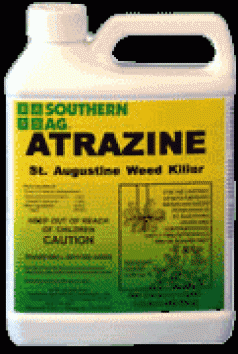
Despite the constant posturing by Syngenta (No threat to frogs – Letter to Mercury 11/3/10), the facts are out for all to read.
The Endocrine Society (International consensus of endocrinologists) and the American Medical Association last year stated quite clearly that atrazine is an endocrine disruptor, biologically active at parts per trillion, and is a threat to all fish, amphibians, reptiles, mammals and humans.
The word is well and truly out.
It remains to be seen if the regulators (APVMA and State Departments) can jump the gap between motherhood statements (no problems if used according to label directions) and reality (atrazine and simazine are ubiquitous in our environment) or whether they need to be forced to act by political means.
Atrazine’s current registration in Tasmania is medically unsupportable.
Meanwhile, from The Pesticides Action Network: EPA petitioned, Syngenta sued over atrazine: with full links, HERE …
Atrazine is getting the national attention it deserves. On Monday of this week, a coalition of 16 Midwestern cities in six states filed a lawsuit to force atrazine manufacturer Syngenta to pay for clean-up costs to filter the chemical out of municipal water supplies, reports the Huffington Post.
Stephen Tillery, the lawyer representing the communities in the suit, said that the cities have spent upwards of $350 million in local taxpayer money filtering atrazine out their drinking water, while Syngenta’s profits from atrazine sales are in the billions. Syngenta’s spokespersons claim there is no need to filter the chemical, despite the fact that in 2008 EPA found atrazine in water from at least two of the cities (Coulterville, IL and Monroeville, OH) at levels of 30 parts per billion (ppb) – well above the 3 ppb level deemed “safe” by the federal government.
Earlier this week, Pesticide Action Network delivered a petition with thousands of member signatures to EPA Administrator Lisa Jackson, urging her to make the current review of atrazine a “model of scientific integrity,” and to take swift action to protect farmers, rural communities and the general public if the herbicide poses a threat to human health and the environment. A weed-killer sprayed primarily on cornfields, atrazine was initially approved by EPA in 2003, after Syngenta held over 50 private, closed door meetings with regulators. The current review coincides with release of new studies linking atrazine to potential health problems.
The most recent was research published last week by the National Academy of Sciences that showed male frogs exposed to “safe” levels of atrazine became females able to mate and lay eggs. National media outlets from the Washington Post to FOX News and Scientific American covered the story.