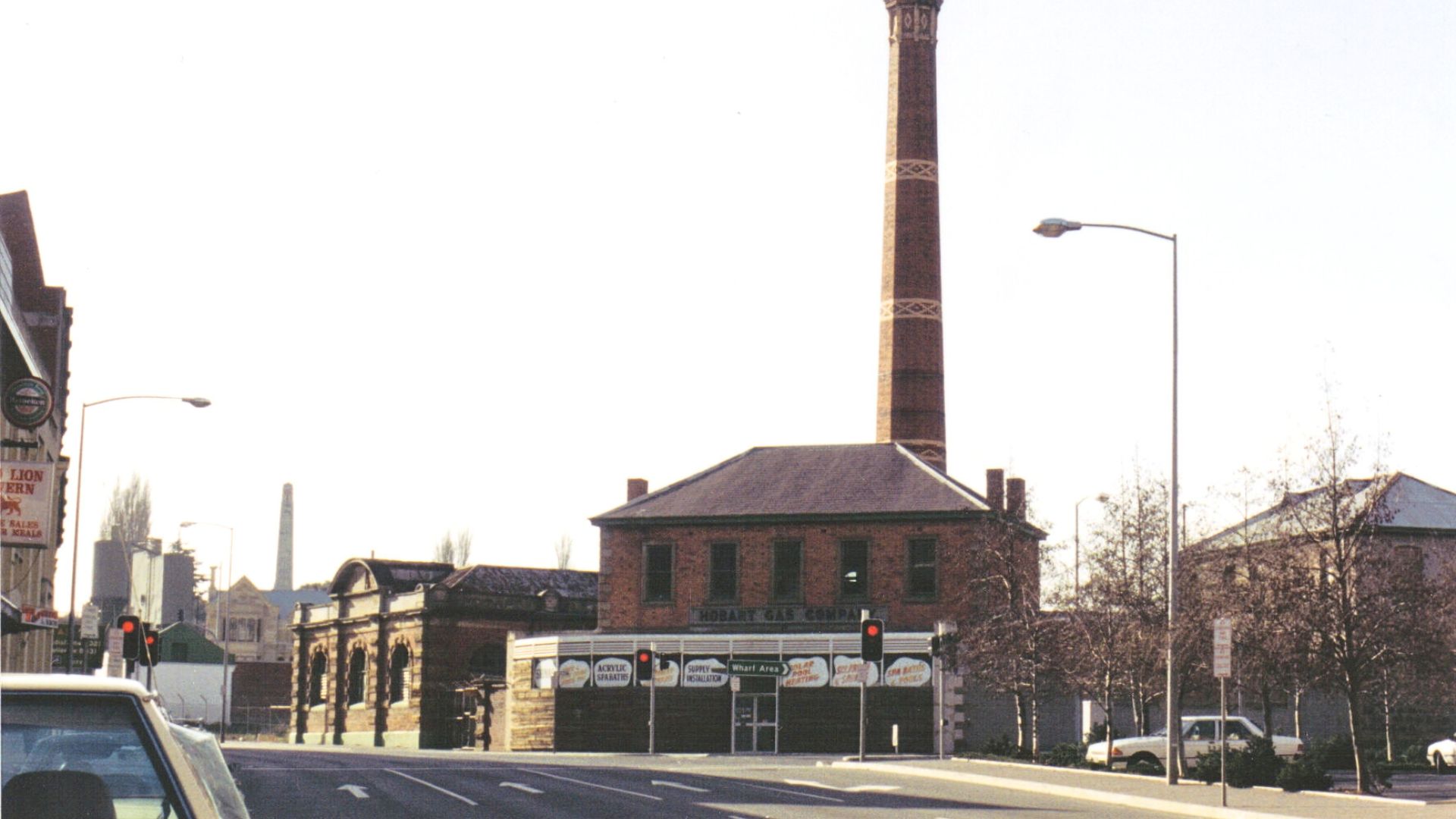
The Hobart Gas Company was established in 1854 under an Act of Parliament, enabling it to manufacture and distribute coal gas and to build and operate a gasworks to illuminate Hobart’s streets at night.
Coal and gas machinery were subsequently imported from Britain, and infrastructure for gas reticulation was planned to support Hobart’s street lighting. The Hobart Gas Company’s gasworks in the Sullivans Cove area was then built, making it one of Tasmania’s earliest gas utilities.
Gas first flowed through Hobart’s newly laid mains on Saturday, 7 March 1857, providing light for the city’s streets and buildings. Demand for gas lighting had increased by the 1880s and 1890s, prompting the Hobart Gas Company to expand its operations and distribute gas to more households and businesses across the city.
In 1894, the company built an electric power station within its existing gasworks site in Sullivans Cove to supply electricity to Hobart customers, initially using gas engines. Nineteen years later, in 1913, it acquired the distribution system of the Hydro-Electric Power and Metallurgical Company, which had been operating for roughly two years up until that point.
In 1915-16, the newly formed Tasmanian Government Hydro-Electric Department (now Hydro Tasmania) acquired the Hobart Gas Company’s combined gas and electricity distribution systems. The gasworks at Sullivans Cove continued to operate, keeping pace with changing technology and economic conditions despite the Great Depression, coal shortages, and competition from electricity.
But nothing lasts forever. Hobart’s need for coke-produced gas* soon declined sharply as electricity and liquefied petroleum gas became more widely used. As a result, gas production in Hobart ceased in 1978.
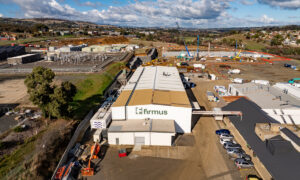
In the 1990s, the original gasworks site in the Sullivans Cove area was redeveloped into a commercial and heritage precinct known as ‘Gasworks Village’. The site was sold again for redevelopment in 2014.
* Coke-produced gas is a flammable gas released when coal is heated in an air-tight oven to produce coke. The gas can then be collected and used as fuel.
References & Bibliography
- Hobart Gas Company (Companion to Tasmanian History)
- Hobart Town Gas Works (The Hobart Town Daily Mercury, 10 February 1858, page 2)
- Hobart Gas Company (On The Convict Trail)
- Hidden Danger: Old Gas Pipes in Hobart and Launceston (myosh)
- Jubilee of the Hobart Gasworks (The Mercury, 11 March 1907, page 8)
- Hobart Gas Company’s Electric Light Bill (Parliament of Tasmania)
- Gasworks, Hobart (YouTube video)
- Landmark chimney (Discover Tasmania)
- Hobart’s historic Gasworks site sold for $7.5 million (Apartments.com.au)
Tas That Was is a column that includes:
- anecdotes of life in Tasmania in the past;
- historical photographs of locations in Tasmania; and/or
- documentaries about locations in Tasmania.
If you have an anecdote or photograph you’d like to share with us, please send it to [email protected].
Callum J. Jones is passionate about telling stories. He studied English, History, and Journalism at the University of Tasmania and lived in Western Sydney from 2022 to 2024 while working as a journalist for Professional Planner, a leading online publication for financial planners. Callum has written for Tasmanian Times since 2018 and has also been published in a range of other outlets, including Quadrant and the BAD Western Sydney anthologies.