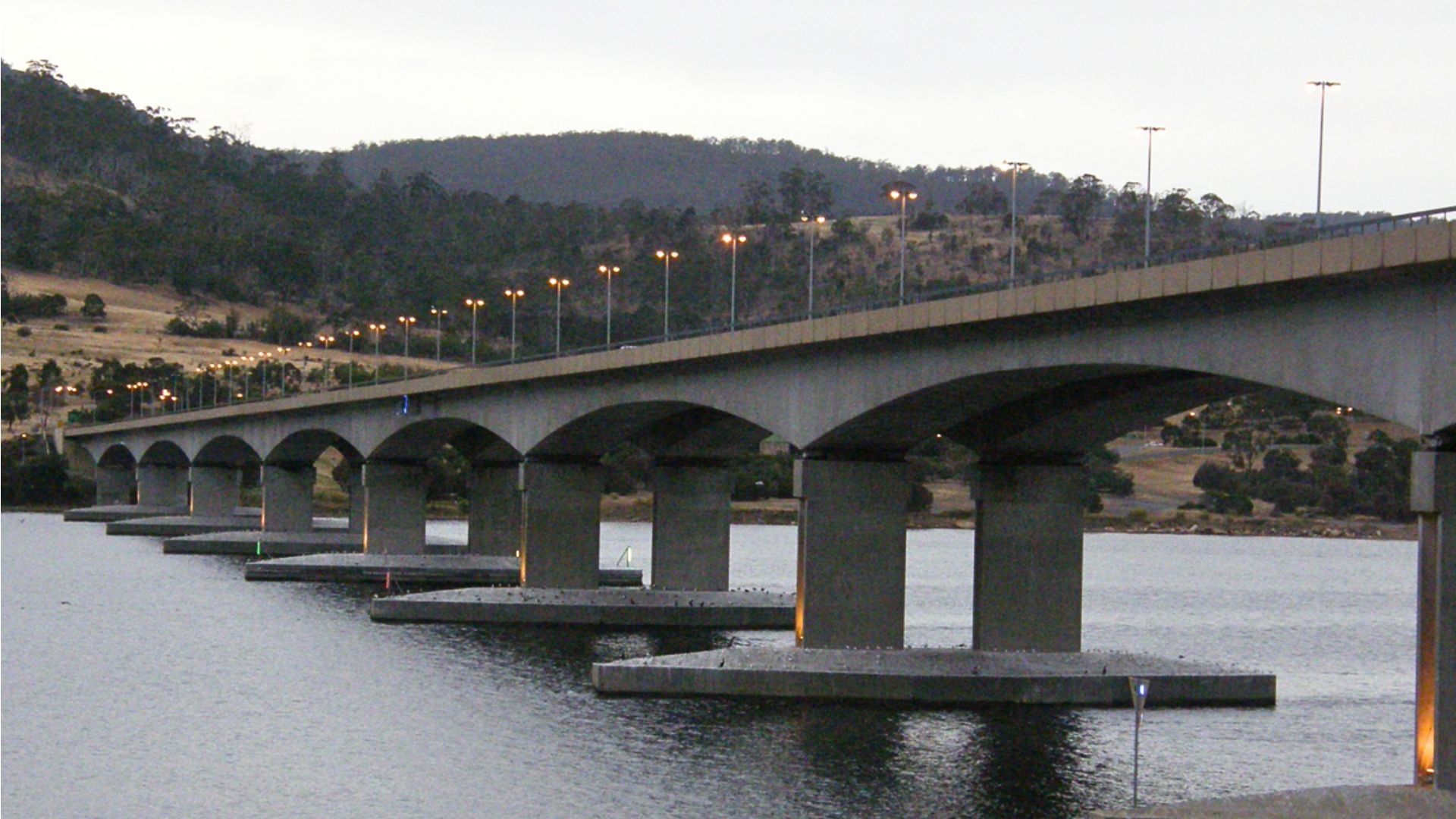
The Bowen Bridge is probably the least thought about bridge across the Derwent River today. It rarely makes headlines, doesn’t carry the same volume of traffic as the Tasman Bridge and the new Bridgewater Bridge, and doesn’t feature in local tourism promotions. One can also argue that it is unremarkable to look at.
Having said all that, it was built in response to one of the most well-known events in Tasmanian history.
On 5 January 1975, a section of the Tasman Bridge collapsed when it was struck by the Lake Illawarra, a bulk ore carrier. The disaster severely disrupted traffic across the Derwent River, prompting the state and federal governments to establish a joint committee to plan and oversee the construction of the Bowen Bridge – a second, alternative crossing over the Derwent.
It was designed as a segmental cantilever road bridge with strong foundations and piers to prevent collapse if a ship collided with it. Construction – which cost $49 million* – began in the early 1980s, and was completed by Thursday, 23 February 1984, when it was officially opened by Prime Minister Bob Hawke.
In his speech, Hawke described the Bowen Bridge as “a magnificent structure” that served as “a triumph of Australian enterprise”.
The nearby Bailey bridge – erected immediately after the Tasman Bridge disaster to allow Hobartians to cross the Derwent without having to travel all the way to Bridgewater – was removed after the Bowen Bridge was opened to traffic.
Namesake
The Bowen Bridge is named after John Bowen, the British Navy officer who set up Tasmania’s first European settlement at Risdon Cove.**
Bob Hawke’s predecessor as Prime Minister, Malcolm Fraser, announced the bridge’s name in a public ceremony at Dowsing Point on Friday, 10 October 1980.
* Over $184 million today.
** Risdon Cove is located a short distance away from the Bowen Bridge, on the east side of the Derwent.
Bibliography
- РM opens new bridge in Tasmania (Leighton Newsletter, April 1984)
- Second Hobart Bridge: Joint Committee Report on Construction
- Tasmania’s Engineering Timeline (Engineering Heritage Australia)
- Tasmania: Historic Bridges (Our Tasmania)
- The Bowen Bridge (YouTube)
- What Becomes of the Hobart Bridges? (YouTube)
Tas That Was is a column that includes:
- anecdotes of life in Tasmania in the past;
- historical photographs of locations in Tasmania; and/or
- documentaries about locations in Tasmania.
If you have an anecdote or photograph you’d like to share with us, please send it to [email protected].
Callum J. Jones is passionate about telling stories. He studied English, History, and Journalism at the University of Tasmania and lived in Western Sydney from 2022 to 2024 while working as a journalist for Professional Planner, a leading online publication for financial planners. Callum has written for Tasmanian Times since 2018 and has also been published in a range of other outlets, including Quadrant and the BAD Western Sydney anthologies.
Tasmanian Times (TT) is a community-based news and current affairs service covering the island state of Tasmania. It exists to provide a diverse presentation of Tasmanian issues. TT creates and supports independent media content utilising the best of modern technologies and tried-and-true practices of public-interest journalism.
Support us in expanding our coverage and developing new content by and for Tasmanians.
New initiatives on the way include … what our contributors and readers suggest! Please get in touch with your suggestions.