Ignorance is Bliss
The macro and the micro.
Watching Trump addressing world leaders last week at the United Nations, attacking and dismissing climate science as coming from ‘stupid people’ and decrying it as ‘the greatest con-job’, prompts an irresistible micro-parallel with the ignorance, denials and blatant falsehoods being perpetrated by proponents of the Macquarie Point stadium.
Short of calling them ‘stupid people’, the five, highly qualified delegates of the Tasmanian Planning Commission, selected and remunerated over the course of a year by the state government for this specific purpose (along with all previous government commissioned independent studies), have been summarily ignored by a Premier and by a treacherous opposition willing to shoot each and every recalcitrant messenger.
But herein lies the critical difference.
Unlike the predictable contrarianism of Trump – who can wilfully disparage independent studies he had nothing to do with – our small-pond Premier adopts the same disregard for planning experts chosen, hired and reimbursed in the veiled pretence of public scrutiny for the taxpayer who will also fund an uncosted project rebuffed at every planning and investment level. The TPC report was so conclusively damning that it provoked exquisite comic relief to hear our hand-clasping Premier’s rehearsed response later that same day – “There is nothing in the report that says it CAN’T be built!”
One has to feel a degree of sympathy for the stress-weary MPDC chief executive, Anne Beach, obliged to stand in front of cameras to parrot her master’s tragic agenda.
“All these findings are matters of opinion and choice.”
Should this legislation be passed, we will have witnessed the greatest and costliest repudiation of public-funded professional advice in the state’s history.
For all concerned Tasmanians (the aggrieved 60%), the following is a timeline of likelihoods.
Keep it on your desktop as an enduring reminder of those victorious ‘Yes Team Yes Stadium’ stickers.
2025: November – Despite unspecified cost, the Macquarie Point Stadium Bill passes through both Houses of Parliament. Public voices demand a referendum or plebiscite for community approval. Premier defiant. Construction begins, inciting protest blockades and nighttime sabotage of earthworks machinery.
2026: June – Unforeseen complications in footings and groundworks nudge projected cost to beyond $1.5 billion. Premier promises ‘alternatives’ to indigenous cultural precinct belatedly subsumed by neglected inclusion of emergency exit passageway.
July – Budget crisis. Treasurer flags an indefinite postponement of the conditional housing zone, triggering serious doubts over promised Federal funding.
2027: August – Leader of the Opposition attacks the Premier over delays and cost blowouts. Premier promotes DA for twin 30-storey hotel/apartment towers on Davey Street as a Project of State Significance to cover ‘possible’ stadium shortfalls.
“Builders, not blockers!”
October – First round of AFLW season at York Park Launceston. Supporters rally for UTAS Stadium as preferred ‘heartland’ of Tassie football.
November – Greens accuse Labor of a deliberate ‘obliging strategy’ as a pathway to government at the expense of Hobart’s civility and all Tasmanian taxpayers. Their Leader addresses the Lower House – “A deplorable opposition of hyperbolic hypocrites trying to slither into government by decrying the wasteful billions being poured into a bottomless money pit they themselves championed.”
2028: March – First round of the AFL season sees the Devils at a revamped York Park. Northern supporters demand the ditching of the ill-fated Mac Point stadium in favour of a Launceston home base. Under pressure from all sides, the Premier promises a stadium completion date for the start of the 2029 season.
April – As anticipated, the AFL demands the second of its multi-million-dollar compensations for delays, forcing a vote of no confidence in the Premier.
Late June – Early election sees Labor (with support of 2 independents) return to power after 15 years in opposition. Stadium costing update (withheld till post-election) reveals a projected estimate of $1.95 billion plus critical infrastructure.
July – Jeremy Rockliff resigns as Liberal leader to assume a promised directorial role on the AFL board.
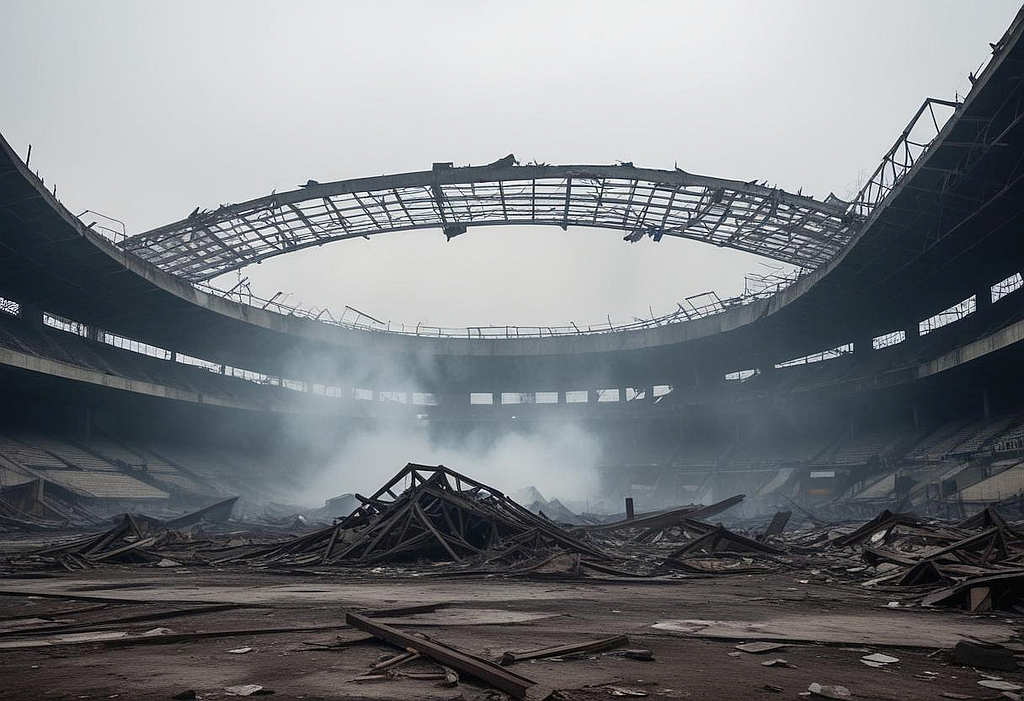
August – Engineering recalculations force a major redesign of the roof frame. Weight concerns abandon hybrid glulam timber for more and larger-section steel beams raising the overall height. Hobartians stand in goggle-eyed disbelief at the looming realisation overwhelming their hard-won historic precinct.
October – Complications with unproven dimensions sees a doubling of contingency estimates for roof membrane following a scale-trial of the ETFE installation.
2029: November – AFL reeling from surveyed ‘reputational damage’ in southern Tasmania. Shipping companies lured by cheap cruise terminal docking and free concert tickets for passengers to secure a capacity crowd for the opening night. Widespread condemnation over poor access corridors prompts a late offer of free admission and a costly refund of presold tickets. Former Premier joins AFL luminaries and aging rock bands at opening of ‘Rockliff Stadium’. Final performance drummed-out by a cacophony of heavy rain on the ‘tension membrane’ roof.
2033: Vacant for more than 320 days and nights of every year as expected, the empty $2.5 billion edifice has become a state embarrassment and an illegal refuge for the homeless. Now already exceeding Saul Eslake’s 2025 forecast warning Tasmania’s net debt would spiral to more than $16 billion by the end of 2034/35 with a corresponding rise in interest payments from $250 million to $730 million a year . . . “For the smallest and poorest state with the tiniest population, this deteriorating economic situation is entirely attributable to policy decisions by the government.” (Tasmania’s Debt Dilemma–March 2025)
2035: Growing support in the north, allied with the reality of the TPC’s predicted 45-cents-in-the-dollar returns, the state government pressures a reluctant AFL to accept the ‘sustainable’ York Park as the Devils’ Playground. With the state coffers haemorrhaging, a ‘commercial in confidence’ deal sees the Rockliff Stadium and its public land sold to an AFL/Tabcorp consortium for an undisclosed figure rumoured to be around half that of the total building and infrastructure costs.
Rockliff Stadium – a shoehorned, vacuous reminder of an unwilling state’s subjugation to a football and gaming empire.
With heartfelt gratitude to those outspoken realists, including – Roland Browne & the entire Our Place community, Kristie Johnston, Meg Webb, Craig Garland, Rosalie Woodruff, Vica Bayley, Helen Burnet, Cassy O’Connor, Cecily Rosol, Peter George, Andrew Wilkie, Ruth Forrest, Mike Gaffney, Janice Overett, Mat Hinde, Richard Flanagan and the thousands who have dedicated and donated their time and money fighting the abhorrence of a multi-billion-dollar genuflection to secure a licence to play a nationwide game we already play.
Mark Pooley is a retired architect living in Hobart.
Tasmanian Times (TT) is a community-based news and current affairs service covering the island state of Tasmania. It exists to provide a diverse presentation of Tasmanian issues. TT creates and supports independent media content utilising the best of modern technologies and tried-and-true practices of public-interest journalism.
Support us in expanding our coverage and developing new content by and for Tasmanians.
New initiatives on the way include … what our contributors and readers suggest! Please get in touch with your suggestions.