Tasmanian filmmakers Catherine Pettman and Rebecca Thomson are launching their latest film project, the animated documentary series There Is No ‘I’ In Island, today in Hobart.
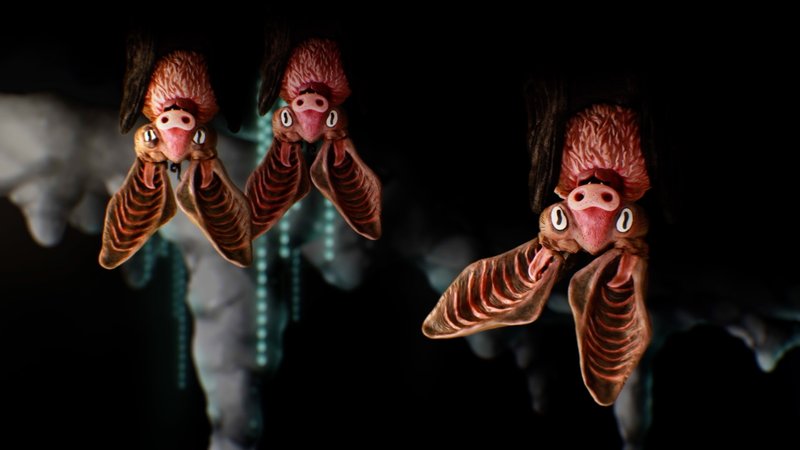
There Is No ‘I’ In Island is a short documentary series weaving the fears, dreams, reflections, and songs of the island community of lutruwita/Tasmania into a fantastical, animated landscape. Every voice heard in the series was self-recorded in May 2020 during Tasmania’s Covid-19 pandemic lockdown and reflects in a personal way on the experience.
The series has already been accepted into an Oscar-qualifying festival in Poland, and is an official selection at Seoul Webfest and Sicily Webfest.
There Is No ‘I’ In Island was created by Catherine Pettman (Rummin Productions) and Rebecca Thomson (Women of the Island). Catherine and Rebecca describe how the concept evolved.
“It came about as an amalgam of our shared interest in telling stories from our local community and our love of fairy tales and telling stories using fantasy, metaphor, and symbolism,” they said. “We liked the idea of exploring the psyche of Tasmania at this extraordinary moment in history in a creatively unique way, and indeed a safe way.”
“Also we envisaged a project that could be realised from start to finish without any of the team or participants needing to be in the same physical space together as we didn’t know at this point how long the pandemic and the lockdown would last. We invited people to self-record answers to specific prompts into their own recording devices (mainly smartphones) and asked them to text or email these audio ‘gifts’ to us. We decided that we would visualise these recordings through animation working with ideas from Tasmanian visual artists.
“We invited members of the community to self-record their voices responding to five different prompts.
We were interested in trying to gauge the psyche of our Tasmanian community during a moment of crisis but also a moment when people’s lives were on pause and they had time to reflect on their fears, values and hopes for the future.”
The project asked for a visual response from its key creatives who were selected based on the quality and uniqueness of their creative voices with an eye on discovering their interpretation of how pandemic isolation changed the interior landscape of our lives as well as how the exterior landscape of our Island also became so vastly different during that time. It was important to make sure that the process allowed each artist a certain amount of creative leeway to respond to the audio and story in their own way to foster creative innovation layering unique Tasmanian voices with the artists’ ‘voice’ to bring them to life.
A key person in the project was Animation Supervisor Vivien Mason, who planned the development stages of each film with the creative teams and supported each of their technical requirements through to delivery. Vivien Mason recalls “It was a real pleasure to see all these elements which have been constructed by different artists come together and look quite unified in the end.”
Tasmanian Aboriginal artist Allan Mansell contributed works to the episode Connected by the Sun. “Every image I make tells a story about my culture and where I’ve been, and what I’ve done,” he said. “That keeps driving me to create more and teach other people about our culture. [The images are] mainly ants and gum leaves and kelp, all the beautiful things in nature, telling the story about how society itself works through using animals, gum leaves or ants. Seeing my images moving was pretty well moving too, because I’ve never seen my images move before. It was pretty full on to see my images animated, to have voices come out behind them was even crazier because they don’t talk back to me.”
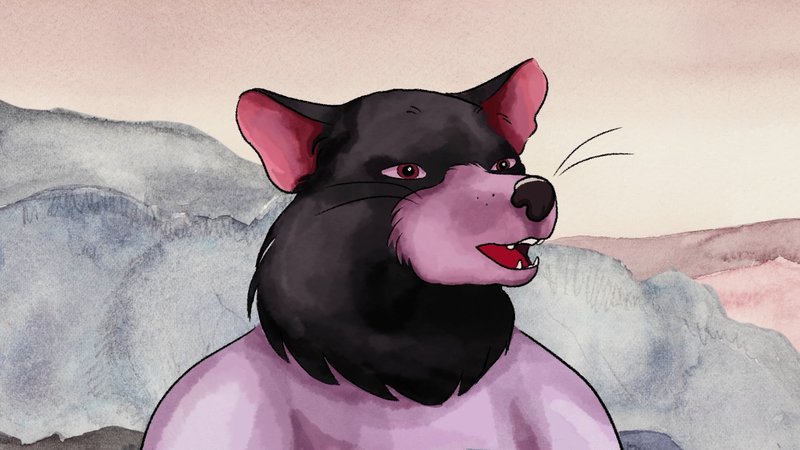
Joshua Santospirito, behind Messages from the Mountain episode said: “The paintings used in the film are largely from western Tasmania, in Queenstown. I’m really enamoured with that landscape. I was imagining a future Tasmania, post humans, post marsupials, at that time. It’s really interesting seeing your artwork recontextualised by someone else, and animation and film is such a collaborative way of working which is quite different from what I was originally doing with those paintings.”
Tasmanian visual artist Elizabeth Barsham said: “I rather enjoyed lockdown because I didn’t feel like I had to go out and talk to people, I could just lock myself away in the studio and paint… I usually call my work Tasmanian Gothic. It’s very much based on my experience as a Tasmanian, I particularly like the forests and the landscape. I was asked to contribute to the Forest of Fears episode which I thought was interesting, so I tried to make it scary, but fun as well. Seeing the finished product was an absolute blast because I had no idea how successful it was going to be. Seeing the characters moving and speaking is just magic.”
The Hobart launch screenings at the Wide Angle Tasmania Screen Centre in Washington Street, South Hobart, celebrate the professional work of Tasmania’s visual artists, animators and cast.The live screenings are sold out but you watch the films and follow the project on the following platforms starting with the first episode ‘Forest of Fears’ on Friday 25 June 2021.
Rummin website: https://rummin.com/there-is-
Facebook: https://www.facebook.com/
Instagram: https://www.instagram.com/
Youtube: https://www.youtube.com/
Vimeo: https://vimeo.com/rummin
Tik Tok: https://www.tiktok.com/@there_
The project was originally commissioned by Ten Days On The Island and received principal support from Screen Australia, proof-of-concept funding through Screen Tasmania and a Creative Hobart medium grant to support local artists and animators. The filmmakers also received assistance through the Bellendena Small Grants scheme and Thrive Women’s Grants.
Josh Santospirito.