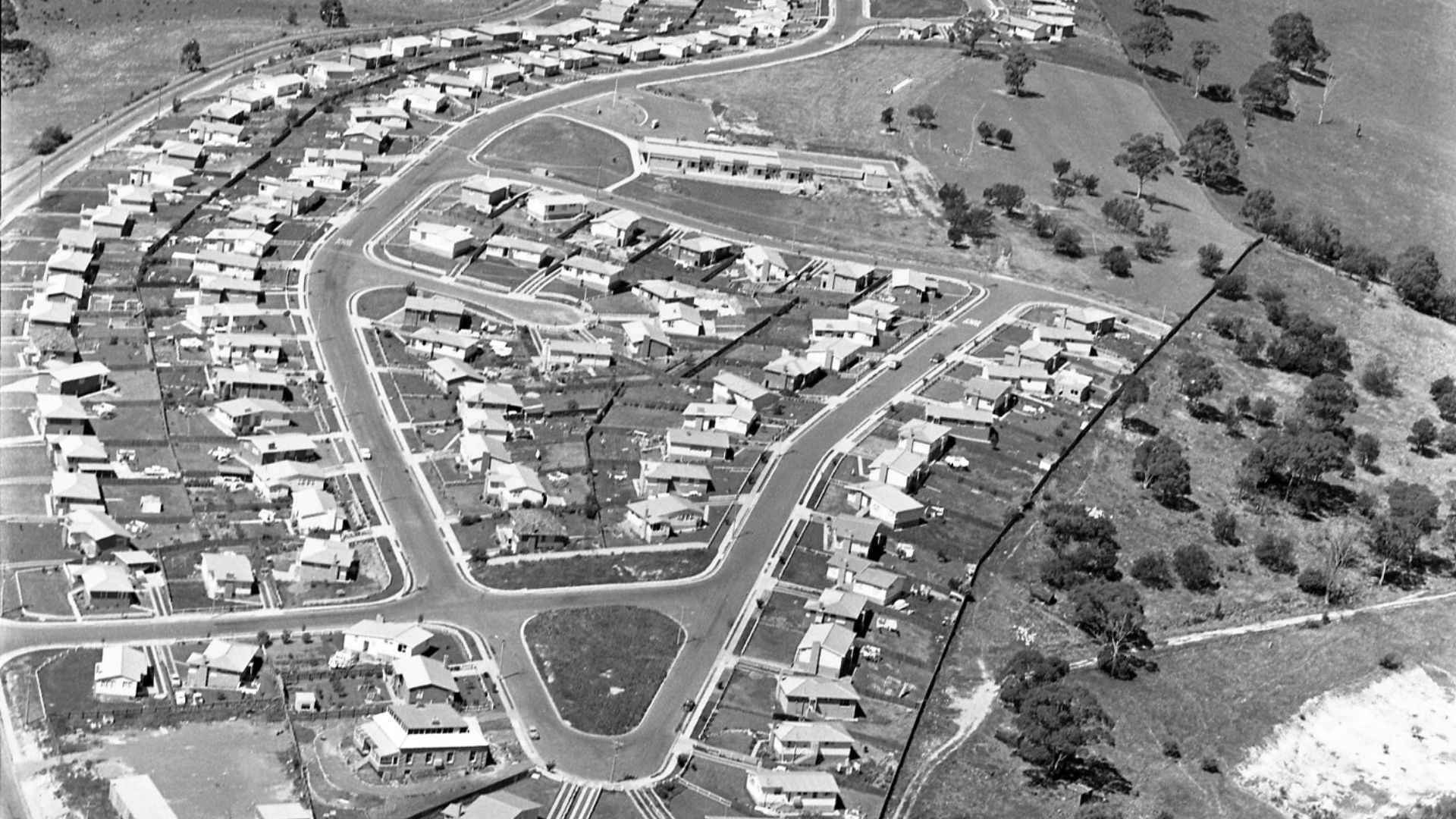
Mornington is one of Hobart’s newer suburbs, developed largely during the post-World War II suburban expansion of the eastern shore in the 1960s and ‘70s.
For thousands of years before the British colonisation of Tasmania began in 1803, the area now known as Mornington formed part of the country of the Moomairremener people. It had open grasslands, forests, wetlands, and foothills leading towards Mount Rumney. The Moomairremener people used these landscapes for hunting, gathering, cultural activities.
Following the establishment of the settlements at Risdon Cove in 1803 and Sullivans Cove in 1804, the eastern shore of the Derwent River was progressively divided up into land grants for settlers and ex-convicts. Although surrounding districts gradually developed, the land that would later become Mornington remained rural, consisting of farms and grazing land.
During the middle part of the 19th century, one of these properties became known as ‘Mornington’, a name that was obviously later adopted for the suburb itself.
Despite being close to the more established communities of Bellerive and Cambridge, the Morninton area remained sparsely populated well into the 20th century.
Following the end of World War II in 1945, Greater Hobart experienced rapid population growth. In response, the Tasmanian Housing Department began developing large housing estates across the eastern shore, including Rokeby and Risdon Vale.
Mornington was developed into a Housing Department estate during the late 1960s because of its relatively gentle terrain and proximity to Hobart. It was formally gazetted as a locality in 1970. Alongside the new homes were schools, churches, parks, and sporting facilities. Many of the original residents were young families.
By the 1990s, the housing estate had evolved into a mixed residential suburb. In 1993, the former Mornington State Primary School was acquired by the Catholic Church, and the following year MacKillop Catholic College opened as one of the eastern shore’s main secondary schools.
Mornington’s residential development continued into the 200s and 2010s, with new subdivisions and infrastructure being added in the 2020s.
Today, Mornington is a well-established suburb.
References & bibliography
- Mornington (Australian Bureau of Statistics)
- Mornington, Tasmania: Suburb Profile (Fall Real Estate)
- The Mornington & District Historical Society website
- MacKillop Catholic College website
- No. 663 – Mornington – MacKillop College – ‘St Joseph’s Chapel’ (Churches of Tasmania)
- No. 805 – Mornington – Eastern Shore Church of Christ (Churches of Tasmania)
- No. 1065 – Mornington – Citywide Baptist Church (Churches of Tasmania)
- No. 1072 – Mornington – Derinya Street Kingdom Hall (Churches of Tasmania)
Tas That Was is a column that includes:
- anecdotes of life in Tasmania in the past;
- historical photographs of locations in Tasmania; and/or
- documentaries about locations in Tasmania.
If you have an anecdote or photograph you’d like to share with us, please send it to [email protected].
Callum J. Jones is passionate about telling stories. He studied English, History, and Journalism at the University of Tasmania and lived in Western Sydney from 2022 to 2024 while working as a journalist for Professional Planner, a leading online publication for financial planners. Callum has written for Tasmanian Times since 2018 and has also been published in a range of other outlets, including Quadrant and the BAD Western Sydney anthologies.
If you’re interested in this article, please join our mailing list. It’s all free … and we won’t share your information with anyone!
If you have any comments you’d like to add to this article, please contribute via this form. We’re trialling this while we work through replacing our comments section.
Truly independent media is a cornerstone of democracy.
Remember: once they gain power the first action of every despot in modern history is to take control of the media, so please consider supporting us.
Your kids will thank you and so will your Granny, but the aspiring despots won’t…