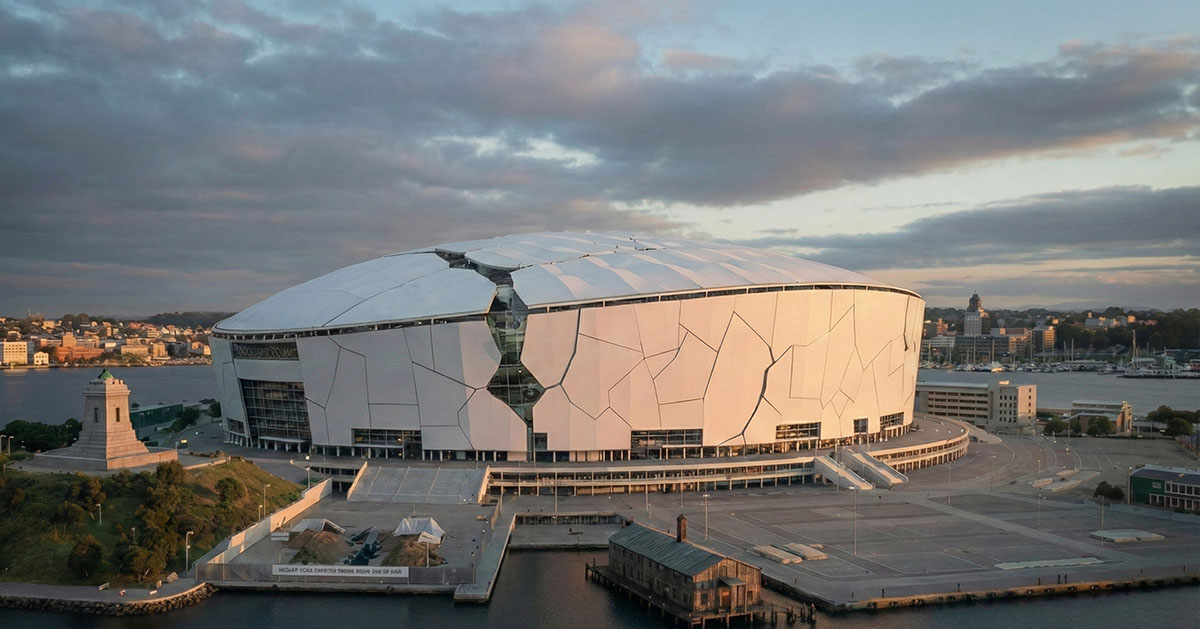
The debate over the proposed Macquarie Point stadium has reached a critical juncture, moving from economic scrutiny to a battle over intangibles and aspirational claims.
This is Part One of a two-part article that rigorously analyses the Tasmanian Government’s official “Response” to the Tasmanian Planning Commission’s (TPC) Final Integrated Assessment Report (FIAR). Despite expert economic analysis repeatedly concluding that the $2 billion+ stadium proposal “just doesn’t stack up,” the Government is now casting about for “unquantifiable intangibles” to justify the massive public investment, leading to what we term an act of ‘imagineering’.
We delve into the Government’s summary document—the “best bits” intended for public consumption—to examine the rhetoric, the reliance on conditional language (such as “might” and “could”), and the wholesale dismissal of the TPC’s planning and economic concerns. This analysis scrutinises whether the promised benefits—from job creation and tourism boosts to intergenerational hope and brand value—are genuine outcomes of a stadium or merely phantasms used to mask a politically driven, financially perilous gamble.
In this first part, Our Place demonstrates how the supposed economic and social benefits are either vastly overstated or entirely attributable to the AFL team itself, not the structure. We further explore how spurious economic modelling has been used to conjure a massive return on investment, whilst dismissing empirical evidence from stadia worldwide.
Part Two will continue this detailed critique, examining the government’s rhetoric of “urban renewal” and “opportunity,” and dismantling their claims of “appropriate mitigation” for the catastrophic visual and cultural heritage impacts on Hobart’s unique waterfront.

Lies, damned lies and unquantifiable intangibles – the Government’s fanciful ‘response’ to the TPC’s Final Integrated Assessment Report
Despite an heroic attempt to resuscitate an economic defence of a stadium at Mac Point recently published in the Mercury by the Tasmanian Co-ordinator General, and roundly trounced by anyone with an iota of expertise in economic modelling [1], the overwhelming consensus – that the proposal just doesn’t stack up economically – remains. There are no tangible economic benefits; no quantifiably positive return to Tasmania for its $2bn+ construction cost of a stadium precinct at Mac Point.
That leaves a desperate Government casting about for ‘unquantifiable intangibles’, leading us down the somewhat perilous path of ‘imagineering’ AKA making stuff up.
We’re left wading through statements full of qualifiers – “might”, “may”, “could”, “has the potential to”, “encourages”, “inspires” – instead of “will”, “would”, “makes”, “causes”, “leads to”, “results in”. It’s illusion rather than reality, made manifest. And it’s all about the “vibe” – like a millenarian cult with a Stadium as our saviour reborn, or a cargo cult with the great flying bird that drops its cargo on the awaiting tribes beneath replaced by an ‘economic enabler’ that will return a fanciful 497% on our investment.
Any suggestion or challenge to these phantasms is written off as negativity. Vague allusions to how great it is elsewhere are offered but no guarantees or hard evidence, probably because none exists. Disappearing down this rabbit hole to ‘check the facts’ finds us face to face with more lies and deceptions as we discover that things really aren’t so great elsewhere. This is what the large body of analysis has been telling us from the start.[2] Stadia do not make a positive return to their investors. When public money is invested to build stadia, the income generated in dollar-for-dollar terms is always at a rate of less than one, i.e. mere cents in the dollar, and most of those cents inevitably end up in private pockets. Stadia investment becomes just another vehicle for wealth transfer and the privatisation of public monies.
Bearing all this in mind and following the Minister’s advice that we read the Government’s Response to the TPC’s Integrated Assessment Report for answers to several of our ‘20 Questions’[3], we offer the following analysis. We are responding to the Summary Document figuring that the Government has presented it as the ‘best bits’, and on the assumption that it’s what most people will read, and from which stadium supporters will likely quote. (No-one should be forced to analyse the ‘propaganda soup’ of the full document – that would just be cruel.)
Please note – this is the Government’s Response to a Planning document and therefore should specifically address planning concerns. Just as the presence or otherwise of a team was largely irrelevant to the Planning Commission’s deliberations over the suitability of the Mac Point site for an AFL Tier 2 sized, roofed stadium, so should this response separate the emotion surrounding the team from a fact-based assessment of the impact of a structure of this size and shape on a heritage precinct. A precinct whose harmonious integration arises from its decades of adherence to a planning scheme that has served to produce the harmony that makes it so unique and accessible.
Government Response Summary doc available https://www.tas.gov.au/dpac/macquarie-point-multipurpose-stadium
Generates benefits for our whole community.
Note the careful wording that’s always employed to avoid referring to NET benefits. Any activity anywhere, by definition, generates some measurable economic benefit and contributes to State Product.
Creates jobs across a wide range of industries – as would any development on that site and there are many projects [4] more suited to the site that would create the same, if not more, jobs that would better suit the existing skillset of Tasmanians.
If job creation really were the goal, York Park is in the region that needs employment, not Mac Point.
and grows a new elite sports sector in the state – it is not investment in the stadium that does this; it’s investment in the HPC and regional sports programs. The focus on the south, with the HPC, would be better balanced by expanding regional sports facilities in the north, with a focus on York Park as the Devils’ home arena. The current agreement allows for 7 games in Hobart and 4 games in Launceston. That ratio could easily be reversed as was recognised by the AFL Taskforce in 2019. [5]
“Launceston has greater opportunity to provide an upgraded stadium to meet anticipated demand for ‘blockbuster’ matches . . . This leads us to suggest – while acknowledging a separate investigation is required – that economically UTAS Stadium may be best placed for upgrade, including its seating capacity to host the major drawing interstate clubs and their supporters.” (p.12)
Redeveloping UTAS Stadium as the initial primary football venue, but seeking a longer-term Hobart CBD-based, ($300 million) roofed stadium in an appropriate entertainment precinct, would mitigate much of the financial risk of Government. Modelling and precedent suggest the potential elimination of the need for any State support post implementation. (p.15)
It would be interesting to know whether the Taskforce would still be so optimistic about a stadium at Mac Point knowing that the cost has risen from their original allowance of $300 million to well over $1Bn (approaching $2Bn over ten years) and upon examination of the ongoing financial drain all Australian stadia have placed on their States’ finances to date.
Boosts tourism, hospitality, and business events – driving new investment and delivering flow-on benefits across the Tasmanian community, including in regional areas – again this is not attributable to a stadium per se.
Fan-tourists aren’t coming to see a stadium; they’re coming to watch their team play. They’ll do that wherever their team plays, as interstate fans have been doing for the last decade.
And we don’t need a huge, 54-metre-high domed cricket oval attached to a conference venue to host business events. If a need can be established for a new conference venue, then one should be included in whatever more suitably scaled development is proposed for Mac Point – one that is privately funded instead of a publicly subsidised venue set up in competition with existing Tasmanian conference and events providers.
Regional Tasmanians need to seriously consider just how much, or how little, of these benefits will ‘trickle down’ to regional communities, despite those communities paying an equal share in footing the bill for a new stadium in Hobart.
Economic theory and empirical tests of such possible benefits unambiguously show that sports facilities cannot be expected to stimulate local economies. The lesson is clear: before agreeing to subsidise a sports facility with public funds, residents should ask themselves what they expect to receive in return – and, realistically, it won’t be a more vibrant local economy.
Spurious economic modelling applied to a stadium at Mac Point has to be called into question when all other empirical studies draw contrary conclusions [2]. An economic impact study of Optus Stadium in Perth, conducted by Deloitte Access Economics in 2019 for Venues West, the Government agency that manages WA stadiums, calculated its impact after it had been operating for a year, and found that total indirect employment generated by the stadium was fewer than 200 FTE jobs for the year 2018-19. Indirect employment refers to those jobs outside the stadium precinct and the calculation was made for the whole of the Western Australia economy, which is 11 times larger than Tasmania’s economy. This number is substantially less than the 726 jobs in just the Hobart LGA alone predicted by the HCC commissioned report from AEC Group. The Perth figures are for a stadium that hosted about 2 million sports fans, concert goers and others in its first year compared to the AEC estimate of 394,000 spectators for the Hobart stadium. The Deloitte study estimated that the increase in Gross State Product (GSP) resulting from the stadium project was about $20 million per annum – compared to the Co-ordinator General’s estimate of $221 million predicted for Tasmania.
Delivers intergenerational benefits by encouraging young people and families to stay in Tasmania and may help boost the interstate migration of young families – while ‘encouraging’ and ‘succeeding’ are two different concepts, again, it is not the stadium that ‘delivers’ these benefits if, in fact, such can be proven to exist: it’s the team.
Furthermore, if we’re to accept these ‘intergenerational benefits’ as fact, rather than pie-in-the-sky fantasies that ‘may help’ boost interstate migration and ‘encourage’ young people to stay, then we need to equally consider what the intergenerational disbenefits ‘may’ deliver – intergenerational debt, for example, or interstate migration in the opposite direction that sees young families of nurses, teachers, paramedics, and public servants leave the state for training or employment or better pay, or their own mental well-being because occupational burnout has become a characteristic of all publicly funded, understaffed Tasmanian work environments; or potential artists, designers and other creatives, and lab technicians who migrate north in search of an accredited course because our underfunded training system makes Tas TAFE courses in their disciplines too expensive or, most recently, removes them entirely from the TAFE Curriculum.
Boosts participation in grassroots sport, particularly among youth and women – again, yes, the team could do this, but not the stadium, notwithstanding the tautology of ‘youth’ being particular participants in ‘grassroots sport’, because grassroots sport will not be played in the stadium. ‘Grassroots’ means amateur or non-professional, local, bottom-up initiatives that are often volunteer-led, where participants are not compensated for their participation; unlike the AFL who will be amply compensated by gifting them a venue for their exclusive use when needed, in return for their paltry investment of 0.83% of its cost (provided that cost can be kept below $1.8Bn)[6].
Increases Tasmania’s brand value nationally and globally – showcasing innovation, culture, and our unique identity – what ‘brand’ is that?
According to Brand Tasmania [7]:
“Tasmania’s brand is defined by the phrase ‘the quiet pursuit of the extraordinary’ embodying values of purity, sustainability, quality over quantity, and a humble yet determined spirit. It’s a brand built on the state’s pristine environment, unique food and beverage products, innovative industries, and a community that works together to achieve excellence through inventive, sustainable practices.”
How does a stadium contribute to that brand? There’s nothing quiet, pure or humble about this incongruous plastic dome leaking noise and plastered in neon towering over our historic waterfront.
With oversized domestic monoliths squeezed into undersized sites a feature of suburban Australian ‘MacMansion’ culture, how is building an over-sized monolith on an under-sized site “showcasing innovation”? That it will visually destroy the last intact heritage harbour in Australia in the process, is simply reprehensible.
What is ‘unique’ about Tasmania’s sporting culture and how does building another AFL stadium contribute to “our unique identity”? The AFL does its best to ensure a ubiquitous experience with its all-pervasive advertising, ‘news’ releases, and full spectrum media infiltration, in- and off-season, right across the country. It uses time-honoured formulae to promote the code in a blanket coverage rather than a targeted process. Why else would Tasmanians be subjected to a nightly news item about some random player in another state ‘considering’ his options in the draft, broadcast months after the ‘season’ has ended? This is simply about promoting the AFL ‘brand’, not Tasmania’s.
Nevertheless, if any of this publicity ‘spin’ could be shown to realise a substantive increase in ‘brand value nationally’, the potential for devaluing our brand needs to be given equal consideration, when we become Australia’s basket-case economy because the biggest line item in the State Budget is servicing the debt, and we can no longer deliver even a third rate education, training or health system. Or when the imposition of this behemoth predictably devalues our waterfront heritage; when its over-weening scale and impervious surfaces create a shaded, windy, grim location on non-event days that repels tourists rather than attracting them; or when ‘anticipatory avoidance’ drives locals away from the area entirely because the reputation of our waterfront on game-days is tarnished by rowdy behaviour, petty crime, or alcohol-induced and disappointment-fuelled altercations between fans of opposing teams – winners vs losers.
How long will it be before the novelty wears off as it has in other locations of similar size like Townsville, and Dunedin? [8]
Delivers the dream & aspirations of past, current & future generations.
Have we really been dreaming of a stadium at Mac Point? How many generations past have held such an aspiration? Mere motherhood statements made without reference to any concrete evidence do not create truth. Remember this is supposed to be the Government’s response to a year’s work by a panel of experts in planning, architecture, local government, economics and law, in which no statement has been made without reference to evidence.
Secures Tasmania’s own AFL team – a long-held dream – adding to our proud legacy alongside the Hurricanes and JackJumpers. It has to be asked, “is this the role of government?”
Even if it were, $144mill in Club fees guaranteed by the State over 12 years, $130mill for upgrades to York Park, and $105mill for the HPC should be enough ‘security’ for the AFL – it’s more than any other state government has been asked to pay upon entry into the national competition. The Premier made a massive mistake in signing Tasmania over to state capture by the AFL and, so far, hasn’t shown the courage to face them down and tell them to waive the ridiculously unfair conditions to which he acceded in a moment of hubris or weakness.
Spurious comparisons with the Jack Jumpers ignore the fact that they are privately funded, although the Tasmanian government (aka taxpayers) did contribute $15mill to the team’s HPC and provides $2mill per annum in sponsorship funding.
Similarly with Cricket, the Tasmanian government provided $2.06mill in 2023 for cricket programs. The rest of Cricket’s funding comes from Cricket Tasmania and private sponsors. Even the most recent increase in state subsidies to cricket, increasing its funding cap to 5 million over 3 years offered as an inducement to get Cricket Tasmania’s support for the latest iteration of the roof fails by a factor of 10 to equal Tasmanian taxpayers’ subsidy of the AFL.
Other sporting codes receive paltry amounts compared to an AFL team ‘secured by a stadium’ at a $2bn cost to taxpayers. That externally funded state teams in other sporting codes require so little Government largesse begs the questions, “Why? Why so much money for a game that’s already ostensibly embedded in our culture? Why a publicly funded venue?” Surely such a proud legacy should see corporate sponsors falling over each other in their rush to compete to sponsor a Tasmanian based team and build them such a profitable venue.
Instead, we have the state handing over billions of dollars to ‘secure a team’ in one code, an amount of money to which no other sport even comes close.
The closest in expenditure (still barely 20% of the annual spend on an AFL team & stadium) is the deed with Tas Racing that commits Tasmania to $27mill per year for 20 years ($540million).
The sport with the highest participation rate in Tasmania (ABS), and also a code that has the potential for true international representation, is Soccer. The State Government supports Soccer with $3.3 million in funding which includes $300,000 through the ‘Levelling the Playing Field’ Grant (2018) and $3 million as part of Tasmania’s FIFA Women’s World Cup legacy commitment (2021). If the government’s claims about the health and community pride benefits of a stadium are true, imagine what $2bn would mean if it were applied to a rectangular field!
Meanwhile, Tasmania will sponsor Hawthorn Football Club to the tune of $9.1million for the 2026 and 2027 AFL seasons, in an agreement that will continue the partnership for two more years and involve Hawthorn playing a total of 8 games in Tasmania each season, including four AFL men’s home games at UTAS Stadium. Previous deals were $13.5 million signed in 2023 to ‘extend’ the previous contract to 2025; a $20 million contract was signed in 2019 to play four home games per season in Launceston between 2020 and 2025; and a five-year, $20 million contract signed in 2015 to ensure four matches and one pre-season game were played in Launceston each season between 2017 and 2021.[9] With such a legacy of spending, one wonders why the AFL is feeling so insecure?
Provides a world-leading all-weather, roofed stadium that can host the highest levels of cricket across all formats – positioning Tasmania as a leader in cricket innovation.
When this response was published, negotiations with Cricket Australia were ongoing with concerns about the roof – height, interference from gantries, and lighting/shadowing on the pitch, so whether “all formats” can use this stadium at this stage is unknown. Recent reports that make it sound like the issue has been resolved with the application of a light diffusing coating and surface treatment, are misinterpretation of the statement by Cricket Australia that it cannot confirm that the ‘new’ roof will work and won’t know until after the stadium is built and games at all levels have been played there to test its efficacy. The Memorandum of Understanding signed by Cricket Tasmania does not cover Test Cricket or ODI/T20 games and is not a binding contract.
Whether the proposed stadium is truly “all weather” is also debatable with recent structural changes deleting the glass curtain wall immediately below the roof. This will allow wind and wind driven rain into the stands. Reports are that Dunedin [8], the only other natural turf, fixed roof stadium in the world, has suffered bad reviews for being as cold or colder inside the venue as outside, thereby causing patrons considerable discomfort.
Attracts more arts and cultural events to our State, including major
‘Attract’ vs ‘materialise’. There is no guarantee that ‘major concert’ promoters will be willing or even able to cross Bass Strait with an entourage of heavy vehicles and take weeks out of their schedule for their acts to perform in what is a relatively small capacity venue at the end of the line. The Government’s own ‘planphlett’ [14] sets out an events schedule of 37 event days, comprising 1 major concert selling out at 31,500 attendees, and one smaller fixture. The rest of the predicted usage is sports, not arts.
As a concert venue, “it has been my view from the beginning that there is not the money nor the population to sustain a stadium at Macquarie Point.”[10] Charles Touber, concert producer with 25 years of experience in Tasmania, addressed the Public Accounts Committee in November 2023 having examined the Department of State Growth Strategic Business Case and the MI Global Cost Benefit Analysis.
There are existing arts and cultural venues on site that would have to be either razed – as in the case of the Red Shed – or relocated in the case of the Goods Shed which will no longer serve as an arts venue, instead becoming a hospitality venue inside the stadium’s security cordon and therefore only open when the stadium is in use (37 events days per year).
Other developments on that site that would more actively attract arts and cultural events could include museums with interactive displays, perhaps associated with the history of the Antarctic Division; or an Indigenous art and cultural centre to house all the artefacts being returned to Tasmania; or a sculpture walk through an arts and reconciliation park as was promised by the MONA vision [4]; or an expanded State Library and education centre that would celebrate Hobart as a City of Literature [13] Moving the Indigenous and Antarctica exhibits to subsidiary sites from the TMAG would allow it to expand in its current location and display more of its own collection.
Inspires the next generation of athletes and builds career pathways for sports professionals.
This is another example of a team rather than a stadium outcome. There’s nothing inherently inspiring about a stadium. It’s watching the team play that’s inspiring. The specific location of a game is irrelevant. The glitz and glamour of a neon wrapped stadium is more about drawing in the gamblers, Las Vegas style.
Once that’s acknowledged, we then need to consider how many professional careers will feasibly result from this enormous investment of public funds. It’s not as if the draftees will be drawn from Tasmania alone. We may have punched above our weight in the past but that was in a much smaller pond. Now the AFL has spread into formerly non-AFL states, the pond has grown markedly and the competition for places in the elite ranks has grown proportionately. The actual ‘building’ of career pathways is not backed by factual evidence and remains firmly in the realms of ‘hopes and dreams’ – heart-string plucking, feel-good statements. It may be that such evidence exists beyond these vague allusions, but if so, why is it not quoted?
Creates a place to gather, celebrate & reflect through the arts, culture, sports, events & entertainment.
To ‘gather’ implies a coming together in a central location. Sadly, a stadium cannot fulfil this goal on any sustainable basis. It is only intermittently accessible as a place to gather and then only when those gathering have to capacity to pay the entry fee. A stadium of this size and form, occupying most of its restricted site, actively discourages gathering. On non-event days, admission will be restricted to prevent foot traffic over recovering turf. Around the outside is nearly a kilometre walk mostly in the shade of the structure itself with all hard surfaces – cold, windy and unappealing.
All the alternative proposals – MONA Vision, Reset Masterplan, Our Place MPV, would achieve this goal more effectively, less divisively, more economically, and with more spatial harmony.
Brings to life an underutilised site by transforming it into a vibrant mixed-use precinct with retail, arts, hospitality, residential, and entertainment offerings.
No timeline is proposed for delivery of these offerings. The word “offering” is a jargonistic term to describe hoped-for activation of the site. It is the very activation the Planning Commission regarded as inherently unlikely.
With regard to residential ‘offerings’, the Future Foreshore Residential Zone would need to be completed in order to qualify for the Federal Grant of $240 million, yet there are no plan drawings nor any costings so far for this.
And who’s to blame for allowing the site to remain “underutilised” for over a decade? Was it the result of deliberate neglect, or just incompetence – each successive Minister taking his eye off the ball?
There’s not a lot of ‘vibrancy’ in a stadium that sits idle 96% of the time.
In its Final Integrated Assessment Report (FIAR) for the Project of State Significance, Macquarie Point Multi-Purpose Stadium [6], the Tasmanian Planning Commission panel found that:
“The extent of the footprint required for the stadium means that the majority of the Mac Point Site will be occupied by that structure. The floor area proposed for buildings in the mixed-use zone is 10,000m2. The Panel considers that the proposed activities associated with the mixed-use zone, together with the non-event day activities within the stadium structure, will not be sufficient to establish either the level of scale or activity synergies necessary for the creation of an activated mixed-use precinct that would result in vibrant activity outside of event mode.
In turn, the Panel notes that there is a lack of available space and capacity on the site to support ongoing economic activity. Also, the location of the nominated ‘complementary integrated mixed use zone’ is on the outer edge of the city’s urban fabric and adjacent to an operating port. This may limit its attractiveness.
These factors may result in:
a lack of realistic opportunity to evolve the intended range of commercial activities
a reduced ability for the site to attract a diverse mix of uses.” (p.57)
Drives urban renewal to create a thriving destination that meets the needs of our growing capital city.
Just saying something like this doesn’t make it true – no evidence is offered that supports this assertion.
Terminology like ‘drives’ suggests dynamism but is largely empty and meaningless without evidence or examples. Even though the TPC accepted the proponent’s optimistic scenarios re stadium usage, its FIAR [6] found it unlikely that the precinct would ‘thrive’ as the stadium occupies the bulk of the site and sits idle for 96% of the year. Its size pushes activities that have the potential to attract economic impetus, to the margins and diminishes their attraction.
As for meeting the needs of our growing capital city, which ‘needs’ are those? They have not been articulated. Could they be:
Employment?
Employment gains in sports are negligible compared to other forms of public investment such as education or infrastructure . . .
Transient usage of stadia means that they generate few permanent jobs post construction.
Most jobs are part-time, seasonal, and low wage (e.g., food vendors, ushers).
Claims that sports venues create jobs and raise local income are unsupported by most empirical studies. Where job gains do exist, they are insufficient to justify the investment. [2]
Even during construction, the ‘experimental’ nature of this design means that it will require specialist skillsets not currently present in Tasmania’s workforce. This means bringing in FIFO workers from the mainland or internationally who will have to be recruited and housed putting pressure on rents and property prices in a “growing capital city”. MPDC has asserted that some 100 rental homes will be required in Hobart. Hobart does not have 100 available homes for rent.
The remaining workers who are employed onsite will impact employment availability across the industry, poaching workers from other projects, public and private, around the city. In a process called ‘crowding out’, the stadium as the single largest construction project in the state, trying to meet tight completion deadlines and funded from a seemingly bottomless pit of public money to attract resources, will out compete local builders, heavy vehicle operators, and material suppliers, thereby slowing construction in areas that are badly needed for a “growing capital city”.
If providing enough jobs for a growing capital city’s population is the goal, many more of them would be created by funding the arts, as the Australia Institute found [11]:
“The arts and entertainment sector employs 193,000 Australians and contributes $14.7 billion to Gross Domestic Product annually.
The sector employs an even balance of women and men, and employs many more people per million dollars of turnover than industries like building construction, coal mining and oil and gas extraction.”
Health facilities?
A capital investment of $375 million, if it were truly unencumbered, would go a long way in adding much needed resources to an over-burdened health system. Tasmania lacks the population size and density to benefit from economies of scale in a health system whose physical resources are by necessity spread over a wider area. This results in a health budget with a proportionately larger sector assigned to capital expenditure as opposed to human resources than in other states where capital goods can be used more intensively. The basic set-up in capital equipment for a regional hospital would be similar to a suburban facility even though the population base for the former may be only half that of the latter. Constant use of medical equipment reduces its cost per capita, while intermittent use increases the cost burden on smaller populations.
Likewise, the interest repayments on $740 million will need to be funded annually from Tasmania’s operating budget, likely found by shaving off other departmental portfolios, including Health. So rather than a stadium meeting the needs of a “growing capital city”, it will diminish the state’s ability to meet those needs. As the TPC concluded [6]
“The extent of the public funding required (given the absence of any private investment) relative to Tasmania’s small population, economic and taxation base . . . results in a substantial cost burden on the Tasmanian community relative to the benefits the community receives.” (p.50)
Tourism?
New stadia are not, in and of themselves, popular tourist attractions because they are single-purpose structures, only accessible part-time, and often lack a sporting history or other surrounding attractions. Unlike a museum or historical site, a stadium’s primary purpose is to host live events, which may not align with the interests or budget of tourists, or the events are too costly leading to a poor overall tourist experience. Outside event times, they sit idle and unused. In the case of a stadium at Mac Point, its domination of its site means its surroundings are more likely to repel visitors rather than attract them. The narrow hard-paved passageways around it will be shaded, windy and unwelcoming, not encouraging people to linger.
Tourists visit Hobart for its unique blend of culture and history, and nature on its doorstep, drawn by attractions like MONA, Salamanca Markets and stunning views from kunanyi/Mt Wellington. The city appeals to food and wine enthusiasts with its popular culinary scene, and to those interested in its convict and colonial history. The TPC noted in its Recommendation Report [12]
“Sullivans Cove has a prevailing 19th century historical character which is highly valued and valuable. This is a large part of its charm and attractiveness, for locals and visitors alike. It is fundamental to Hobart’s spatial character and identity, and an important part of the brand Tasmania. Those things will be unacceptably diminished by the Stadium’s presence and impacts. (p.7)
Increasingly, some tourists also visit Hobart because it is a UNESCO City of Literature [13] that boasts a rich history of storytelling, including the first Australian novel published there in 1818. They are drawn to its vibrant literary scene, which features award-winning authors, independent bookshops, local publishers, and numerous literary events like the Tasmanian Writers Festival. The city’s designation is also an attraction, showcasing its strong cultural identity and providing access to unique storytelling experiences and a growing literary ecosystem.
Rather than a stadium, Hobart needs another museum – TMAG as both Museum and Art Gallery lacks the space to display its full collection in a timely rotation. Its collection of indigenous artefacts needs to be more accessible, and the growing collection of returned artefacts needs a home.
Housing?
Despite the Federal Government contribution of $240 million being conditional upon the delivery of infrastructure upgrades, and social and affordable housing in the wider precinct, there has been no cost assessment for the Future Foreshore Residential Zone.
“The Project does nothing to support the delivery of housing, as envisaged by the Precinct Plan, other than by nominating an adjoining location for housing and the creation of a way past the southern and eastern sides of the stadium by which residents may come and go to their homes”. (TPC FIAR p. 58)
The $375 million in ‘red cents’ that the Government likes to carve out of the equation while it plays a giant shell-game hiding costs in different ‘buckets’, in order to imply that it won’t contribute to State debt, could fund 1,000 homes throughout the state to house the 1,154 young Tasmanians currently experiencing homelessness, and accelerate progress towards 2027 target of 2,000 social housing units.
Contrary to the Minister’s assertion that a ‘no’ vote for the Stadium Order in the Upper House will mean that grant will disappear, the Federal Government has repeatedly stated its determination that the money is for the development of the whole precinct. The grant agreement makes no mention of a stadium. To say otherwise is untrue. Application of this money exclusively to the Stadium is another misdirection that disguises the full cost of the development to the Tasmanian economy.
Respectfully integrates the site’s rich heritage into its design and purpose and ensures the past is meaningfully woven into our vision for the future.
‘Respectfully’? Respectful, it’s not. That’s a major concern. The proposal disrespects the harbour, the Cenotaph, the Soldiers Memorial Walk over the Domain, the Aboriginal community, the TSO, the residents of The Glebe, Wapping and Evans Street, and Hobart ratepayers.
The Aboriginal Culturally Informed Zone is an insult jammed into a tight corner between an impenetrable concrete wall and a 6-lane highway. And it is also an Emergency Access Point. Where is the respect in that?
This zone will be further reduced as it will now be needed for pedestrian and emergency egress from the NW gate. It’s in the shade of the stadium all morning in winter, and in the path of prevailing W/NW winds making it thoroughly unpleasant place to spend any time, deterring, rather than encouraging people to linger. Where is the respect in that?
The archaeological remains of the first inhabitants of the site, middens and artefacts that testify to thousands of years of occupation, will be buried under the Cricket practice pitches. Is that what’s meant by ‘integration’? Where is the respect in that?
An Aboriginal Heritage site is likely to be significantly impacted by the construction of the proposed northern access road and bus mall. Where is the respect in that?
Mere lip service paid to Aboriginal Tasmanians is not respectful and adds insult to injury caused by their treatment since colonisation.
“Macquarie Point will be a place that draws optimism and co-operation from across the world. It will re-create Tasmania as a place where the darkest of histories are transformed into the brightest of futures. Macquarie Point will be where Australia comes of age.” Gregory Lehman, Aboriginal Elder – foreword to the Reset Masterplan 2017-2030 [4]
The height and bulk of the roof completely obliterates sacred sight lines from the Cenotaph over a wide arc of Sullivan’s Cove. Where’s the respect in that?
Not even lip service to Tasmania’s Veterans, who have had their concerns summarily dismissed.
Premier Sir, the very essence of the Cenotaph is its sightlines, to destroy these sightlines is to desecrate, humiliate and play little more than lip service to our sacred place. [14]
The Heritage listed Goods Shed will have to be moved from its original location. This location is intrinsic to its heritage value and moving the structure will diminish that value. Dismantling it, storing it off-site, and reconstructing it in a marginal location, forcibly diminishes its heritage value and the incongruity of form in tacking a rectangular gable-roofed shed onto an enormous cylinder capped by a plastic dome is an inferior solution and just bad architecture.
The height, bulk and modern surface materials (plastic, neon, concrete & steel) of the stadium conflict with the historic buildings around it, overwhelming the Engineers Institute and the IXL complex, and casting the whole precinct into deep shadow for much of the day in Winter.
The site’s rich heritage is not integrated into the stadium’s design. Heritage is pushed to the margins. Where’s the respect in that?
REFERENCES
[1] Why the Co-ordinator General’s figures don’t add up.
Stadium Gamble – When the Numbers Don’t Add Up Tasmanian Times, 11/10/25
https://nonewstadium.au/tasmanian-times-stadium-gamble-when-the-numbers-dont-add-up/
When Economic Spin Masquerades as Analysis”. Ruth Forrest MLC, 17/10/2025
https://ruthforrest.com.au/opinion/opinion-when-economic-spin-masquerades-as-analysis/?fbclid=IwY2xjawNhF_lleHRuA2FlbQIxMQABHqi5_Oc6fOVzA9SI1os8aZlBkh4R3j2X9IvMP1EHxPLGVehDkmhY2KGKm-NU_aem_zoVCFy-p9cdG8QvKA94usg
[2] What the research literature says about public funding of stadia:
Zimbalist & Noll (1997). Sports, Jobs, & Taxes: Are New Stadiums Worth the Cost? Brookings Institution Press.
https://www.brookings.edu/articles/sports-jobs-taxes-are-new-stadiums-worth-the-cost/
Parker, C. B. (2015) Sports stadiums do not generate significant local economic growth. Stanford Report
https://news.stanford.edu/stories/2015/07/stadium-economics-noll-073015
Bradbury J, Coates D and Humphrey B (2023), The impact of professional sports franchises and venues on local economies: A comprehensive survey. Journal of Economic Surveys. Vol. 37 p1389-1431.
Bradbury, J. C. (2024). Sports stadiums and local economic activity: Evidence from sales tax collections Journal of Urban Affairs, 46(1), 139–159.
Deloitte Access Economics (2019): Economic impact of Optus Stadium. Report for Venues West. https://www.deloitte.com/au/en/services/economics/perspectives/economic-impact-optus-stadium.html
[3] ‘20 Questions – an open letter to Minister Abetz’
https://nonewstadium.au/our-place-releases-20-critical-questions-about-the-costs-of-the-proposed-mac-point-stadium/
Links to the Minister’s response:
https://nonewstadium.au/wp-content/uploads/2025/11/Open-Letter-to-Roland-Browne.pdf
and Our Place’s Rating of the Minister’s response:
https://nonewstadium.au/wp-content/uploads/2025/11/20-not-answered.pdf
[4] Other Mac Point proposals
MONA’s waterfront vision 2016
https://www.abc.net.au/news/2016-12-11/mona-waterfront-vision-to-take-three-decades/8109566?fbclid=IwAR1OJaFNcgFe4aPVc3w1MU17l02wixv8BYBOuaLge8Wp7Sx2pZS0R0Xt5MI
https://architectureau.com/articles/mona-unveils-vision-for-hobarts-macquarie-point-renewal/
Tasmanian Planning Commission: Macquarie Point Reset Masterplan 2017 – 2030
https://www.planning.tas.gov.au › assets
Our Place Vision: An Alternative Vision for Macquarie Point as a Place for all Tasmanians
https://nonewstadium.au/our-vision/
Shamus Mulcahy presents Our Place’s Vision to the PAC 21/06/24
https://nonewstadium.au/our-place-at-the-public-accounts-committee-21-june-2024-shamus-mulcahy/
This project, this vision, is about building community. It proposes uses that provide perpetual and sustained economic activity for the whole year, 24/7. It stands as an absolute counterpoint to a singular dominating corporate use on that site. It does not rely on Tier 1 mainland contractors or mainland lead consultants with token appointments for optics. The construction industry needs sustained and targeted spending on projects that directly benefit small-, medium-, and large-scale Tasmanian businesses, not a singular megaproject where so much of the economic benefits flow offshore.
[5] AFL Licence Taskforce Business Plan (2019):
https://www.tas.gov.au/__data/assets/pdf_file/0024/439530/AFL-Licence-Taskforce-Business-Plan-2019.pdf
[6] Tasmanian Planning Commission: Final Integrated Assessment Report. Macquarie Point Multipurpose Stadium. PoSS, 15/09/2025
https://www.planning.tas.gov.au/__data/assets/pdf_file/0011/829379/Integrated-Assessment-Report.pdf
TPC’s cost estimate over 10 years is based on the May 2025 build estimate of $945 million which the TPC calculates will have grown to $1.02 billion by construction completion, including interest repayments on borrowings. As construction costs increase, so will the borrowings and hence the interest payments. Once the project enters its operational phase, other team costs must be added bringing the total debt over 10 years to $1.83Bn. (p.49)
[7] Brand Tasmania: The quiet pursuit of the Extraordinary
https://tasmanian.com.au/brand-tasmania/
[8] Other Stadia:
Forsyth Barr Dunedin
“Major events, however, have declined in the last three years with the Dunedin stadium idle for much of the time.” Otago Daily Times, 24/11/2025
https://www.odt.co.nz/opinion/tale-two-stadiums-and-both-may-have-unhappy-endings
“Rent for Forsyth Barr Stadium has been slashed by more than 60% amid concerns for its financial future.” Otago Daily Times. 11/03/2025
https://www.odt.co.nz/news/dunedin/stadiums-rent-cut-amid-fears-future
“Down-time alone means stadium turf must go.” Otago Daily Times, 03/09/2012
https://www.odt.co.nz/opinion/down-time-alone-means-stadium-turf-must-go
Forsyth Barr Stadium: New Zealand’s largest indoor, multi-purpose stadium
https://jasmax.com/projects/forsyth-barr-stadium
2016: Townsville Stadium doesn’t stack up (2016)
“Labor’s proposed new $250 million sports stadium in Townsville is not financially viable and will cost taxpayers half a billion dollars in its first 30 years in operation, according to a confidential business case submitted to the federal government’s peak infrastructure body.”
https://www.afr.com/politics/election-2016–townsville-stadium-doesnt-stack-up-20160511-gosd8y
2023: Regional Qld misses out on big acts despite stadium and a legion of music fans.
“It has a $300 million stadium and legions of music fans — but the unofficial capital of northern Australia is struggling to attract major music events. . . the venue has hosted plenty of NRL games, but no live music.”
Queensland Stadiums: 4.0 Stadiums Queensland Business Model
https://www.dtis.qld.gov.au/__data/assets/pdf_file/0008/1538747/stadiumtaskforcereportpart2.pdf
Stadiums Queensland is a financial drain’
https://queenslandeconomywatch.com/2018/04/16/stadiums-qld-is-a-financial-drain/
[9] AFL Funding Deals
Hawks extend Tassie deal for two more years. (AAP Jan 31, 2023)
https://www.afl.com.au/news/873800/hawthorn-hawks-extend-tasmania-deal-for-two-more-years
New $20 million deal locks Hawthorn into playing matches in Tasmania for another five years. (ABC 31 July 2015)
https://www.abc.net.au/news/2015-07-31/new-deal-keeps-hawthorn-in-tasmania-for-another-5-years/6664270
“The Government has agreed to pay the team $3.8 million in 2017, and the amount will be adjusted in line with the Consumer Price Index each year until 2021.”
Why Hawthorn gets “offended” by Tasmania critics (SEN 2020)
https://archive.sen.com.au/news/2021/02/23/why-hawthorn-gets-offended-by-tasmania-critics/index.html
“The Tasmania-Hawks partnership began in 2001 and has grown over a period of time, with the state becaming (sic) a naming rights sponsor of the club in 2006.
Hawthorn play four games per season in Launceston with its current deal with the Tasmanian Government worth close to $20 million.”
Hawthorn in discussions to host games in Tasmania beyond 2025 (SEN 2024)
https://www.sen.com.au/news/2025/02/03/hawthorn-in-discussions-to-host-games-in-tasmania-beyond-2025
“The Hawks-Tassie partnership dates back to 2001, with its current contract to play four games per season in Launceston worth close to $20 million.
[10] Tas Gov ; Public Accounts Committee –Inquiry into the Tasmanian Government’s Process into the Proposed Arts, Entertainment and Sports Precinct in Hobart. 28/11/2023
https://www.parliament.tas.gov.au/__data/assets/pdf_file/0026/77327/Public-Accounts-Committee-28-November-2023.pdf
[11] Employment:
The Australia Institute (2021) New Analysis: Arts & Entertainment Funding Creates 10x More Jobs for Women than HomeBuilder (13/05/2021)
https://australiainstitute.org.au/post/new-analysis-arts-entertainment-funding-creates-10x-more-jobs-for-women-than-homebuilder/
Bill Browne (2020) Background Brief: Economic Importance of the Arts and Entertainment Sector (25/06/2020)
https://australiainstitute.org.au/report/background-brief-economic-importance-of-the-arts-and-entertainment-sector/
For every million dollars in turnover, arts and entertainment produce nine jobs compared with the construction industry’s one.
[12] Tasmanian Planning Commission: Recommendation Report. Macquarie Point Multipurpose Stadium. PoSS, 15/11/2025
[13] Hobart: City of Literature
https://www.hobartcity.com.au/Things-To-Do/Arts-and-culture/UNESCO-City-of-Literature – :~:text=Hobart has a rich history of literature:,festivals, awards, events, and celebrations of reading
[14] John Hardy CEO, RSL Tasmania (2024) Letter to the Premier, 18 July 2024
https://www.rsltas.org.au/wp-content/uploads/2024/07/Media-Release-RSL-Tasmania-Hobart-Cenotaph-Disrespected-re-Stadium-Proposal-July-19-2024.pdf
Tasmanian Times (TT) is a community-based news and current affairs service covering the island state of Tasmania. It exists to provide a diverse presentation of Tasmanian issues. TT creates and supports independent media content utilising the best of modern technologies and tried-and-true practices of public-interest journalism.
Support us in expanding our coverage and developing new content by and for Tasmanians.
New initiatives on the way include … what our contributors and readers suggest! Please get in touch with your suggestions.