We are three community members of Southeast Tasmania: a recreational fisher from Bellerive, a sculptor from Port Huon, and a writer from Verona Sands.
What we have in common is that we share our coast and waterways with the salmon industry.
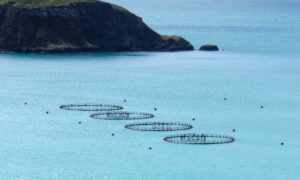
Each of us have seen the environmental changes that come with salmon farming – additional light, odour and noise around shore bases and pens and debris washing ashore. An increase in filamentous algae, suspended sediment and fewer fish. Then there’s last summer, when decomposing salmon washed up on our beaches.
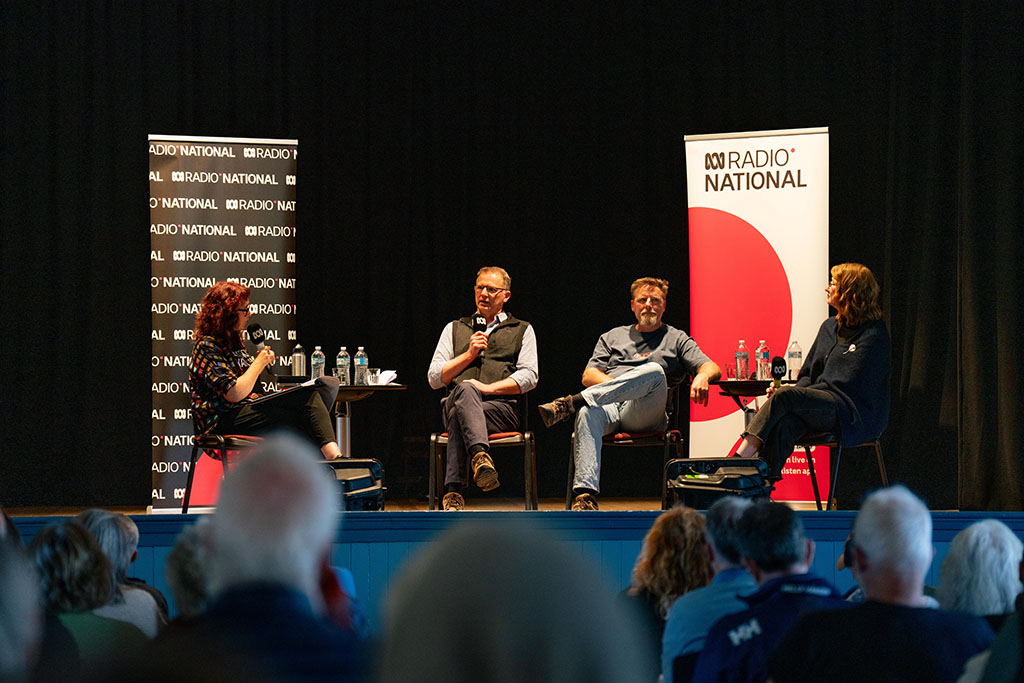
We were invited to participate in an ABC Radio National program called “Citizen Jury”, where communities come together to share big ideas and solutions to thorny local issues.
In this case, the issue was how to reduce the environmental impact of salmon farming in Tasmania.
The salmon industry declined the opportunity to nominate a jury member, but salmon workers were well represented in the audience.
Dr John Whittington, CEO of Salmon Tasmania, was also available as an expert witness both during the Whale Point tour and at the event, adding to the conversation. The Environmental Protection Agency (EPA) and Department of Natural Resources and Environment (NRE) were also invited to participate but declined.
After several weeks of discussions, online meetings with expert scientists and a tour of Huon Aquaculture’s land and water facilities, we presented various solutions to a sold-out audience at the Palais Theatre in Franklin on Wednesday 29 October. Our conversation was guided by Natasha Mitchell, a science journalist and producer of ABC Radio National’s Big Ideas program. The recording will aired on ABC Radio National on Wednesday 5 November.
We began our conversation by acknowledging that there is a place for salmon farming in Tasmania. It provides valuable jobs for rural communities and protein for a growing human population. The workforce directly employed by salmon is between 1,100 and 1,700 with downstream industry including boat building, farm infrastructure, feed manufacture and more adding to the total workforce supported by the salmon industry.
A concern is that all open-net salmon farms in Tasmania are owned by multinational corporations and, like many others, pay near-zero corporate tax – despite it being a $1.4-billion-dollar industry.
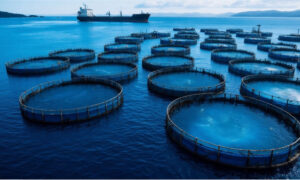
The most significant issue for us all is the overloading of nutrients in our coastal waters. According to the scientific experts we consulted, one 168-meter pen of fully grown salmon can emit bioavailable nitrogen equivalent to the sewage produced by a town of 10,000 to 15,000 people; and that is a single pen. Large aquaculture leases such as those at North Bruny (designed to accommodate 96 pens) can produce nitrogen waste equivalent to the sewerage of a city of 1 million people.
An opportunity for Tasmania to lead the globe is through continued investment and application of land-based farming technologies such as Recirculating Aquaculture Systems (RAS), a controlled environment that reuses and filters water to enable companies to produce salmon with greater efficiency and lower environmental impact. This also minimises the spread of disease, reducing the need for antibiotics and reduces noise and light pollution for coastal communities.
While we acknowledged there is still work to be done in developing these technologies at scale, the success of Huon Aquaculture’s Whale Point Nursery (currently under $110 million expansion) shows that with sufficient investment, Tasmania could be a world-leader in this field.
Other solutions we offered included re-establishing independent water monitoring with updated Broadscale Environmental Management Programs; greater transparency by making real-time data available to the public; transitioning away from Antarctic krill-based salmon feed to more sustainable sources such as black flies and seaweed, replacing flow-through hatcheries with RAS to prevent continued degradation of our inland waterways, and strengthening regulatory oversight by having a well-resourced and fully independent EPA.
This last point is crucial in re-establishing community trust in our government and institutions.
When the decomposing bodies of diseased salmon started washing up on our beaches last summer, it was the community that rang the alarm bells. Politicians from both major political parties, at state and federal levels, lined up in front of cameras waving plastic-wrapped packages of salmon, acting like social media influencers for the industry.
The head of the EPA told us if we were concerned about antibiotics getting into our wild fish, we should fish elsewhere.
Our communities deserve better. We need a government that listens to community concerns and an independent regulator who will prioritise the health and safety of our communities and environment over the commercial interests of industry.
This experience was informative, thought-provoking and positive. We were impressed that a group of people with differing opinions could meet face-to-face and have a civil discussion about contentious issues facing our community.
The conversation highlighted the challenges and risks of large-scale salmon farming in our waterways, but also the opportunities we have to make Tasmania a leader in innovation and industry, while ensuring the long-term health of our environment.
Rayne Allison, Peter Graham, John Stanfield
Tasmanian Times (TT) is a community-based news and current affairs service covering the island state of Tasmania. It exists to provide a diverse presentation of Tasmanian issues. TT creates and supports independent media content utilising the best of modern technologies and tried-and-true practices of public-interest journalism.
Support us in expanding our coverage and developing new content by and for Tasmanians.
New initiatives on the way include … what our contributors and readers suggest! Please get in touch with your suggestions.