On the afternoon of 7 November 2025, as Tassal began deploying florfenicol at Meads Creek and Stringers Cove, the Department of Public Health released advice warning recreational fishers to avoid eating fish caught within 3 kilometres of treated pens for 21 days after treatment ends.
The antibiotic being deployed is manufactured by Abbey Animal Health, a Sydney-based pharmaceutical supplier. Abbey’s florfenicol product is registered only for use in pigs—not fish, and not previously for any aquatic species. Its application for Tasmanian salmon use was orchestrated by Nautilus Collaboration, a consultancy acting as intermediary between Abbey Labs and the salmon industry.
While florfenicol has never been authorised in Australian waters for salmon, it has been used extensively in salmon farming internationally—with documented environmental consequences.
Chile has deployed florfenicol as its primary salmon antibiotic since the mid-2000s—by 2016 it represented 82.5% of all antibiotics used in Chilean salmon farming. Studies document florfenicol resistance levels of 26.4% in under-cage sediments and resistance genes spreading to non-target bacteria. Tasmania is not pioneering careful use of a novel compound—it is repeating an experiment that has already produced concerning environmental results elsewhere, but without the baseline data that should inform such decisions.
The Department of Health offers no evidence of harm to human health from consuming traces of florfenicol. Dr Mark Veitch, Director of Public Health, stated that “while there is no evidence of harm to human health from consuming traces of florfenicol,” fishers may choose to avoid exposure.
This is not reassurance. This is an admission of uncertainty—authorities do not know if florfenicol residues pose human health risks, so they recommend avoidance whilst monitoring begins.
An antibiotic registered for pigs, already linked to environmental damage in Chilean salmon farming, is being released into Tasmanian public waterways on the same day the Department of Health signals it is unsafe to eat wild fish caught nearby.
This simultaneous approval, deployment and caution exemplifies regulatory failure in real time.
Christmas Fishing in Doubt
Treatment is scheduled for ten consecutive days. The 21-day avoidance period begins after treatment ends—not when it begins. If treatment started on 7 November and continues for ten days until 16 November, wild-caught fish would theoretically be “safe” to eat from 7 December onward.
But this assumes all antibiotic is administered within a strict ten-day window. If administration extends over weeks, or if multiple treatment cycles occur across different leases, as expected, then wild-caught local fish from the D’Entrecasteaux Channel and other areas may well be off this year’s Christmas holiday menu.
The health warning applies to fish caught within 3 kilometres of treated pens. But what about crayfish, abalone, and other seafood sharing the same waters? The Department of Health advice does not address crustaceans or shellfish. Do the same contamination risks apply?
Should recreational fishers avoid taking crayfish from areas near treated pens?
Should swimmers avoid these waters during treatment periods?
These questions remain unanswered. Monitoring is designed to detect florfenicol residues after deployment—not to establish safe consumption parameters before release.
The Invisible Warning
The Department of Public Health’s advice is posted to www.health.tas.gov.au/advice-recreational-fishing. This appears to be the entire communication strategy.
No media release to fishing publications, newspapers or radio stations. No alert to fishing clubs, tackle shops, charter services or beach-user groups. No signs at boat ramps, jetties, or public fishing areas in the D’Entrecasteaux Channel.
Tasmania has thousands of recreational fishers. Many will fish the D’Entrecasteaux Channel over coming weeks—including the critical Christmas holiday period—unaware they should avoid eating their catch. They will not know florfenicol treatment is occurring. They will not know wild fish in treated areas may have consumed medicated feed pellets. They will not know the Department of Public Health recommends avoiding fish caught within 3 kilometres of treatment sites.
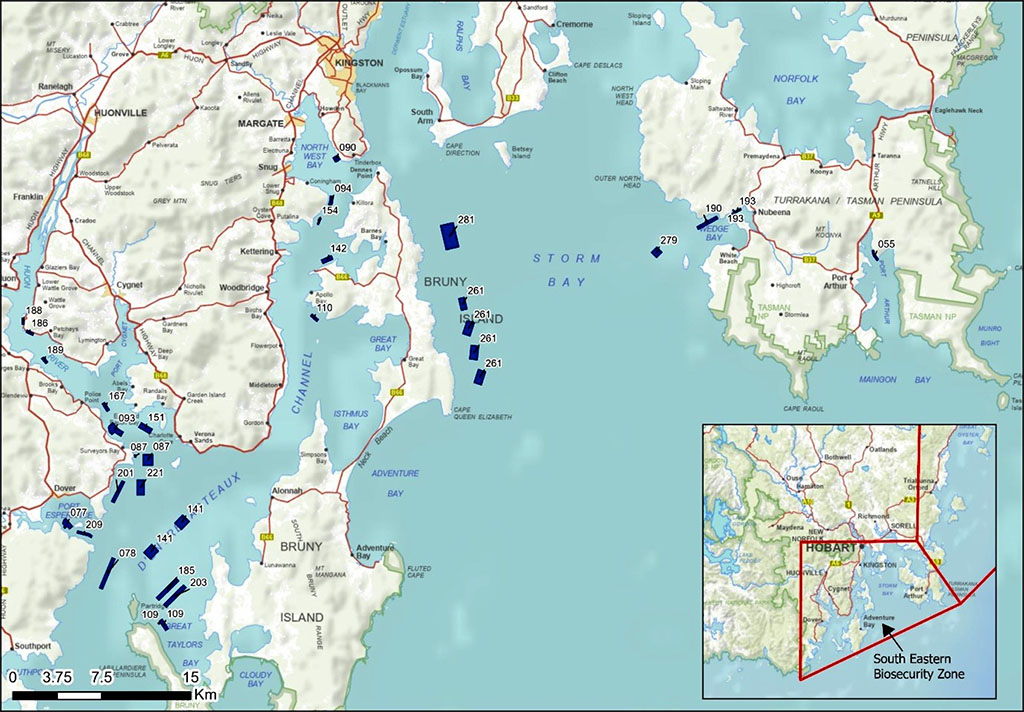
The density of salmon farms across the Huon and Channel, Long Bay, Okehampton and Storm Bay, coupled with distances wild fish travel, makes determining safe fishing zones nearly impossible for recreational fishers. Where are the 3-kilometre boundaries? Which leases are being treated, and when?
Perhaps most tellingly, Tasmanian Times has received anecdotal evidence that fish farm workers—the people with firsthand knowledge of these treatments—are declining to take home their company-supplied salmon since antibiotic dosing began. Workers who see the treatments administered daily are choosing not to eat the product. Yet recreational fishers, with no knowledge of treatment schedules or locations, are expected to navigate these waters and make informed decisions about seafood safety.
Right to Information documents reveal Tassal has prescribed antibiotic treatments requiring similar withdrawal periods and public health precautions since at least 2019. Despite years of antibiotic use requiring degree-day withdrawal periods, no established protocols for public notification to recreational fishers were developed.
The florfenicol deployment reveals a systemic communication failure, not an isolated oversight.
The EPA’s regulatory notice, issued 7 November 2025—the same day florfenicol approval was announced—reveals the fundamental problem. The EPA states it “has developed a new Florfenicol Antibiotic Residue Monitoring Schedule” and that “the Schedule also requires baseline surveys to be completed before any antibiotic treatment event.”
This is backwards. Baseline surveys should be completed before approval, not after.
The EPA is attempting to establish baseline data reactively, after an antibiotic is already being administered to farmed fish in public waterways. Florfenicol differs fundamentally from oxytetracycline in its environmental behaviour. Abbey’s product represents a shift from terrestrial veterinary medicine to aquatic deployment without prior aquatic environmental study in Australian waters.
The EPA acknowledges “the Schedule addresses the shorter half-life of Florfenicol and will provide data on the detection and break-down of antibiotic residues in sediments, wild fish and water.”
However, no data on florfenicol metabolites—the breakdown products—exists for Tasmanian waters. The EPA will collect this data after the antibiotic is already being deployed at scale.
Tassal’s notification received 7 November indicates treatment commenced that day at Meads Creek and Stringers Cove for 10 days, with expectation of broader use across other leases to follow.
The EPA confirms that monitoring results “will inform future environmental and public health advice relating to the use of Florfenicol in Tasmania.” This is acknowledgment that no such advice exists now. The antibiotic is being used without established thresholds for acceptable environmental impact, without baseline data on wild fish populations or water quality, and without knowledge of how florfenicol metabolites will behave in Tasmanian marine waters.
Public Health Tasmania acknowledges the same gap – monitoring “will inform future public health advice.” Future advice will be informed by monitoring conducted after deployment.
The EPA states florfenicol was “previously used in Tasmania in small quantities between 2007 and 2010.” The regulatory notice does not specify what florfenicol was used for or in what farming context.
No clarity on whether it was used in salmon farming, pig farming, poultry or other livestock operations. No data on scale of previous use or environmental monitoring conducted. No explanation for why regulatory documentation is unavailable.
The 2025 approval represents broad-scale deployment at significantly larger scale than any historical use and represents its first authorised use in fish farming in Australian waters. The absence of baseline environmental data for this expanded use—and the product’s origin in pig farming—remains the critical regulatory failure.
Five Years Without Valid Permits
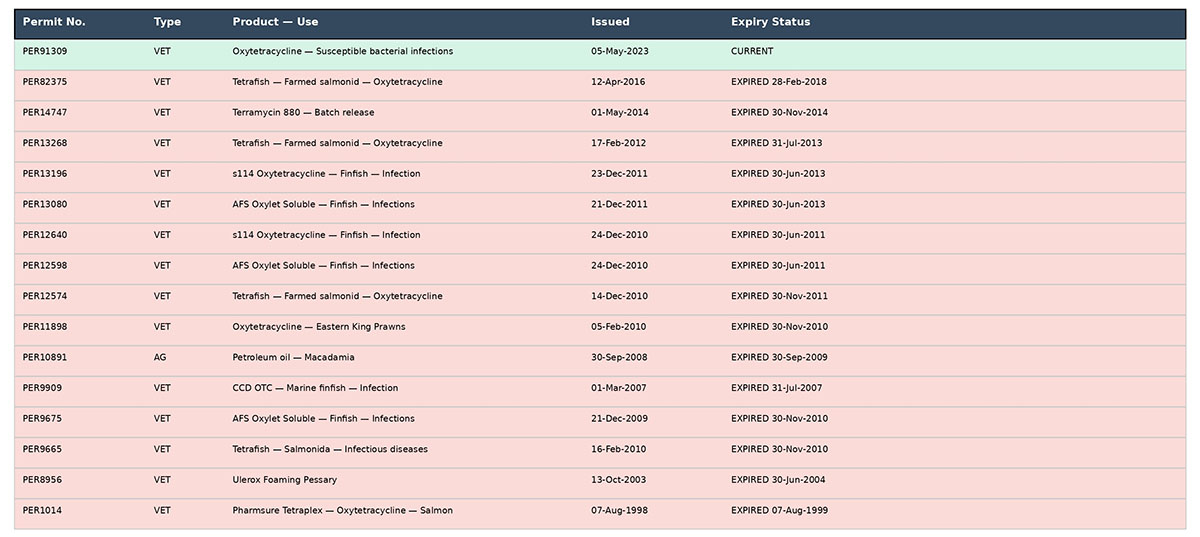
Between the late 1990s and 2018, the salmon industry operated under a succession of minor use permits issued by the APVMA for oxytetracycline. All expired by 2018.
From 2018 to May 2023—a five-year gap—the salmon industry continued operating without any valid federal permit or registration for antibiotic use. No enforcement action was documented.
After 2018, with oxytetracycline permits expired and no valid federal authorisation available, Tasmania’s AgVet Code of Practice provided a regulatory pathway unavailable in most other Australian states. Tasmania’s legislation permits veterinarians to supply unregistered veterinary chemical products under professional supervision—not just for individual animals, but for treating multiple animals in non-major food species.
Prior to October 2024, salmon was not classified as a major food species, making this loophole available.
This represents significant divergence from national practice. In Victoria and most other states, off-label and unregistered drug use by veterinarians is restricted to single-animal treatment. Tasmania’s more permissive provision created a legal jurisdictional gap theoretically exploitable to circumvent federal registration requirements.
In February 2025, Tasmanian government officials explicitly confirmed to industry representatives that the regulatory framework permits this pathway. The acknowledgement was responsive to industry enquiry about regulatory options available under Tasmanian law. That confirmation—combined with explicit commitment to support Abbey Animal Health’s registration application—provided industry confidence to pursue emergency approval through multiple pathways simultaneously.
A new oxytetracycline permit (PER91309) was issued in May 2023. However, no antibiotic product has ever been formally registered by the APVMA specifically for salmon use.
Refusing to Address Root Causes
The deployment of florfenicol represents an industry refusing to implement fundamental changes to farming practices that might reduce disease pressure. International experience—particularly from Norway and Chile—demonstrates that high stocking densities, inadequate fallow periods, and continuous production cycles create conditions for disease outbreaks requiring antibiotic intervention.
Rather than destocking pens, implementing longer fallow periods, or reducing biomass to levels that might prevent disease outbreaks, Tasmania’s salmon industry has opted for chemical intervention using an antibiotic already linked to environmental damage in Chilean waters. The environmental and public health risks are transferred to recreational fishers, wild fish populations and marine ecosystems rather than addressed through changes to farming practices.
This approach ignores warnings from jurisdictions that have already experienced the consequences of antibiotic overuse in marine environments. Chile’s experience with antibiotic-resistant bacteria and environmental degradation provides a clear precedent that Tasmania appears determined to repeat.
Public Waterways, Private Decisions
Salmon farming occurs in public waterways. Disease treatment decisions affecting wild fish populations, water quality and marine ecosystems should be governed by robust environmental assessment completed before new compounds are deployed—not by emergency provisions that bypass safeguards and defer baseline monitoring until after approval.
The approval of florfenicol without baseline environmental data—and the subsequent scramble to establish monitoring protocols—demonstrates systemic failure in how antibiotics are regulated in Tasmania.
Environmental monitoring has become reactive rather than preventative.
Public health warnings arrive after deployment has begun. The industry refuses to implement farming practice changes that might reduce disease pressure. And recreational fishers are left to navigate unmarked waters during the peak holiday season, unaware of the risks to themselves and their families.
Note: This investigation is based on Right to Information documents referenced by Tasmanian Times (NRE-RTI-059-2024-25 and NRE-RTI-060-2024-25) revealing coordination between Abbey Animal Health, Nautilus Collaboration, Salmon Tasmania and government officials, as well as documented antibiotic treatments requiring withdrawal periods dating to 2019.
RTI Documents Referenced:
- NRE-RTI-059-2024-25 Part B (Veterinary antibiotic prescriptions 2019-2025)
- NRE-RTI-060-2024-25 (Florfenicol approval coordination documents)
Footnote
Environmental Licence 9886/4 for Stringers Cove (issued 30 January 2025) does not contain specific conditions governing antibiotic treatments, though it requires a Waste Management Plan addressing “medicated feed waste” (WM1.2.2), suggesting regulators anticipated such treatments would occur. The licence’s general notification provision (G2) requires the licence holder to notify the Director before “implementing any change to the activity that may cause or increase the emission of a pollutant or which may result in environmental harm,” but whether antibiotic treatments constitute such a change requiring pre-notification remains legally ambiguous.
Standard BEMP conditions require regular water quality and sediment sampling but do not specifically mandate antibiotic residue testing, creating fragmented regulatory oversight where no single authority comprehensively assesses environmental impacts of medicated treatments at site level.
Tasmanian Times (TT) is a community-based news and current affairs service covering the island state of Tasmania. It exists to provide a diverse presentation of Tasmanian issues. TT creates and supports independent media content utilising the best of modern technologies and tried-and-true practices of public-interest journalism.
Support us in expanding our coverage and developing new content by and for Tasmanians.
New initiatives on the way include … what our contributors and readers suggest! Please get in touch with your suggestions.