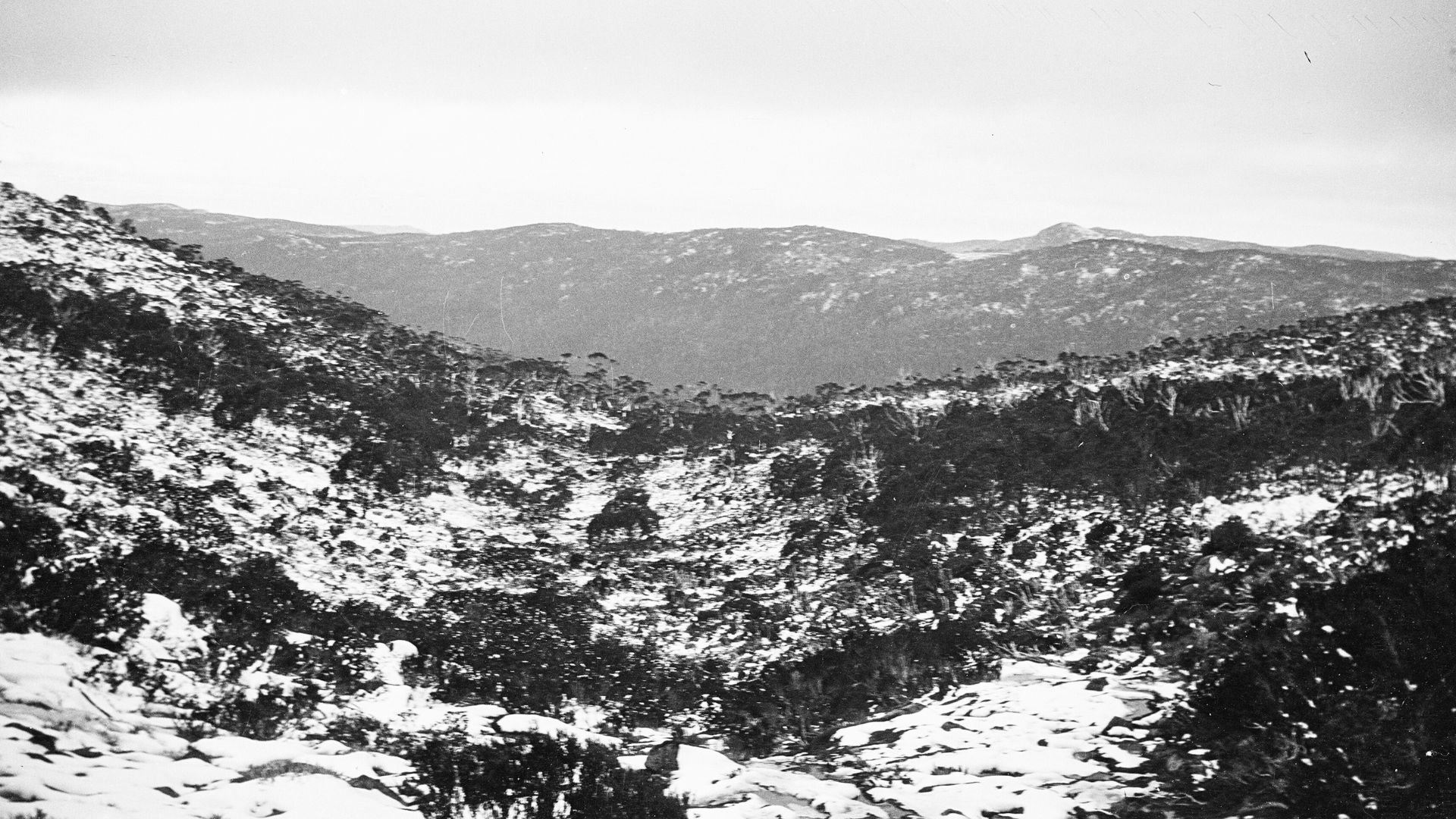
This photograph, snapped at some point during 1950, shows a snow-covered Mount Field, one of Tasmania’s earliest national parks.
Today, national parks cover about one-fifth of the state, but before 1916, there were none.
Early history
The Big River tribe of Tasmanian Aboriginals once lived in the area in and around Mount Field. They have since left behind evidence of their occupation, including rock engravings and other artworks.
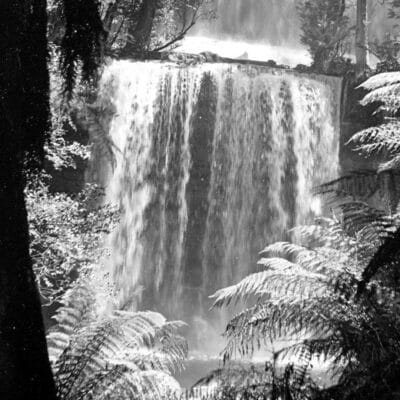
Russell Falls in 1958.
Europeans settled Tasmania in the very early 1800s, but it wasn’t until the 1830s that some of them – specifically trappers and snarers – ventured into the Mount Field area. Bushrangers and escaped convicts would also eventually seek refuge in the countryside around the twin-peaked mountain and Bushy Park.
In the 1850s, botanist Leonard Rodway explored Mount Field, and in 1869, another botanist named Baron von Mueller visited the area and documented many of its plants and trees. In time, the Rodway Range would be named after Rodway.
Russell Falls, a waterfall located near Mount Field’s present-day visitor centre, was declared Tasmania’s first nature reserve in 1884.* It would then go on to feature in a series of postage stamps in 1899.
In 1898, trout were deliberately released into Mount Field’s lakes to encourage people to fish there. Thirteen years later, in 1911, a guesthouse was built at the entrance of Mount Field to accommodate the increasing number of people who were visiting the area.
National park
In the year 1913, there were various organisations and individuals – including Leonard Rodway – who were calling for Mount Field to be made a national park. According to The Mercury:
“Mr W. Crooke, Hon, secretary Southern Tasmanian Railway and Exploration League, has received a communication from the Minister of Lands and Public Works (Hon E. Mulcahy, M.H A. ), in which he acknowledges receipt of a communication from representatives of the Hobart Corporation, the Tasmanian University, the Royal Society, and other public bodies, asking for a National Park to be established at Mount Field…”
On 29 August 1916, their wish was granted: Mount Field became a national park under the Scenery Preservation Act. The Mercury reported:
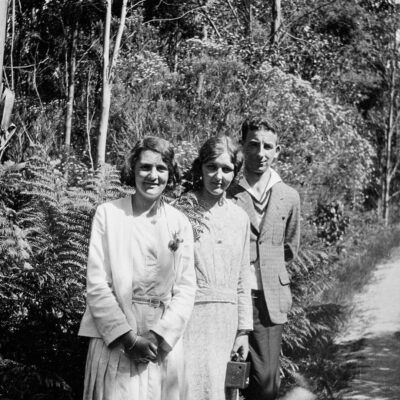
Two women and a man at Mount Field National Park in 1950.
“A large area of land near Russell Falls has been set apart by the Government as a National Park, for which purpose it is admirably suited. It is a delightful bit of bush, which is already within reach of Hobart for a day’s outing, and which will be still easier of access when the railway is finished. At present it is under the control of the Scenery Preservation Board…”
A man named William Belcher was employed as the park’s first ranger in 1917, and he spent a lot of his time building tracks, constructing huts, and shaping its overall visitor experience. Belcher would leave his role at Mount Field in 1934, 17 years after he first started.
The 1920s and 1930s saw the rise of winter recreation at Mount Field, resulting in a number of ski huts being built around the park. A road leading all the way to Lake Dobson had also been constructed by 1937.
A couple of years later, the Lake Fenton water supply scheme was completed. To this day, water from the lake – which is located within the Mount Field National Park – continues to supply around 20% of Hobart’s drinking water.
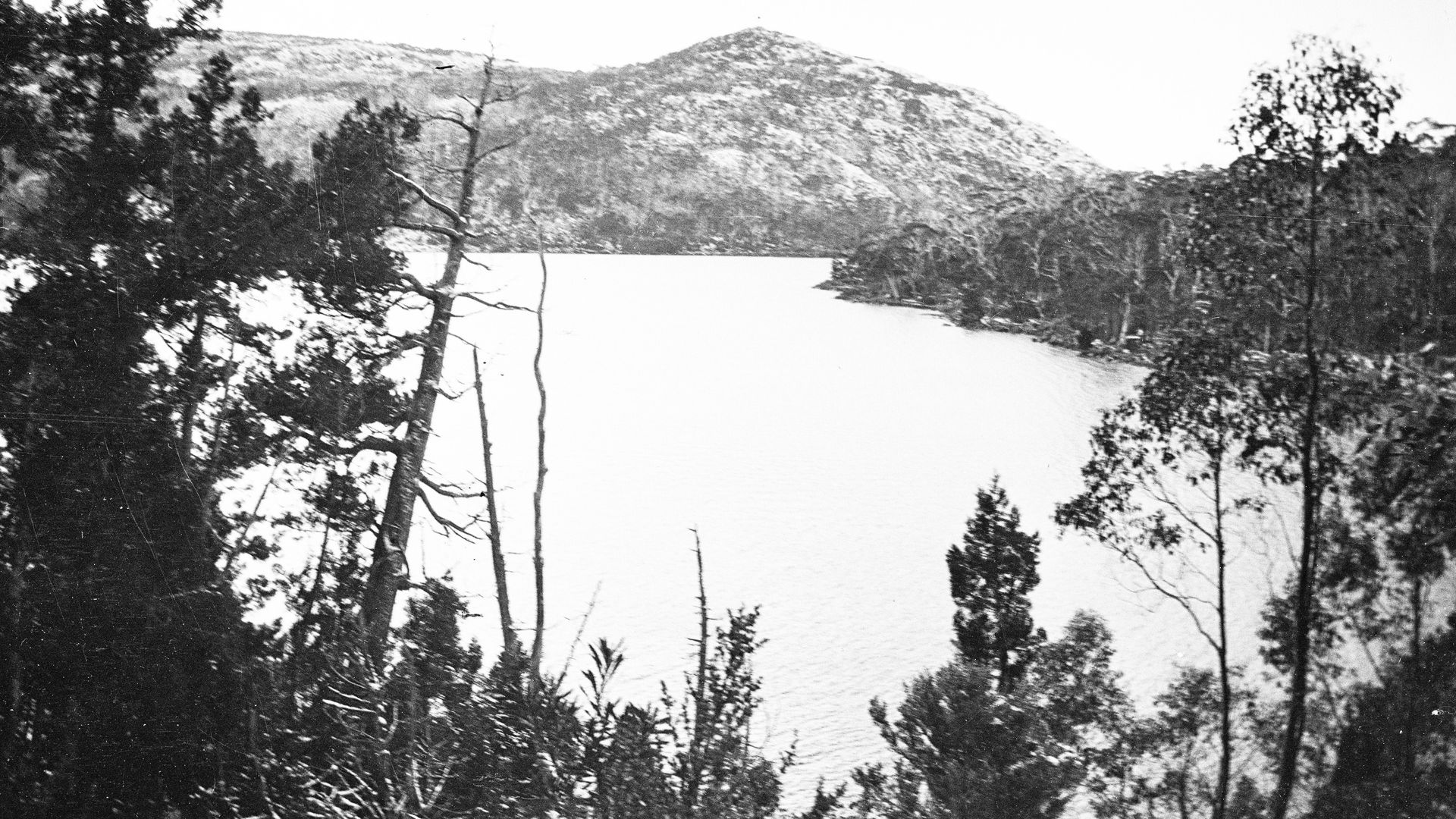
Mount Field National Park in 1950.
Recent history
In 2013, the Mount Field National Park was recognised for its natural and cultural value by being incorporated into the Tasmanian Wilderness World Heritage Area, which was established during the 1980s.
Mount Field marked its 100th anniversary as a national park in 2016. More accommodation has since been built near Lake Dobson – another lake in the park – to keep up with growing demand, with visitor numbers climbing to 232,000 in the 2023-24 fiscal year.
The park remains popular in 2025.
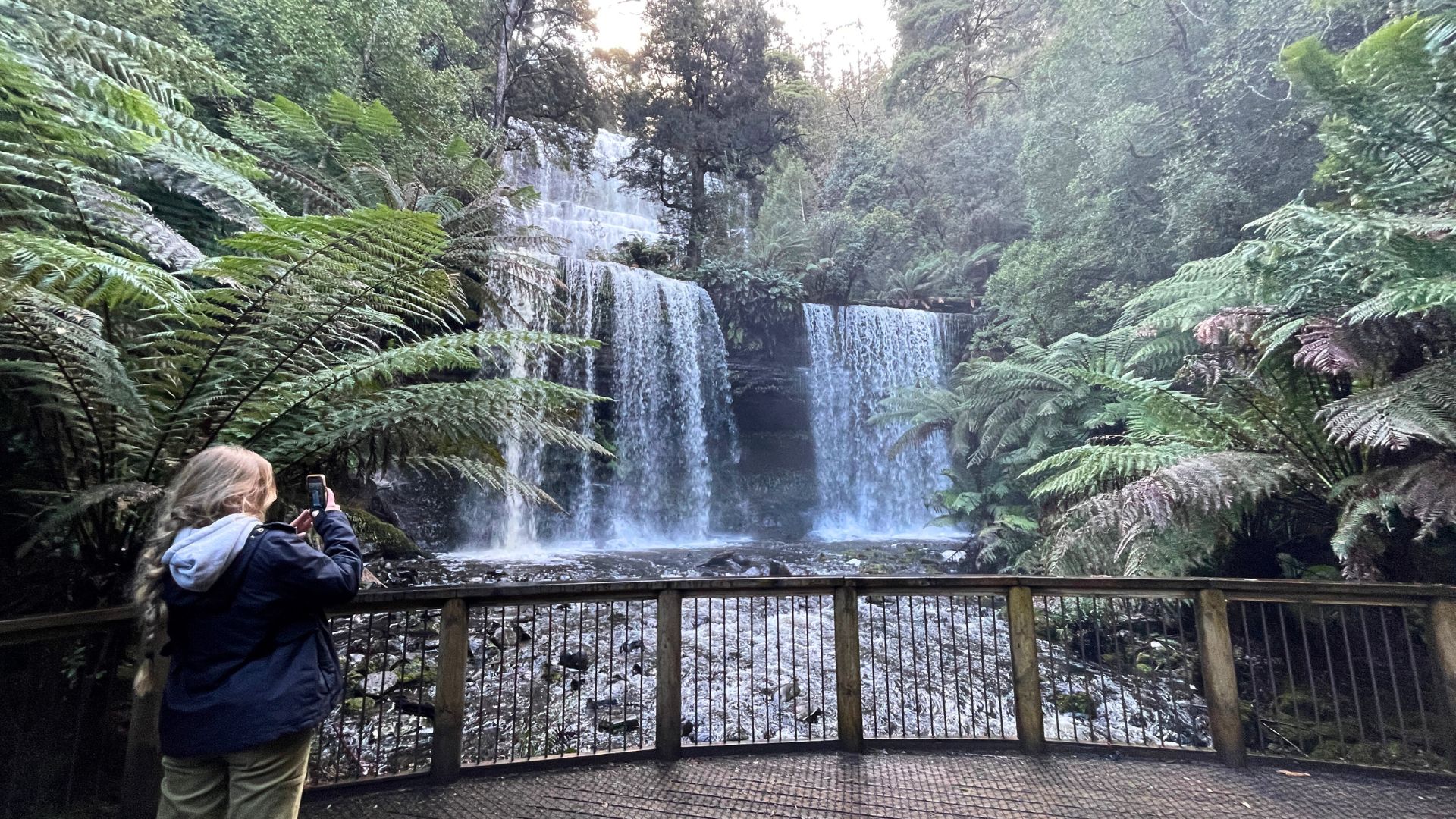
Russell Falls today.
* A nature reserve isn’t quite the same as a national park. Reserves are created solely to protect ecosystems and wildlife, while national parks balance nature conservation with public enjoyment.
Tas That Was is a column that includes:
- anecdotes of life in Tasmania in the past;
- historical photographs of locations in Tasmania; and/or
- documentaries about locations in Tasmania.
If you have an anecdote or photograph you’d like to share with us, please send it to [email protected].
Callum J. Jones is passionate about telling stories. He studied English, History, and Journalism at the University of Tasmania and lived in Western Sydney from 2022 to 2024 while working as a journalist for Professional Planner, a leading online publication for financial planners. Callum has written for Tasmanian Times since 2018 and has also been published in a range of other outlets, including Quadrant and the BAD Western Sydney anthologies.