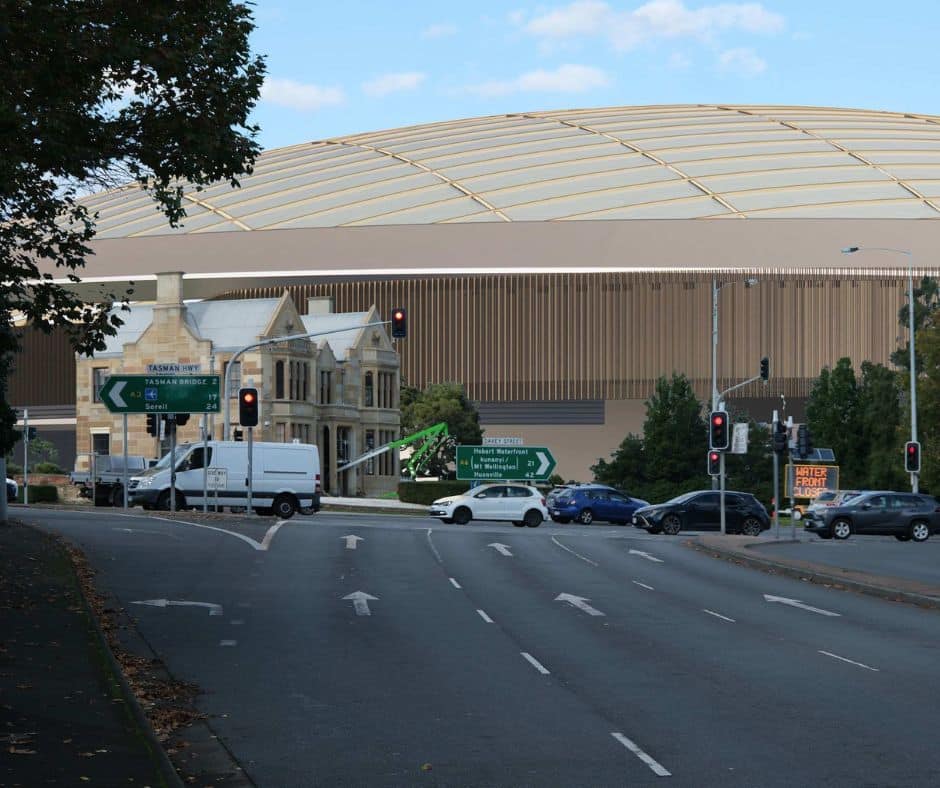
After two weeks of public hearings regarding the Macquarie Point Stadium, the Tasmanian Planning Commission panel has retired to write its final report. A very wide range of evidence was presented, covering matters ranging from drainage to noise, traffic, design and host of others. I sat through much of the hearings – what follows is a report from an economist’s perspective.
When the stadium project was made a Project of State Significance (PoSS), I had assumed that evaluation would be guided by the government’s fiscal strategy. The strategy notes that by 2032-33, all social infrastructure projects costing more than $50m will be assessed using Infrastructure Australia Guidelines, and that by then all of them will have a positive benefit-cost ratio. (I presume this is a typographical error – even the most wasteful project could achieve a ratio greater than zero; I assume it means a ratio greater than one).
As the hearings progressed it was obvious that the Department of State Growth, acting as the co-ordinating body for the government, had no intention of going anywhere near the fiscal strategy. Quite the contrary. It did its best to bury it.
The first hint of this approach was provided by the differences in departmental responses to the Commission’s Draft Assessment Guidelines.
In its response, the Treasury emphasised the importance of following Infrastructure Australia guidelines for benefit-cost analysis. It also recommended strengthening the proposed analysis of the fiscal impact of the project.
State Growth took a different tack. It claimed that it is not the job of the Commission to prepare a fiscal impact statement, noting that there are “existing public scrutiny processes and pathways to review government budget processes”. Given that the two independent Members’ concerns over the state of the budget were one of the triggers for the PoSS referral, this seems a bizarre claim.
State Growth didn’t stop there, claiming that there is no precedent for fiscal analysis, citing earlier PoSS evaluations of private-sector projects such as the Ralphs Bay marina. But as the Commission panel noted, in the absence of taxpayer funding a fiscal impact statement was not required for a private sector project. The stadium project relies on taxpayer funds.
The third line of argument was that, for a project like the stadium, many of the benefits and costs are intangible and difficult to evaluate using standard benefit-cost methods. State Growth advocated the use of a ‘willingness to pay’ approach as is sometimes used to determine the social value of public assets such as national parks. While this is a reasonable suggestion, State Growth did not follow it up by commissioning the required research.
When it released its revised assessment guidelines, it emerged that the Commission had given more weight to the Treasury’s responses than to those of State Growth. The Scope for the inquiry included a fiscal impact statement and a requirement to follow Infrastructure Australia guidelines.
Before the hearings got under way, State Growth tried a different tack. Immediately after the election was called on June 11, it requested an adjournment of PoSS proceedings for six weeks until August 29, on the grounds that an inquiry could not be held until the government caretaker period expired. This request was rejected by the chair of the Assessment panel, Mr Turner.
The Commission’s hearings began on June 25 with an opening statement from State Growth’s lawyers. They offered various arguments intended to restrict the scope of the assessment.
For example, it was argued that the assessment should be treated as a town planning exercise and that, as in other town planning assessments, economic considerations should be limited to the impacts on businesses in proximity to the stadium.
It also rehearsed the arguments provided in their response to the Scope guidelines (which I’ve discussed earlier in this article). State Growth wanted to focus on benefits rather than costs. However, rather than repeating the call for a willingness to pay analysis to evaluate social benefits, Mr Townshend KC argued that there is “no possible way to estimate social benefits” over generations, and that they are best not to be quantified, but “best to be imagined”. For me, this line of argument was reminiscent of that put forward by the hapless Denis Denuto in The Castle courtroom scene – ‘It’s the vibe of it’.
The Commission’s draft assessment report was also criticised for including costs of items considered necessary for the operation of the stadium, but which State Growth considered to be out of scope. While some of these items may be open to interpretation others, such as the bus plaza, are an integral part of the stadium’s operation and would not be built without it. State Growth wanted to exclude all of them.
The fiscal impact statement, including the $240m for precinct development under the federation funding agreement, also came under scrutiny. The agreement only refers to the development of the wharves and social housing. I had argued in my submission that this should not be counted as a source of funding for the stadium. No deal. Enquiries as to the allocation of these funds were met with a government response that the allocation of funds for the stadium are ‘out of scope’.
Things took a surprising turn on the day KPMG made their presentation on economic analysis. At that point Mr Townshend KC insisted that, as a matter of natural justice, the proponent should be informed as to the authorship of the Commission’s draft report. More specifically, which members of the panel were responsible for the various sections of the report?
The Panel chair declined this request, noting that the report is authored as a ‘whole of Panel’ document.
But I did wonder why the request was made. I hope it wasn’t an attempt to question the competence or independence of individual members.
Overall, my impression is that the submissions made at the hearings identified both benefits and costs which had not previously been considered. It will be up to the panel to form a judgement on their importance, and whether they significantly change the conclusions of their earlier draft report. Parliament can then decide.
When it was proposed, the PoSS process was offered as a way towards transparency so that Parliament could, in possession of all relevant information, decide on the project.
Evidently, the Department of State Growth acting for the proponent, didn’t see it that way.
Dr Graeme Wells is an independent economist, having previously had an academic career in New Zealand, North America and, more recently, as Associate Professor at ANU and UTAS. Since returning to lutruwita/Tasmania he has been a consultant and adviser to a range of private sector and government agencies.
Tasmanian Times (TT) is a community-based news and current affairs service covering the island state of Tasmania. It exists to provide a diverse view of Tasmanian issues. TT creates and supports independent media content utilising the best of modern technologies and tried-and-true practices of public-interest journalism.
Support us in expanding our coverage and developing new content by and for Tasmanians.
New initiatives on the way include:
- a weekly podcast covering current affairs
- a revamped website
- a monthly cartoon competition
- a user-friendly app for both Android and Apple devices
- a weekly roundup of key stories