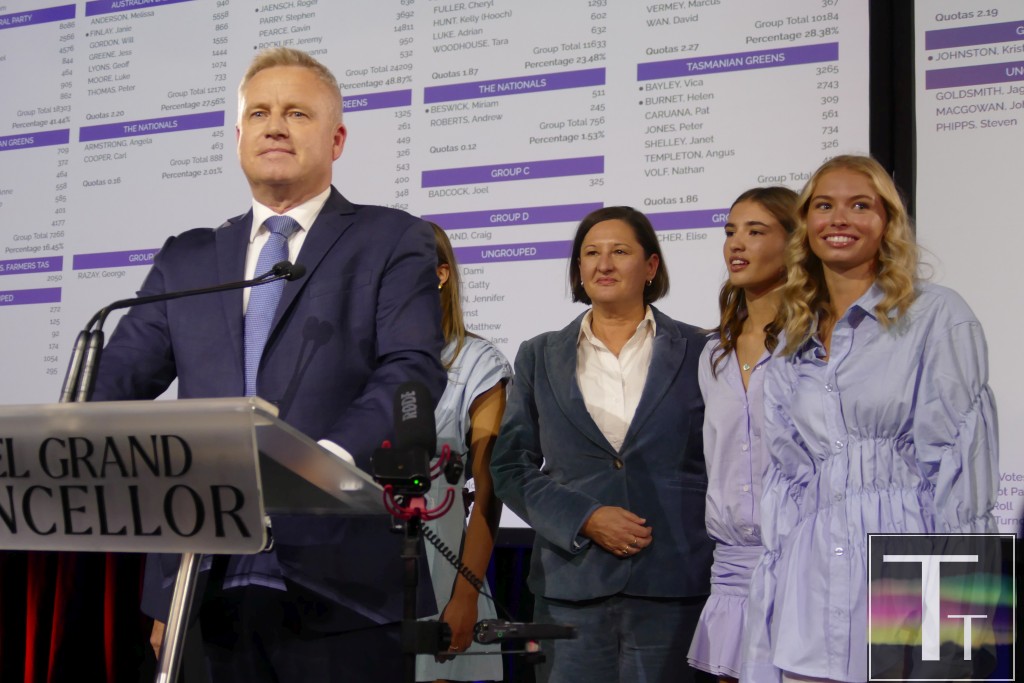
In less than a week we have seen our Liberal government go from throwing barbs to actively seeking an alliance with crossbenchers as Premier Jeremy Rockliff attempts to cobble together a party that he can take to the Governor as the reason why she should allow the Liberals to form government.
The light bulb moment behind this much needed alliance with the independents, is what appears to be a hastily contrived one page vision of what Rockliff is ‘prepared to offer’ previous parliamentary incumbents Kristie Johnston, Craig Garland, and David O’Byrne along with newcomers Peter George and most likely Carlo Di Falco.
The peace offering titled ‘Foundations of Stability’ appears to be the result of Rockliff telling his backroom minders whatever they come up with needs to fit on a single page, and to use big, bold fonts to be sure the independents get the message.
It is an effort reminiscent of when the office secretary back in the eighties first started to explore desktop publishing software.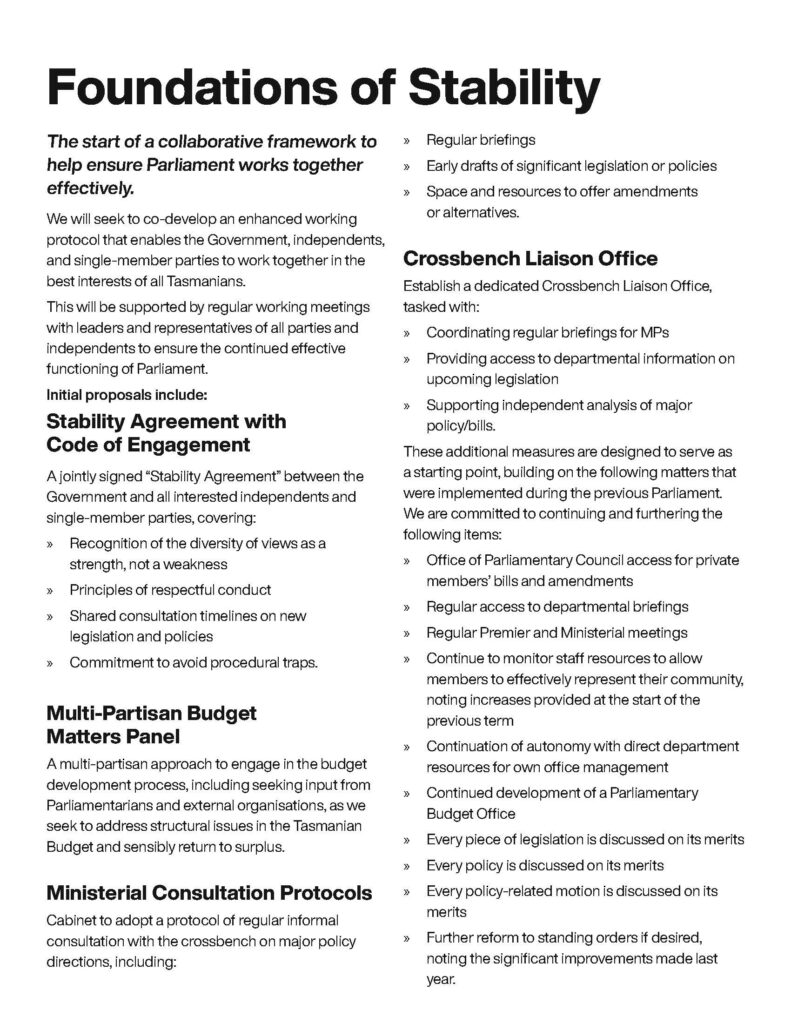 More importantly, what is this one pager trying to sell.
The opening paragraph, written as a vision style statement, is surely stating the obvious – ‘working together’ and ‘regular meetings’ sounds like what is already expected of our elected parliamentarians.
Is this the start of a collaborative framework to help ensure Parliament works together effectively, or is it a straightjacket?
Is it a mechanism to bind independents to government processes without offering reciprocal power?
While it aims to ‘avoid procedural traps’, this could be interpreted as limiting an independent’s ability to disrupt or challenge the government through parliamentary procedures, thereby reducing their leverage.
The focus on “respectful conduct” is positive but might implicitly discourage robust opposition when necessary.
The ‘Multi-Partisan Budget Matters Panel’ is presented as an opportunity for independents to provide ‘input’ into the budget process. However, this falls short of granting any real veto power or guarantee that independent priorities will be incorporated into the final budget.
Independents could end up being consulted extensively without their suggestions ultimately being adopted, leading to a perception of involvement without genuine impact.
The ‘Ministerial Consultation Protocols’ to ensure Cabinet adopts a protocol of regular informal consultation with the crossbench on major policy directions, including regular briefings, early drafts of significant legislation or policies and space and resources to offer amendments or alternatives, is simply stating the obvious.
It is no more than we would expect from our politicians going about their daily tasks.
Establishing a ‘Crossbench Liaison Office’ is framed as providing support, including ‘access to departmental information’ and ‘supporting independent analysis. While beneficial, there’s a risk that this office could also become a channel for the government to manage or co-opt independent voices, rather than solely serving as an independent resource. The effectiveness will depend heavily on the independence and mandate of this office, which isn’t fully detailed.
Many of the ‘additional measures’ are continuations of practices from the previous Parliament. While positive (e.g., ‘Office of Parliamentary Council access’ and ‘regular access to departmental briefings’), relying heavily on existing arrangements might not represent a significant shift in power dynamics for independents.
The emphasis on discussing ‘every piece of legislation… on its merits’ is a foundational expectation of Parliament, not necessarily a new concession.
Ultimately, the Foundations of Stability framework presents a mixed bag for independents in Tasmanian politics. While offering improved communication channels and access to information, its true impact hinges on whether it genuinely empowers independents to influence policy and legislation, or merely provides a more structured platform for their views to be heard without assured action.
The success of this framework will depend on the good faith and flexibility of the government in translating consultation into tangible policy outcomes, rather than simply maintaining stability through managed engagement.
Liberals Offer ‘Stability Agreement’ Olive Branch to Crossbench
Tasmanian Times (TT) is a community-based news and current affairs service covering the island state of Tasmania. It exists to provide a diverse view of Tasmanian issues. TT creates and supports independent media content utilising the best of modern technologies and tried-and-true practices of public-interest journalism.
Support us in expanding our coverage and developing new content by and for Tasmanians.
New initiatives on the way include:
- a weekly podcast covering current affairs
- a revamped website
- a monthly cartoon competition
- a user-friendly app for both Android and Apple devices
- a weekly roundup of key stories