Media release – Coalition for the Protection of Greyhounds (CPG), 27 November 2024
Research shows Tasracing’s greyhound rehoming sinks to new four-year low
New research reveals the Tasmanian greyhound racing industry has hit a four-year low in rehoming its ex-racing dogs, said the Coalition for the Protection of Greyhounds (CPG) today.
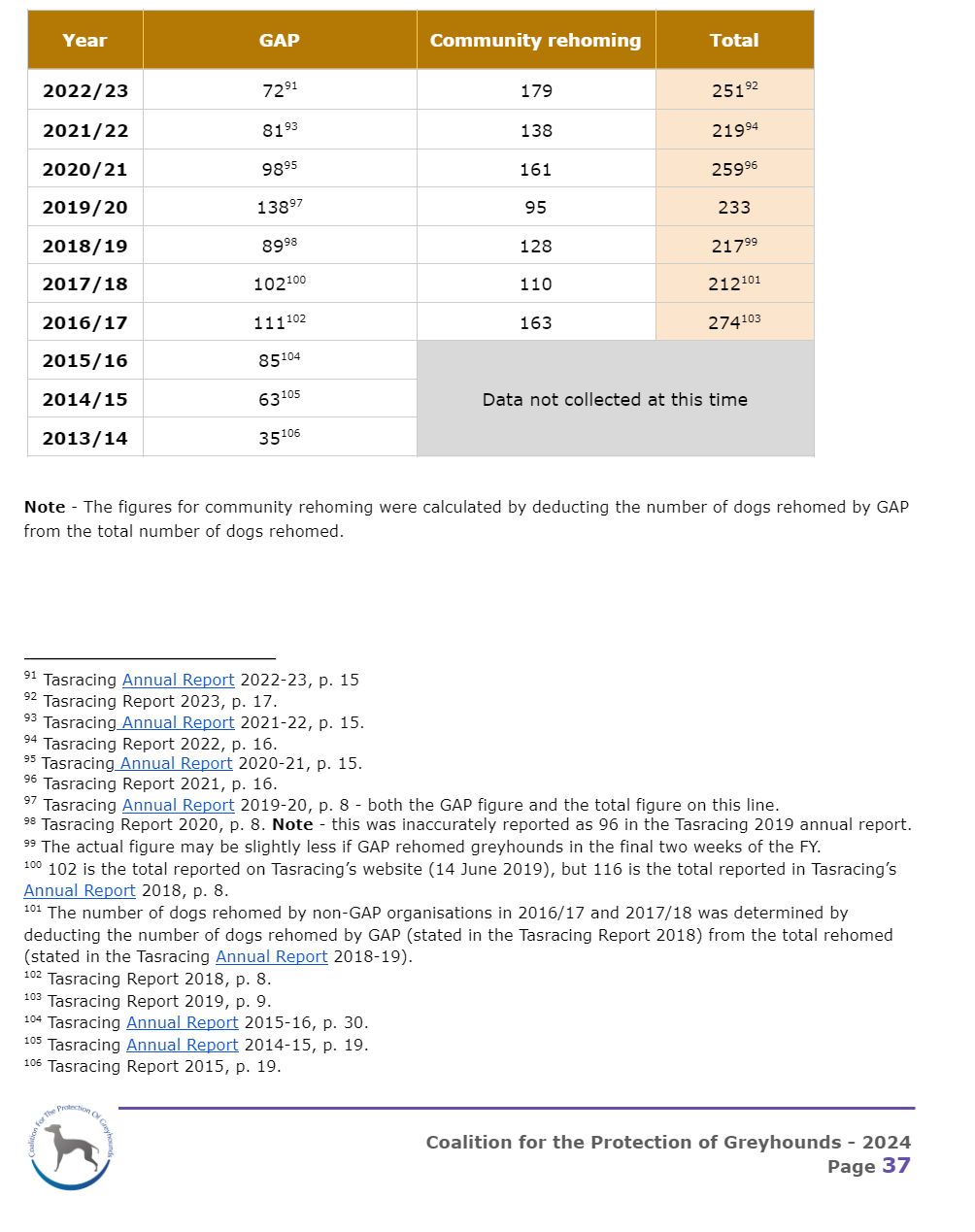
CPG’s annual rehoming update for FY 2022-23 shows Tasracing’s rehoming arm, GAP, rehomed only 72 dogs, marking a decline for the third consecutive year—the lowest since the 14/15 financial year (see backgrounder).
Ms Kylie Field, CPG’s Tasmanian director, said GAP’s poor performance shows the state’s dog racing industry is unsustainable and should be phased out.
“Tasracing has clearly failed to take responsibility for rehoming its dogs via GAP. Meanwhile, community volunteers rehomed 179 greyhounds in the same period, the highest since FY 2016-17. That’s a fantastic achievement,” she said.
“Tasracing has been given millions of taxpayers’ dollars, yet the community has to rehome the dogs GAP fails to rehome by relying on donations and fundraising. It’s a disgrace.”
Ms Field said Tasracing’s poor rehoming efforts are unacceptable given it made $400,000 in profit for 2022/23 and last year was given more than $36M in public funds.
“Despite this, Tasracing managed to make a big loss in 2023/24, so you can imagine what will happen to the GAP budget in the same period. Worse still, Tasmania doesn’t have birth to death tracking, with the fate of many retired greyhounds unknown,” she said.
“A troubling article in the Hobart Mercury detailed poor conditions within GAP Tas, calling for urgent reform and a leaked document suggests increased euthanasia may be considered, which we strongly oppose.”
Meanwhile, the Greyhound Retirement Preparation Scheme (GRPS) which required owners to fund neutering upfront from January 15 this year, could lead to fewer dogs being desexed.
“This replaces the prior scheme under which Tasracing directly covered vet bills for mandatory desexing and won’t help the rehoming cause,” she said.
Finally, Ms Field said unless the State Government removes inspection and anti-doping responsibilities from Tasracing and establishes a new independent industry regulator, racing animals will continue to suffer – see CPG’s Tasmanian regulatory report for greater detail.
Backgrounder
About greyhound rehoming in Australia
Each year, thousands of retired greyhounds urgently need ‘forever’ homes. Some of these greyhounds typically find new homes through four channels.
- Industry participants: owners or trainers may keep greyhounds for breeding or as pets. In reality, they are often kept confined. The NSW Greyhound Welfare Code allows a dog to be kept in a pen that is 1.2 x 1.8 metres and exercised for only 30 minutes a day.
- Third parties: greyhounds are often rehomed to unvetted third parties by racing owners who give them away privately, often via Gumtree – without ensuring the adopters’ suitability. Dogs rehomed this way can end up in unsuitable homes, mistreated or killed. This is why the RSPCA says – “Third party adoptions … should be verified and followed up to ensure they are genuine.” Here’s a case study.
- GAPs: these are industry-run programs funded by state racing bodies. While referred to as GAP (Greyhound Adoption Program) in most states, the NSW industry calls its rehoming scheme Greyhounds as Pets (also called GAP for short), as does WA. GAPs only take dogs which are easy to rehome. GAPs euthanise dogs they deem hard to rehabilitate.
GAP budgets come from their respective state racing bodies, the exceptions being GAP Queensland which is entirely funded by the State Government, while GAP Tasmania could virtually be described the same way, as the vast majority of Tasracing’s budget comes from the State Government.
- Community rescues: these groups are run by volunteers, provide a more humane approach to rehoming and achieve better outcomes with a fraction of the money available to GAPs. These rescue groups rely on donations and don’t euthanise a dog unless it’s terminally ill.


Media release – Cassy O’Connor MLC, Greens Animal Justice spokesperson, 24 November 2024
TasRacing Deed and Massive Subsidy Needs Scrutiny Before Renewal
The Greens and animal advocates are calling on the Rockliff Government not to re-sign the TasRacing Deed before Parliament has the opportunity to examine its economic, social and animal rights outcomes.
It became clear in Legislative Council Estimates hearings that Labor would like the Liberals to get on with renegotiating the Deed – in secret – well before its expiry in 2029.
Signed after the sale of the government betting agency, TOTE, in 2009, the twenty-year Deed has provided more than half a billion dollars in public subsidies since.
This year, the Deed tipped close to $40 million in public funds into the racing industries. That’s state-sponsored cruelty to animals and a huge amount of public money not going into our hospitals, building homes or our schools.
In a tough budgetary time for the State and cuts across the public sector, this is a matter of significant public interest.
EMRS polling in November 2023 found 74% of Tasmanians surveyed don’t support public funding to the horse and greyhound racing industries. The Tasracing annual report, meanwhile, shows wagering is down as support for the industry declines.
While the Liberals and Labor might hope to rush the signing through without scrutiny, Parliament has a responsibility to test the costs and any benefits of the Deed before another twenty years of subsidies are locked in.
Of course, the Greens want the subsidies and the cruelty to end, and will keep pushing for an end to industrialised racing, but we are also determined that the Deed not be stitched up without scrutiny.
With five years before the Deed expires, the Greens will move for Parliament to openly and transparently examine the Deed. This will provide all Tasmanians, including industry participants and animal advocates, the chance to have their say.