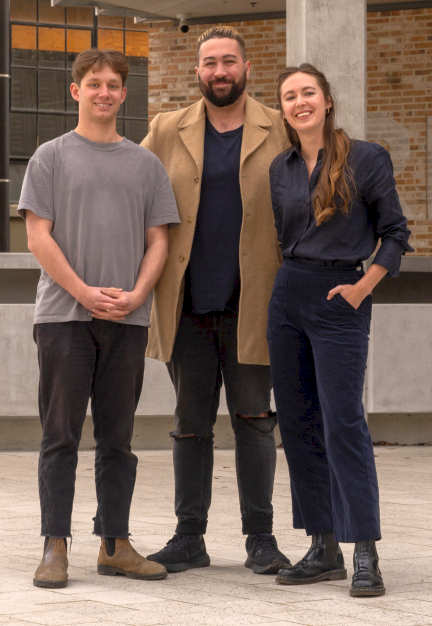
Lachlan Sutton, Luke Prendergast, Mia Larsen.
A trio of architecture students has won the National Super Studio Design Competition, showcasing an innovative approach to disaster relief housing.
More than 80 teams from 20 universities across the country entered the competition.
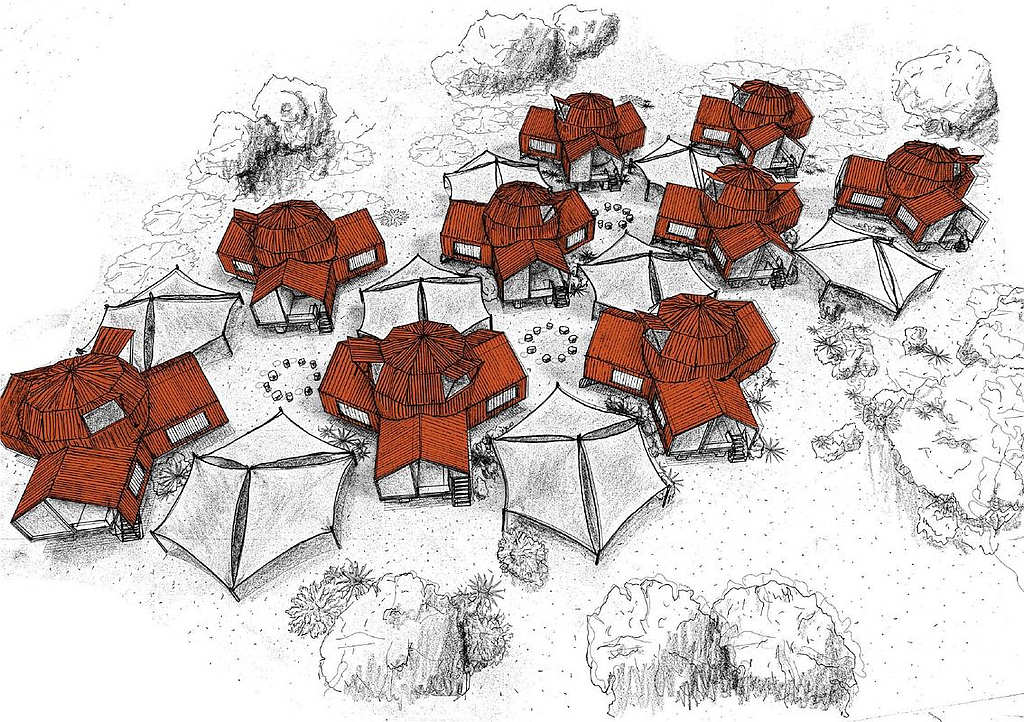
University of Tasmania Master of Architecture students Mia Larsen, Luke Pendergast and Lachlan Sutton won the national competition with their Jingana Epicormic Resilient Community Housing Strategy project, which presented a bold vision for public spaces that seamlessly blends innovation with sustainability.
Inspired by the resilient jingana (Banksia aquilonia) plant, the team’s design mimics nature’s adaptability in the face of constant changes to climate.
The National Super Studio Design Competition, organised by the Australian Institute of Architects and SONA, invites architecture students from across the nation to stretch the boundaries of creative thinking.
Responding to a national brief with a theme of design for adaptation, participants were invited to explore radical and innovative solutions to address the impacts of extreme weather.
The jury was impressed by the quality of work and creative ideas of the Tasmania team, particularly the immediate rollout post-disaster that allows for customisation and modification during occupation, and the capacity for repair and relocation in the longer term.
The jury citation noted:
“The jury found the ‘light touch’ approach to disaster relief captivating. The jury was particularly impressed by the careful consideration of timescale in the response to the brief, such as the immediate rollout post-disaster, allowances for customisation and modification during occupation, and the capacity for repair and relocation in the longer term. The design response is commended for its adaptability, with the provision of a central refuge core alongside the flexible extension modules.
This strategy successfully balances the need for immediate respite and emergency shelter with the longer term needs of a community in recovery. Furthermore, the inspiration of biomimetic responses from the jingana plant demonstrates a thorough investigation of natures adaptability in the face of constant changes to climate.”
Professor Julian Worrall, Head of the School of Architecture and Design at the University of Tasmania, praised the students’ achievement:
“Design for adaptation and resilience is what the brief called for. The winning response was based on an understanding of how this happens in nature, which the students translated into architecture that is both functional and beautiful.
“This award highlights the profound significance of connection to nature, country and community as we adapt and recast our relations to the planet. This perspective is embedded in the ethos of our School, and we are very proud that our students have received national recognition for their work that so eloquently expresses these values.”
The National Super Studio Design Competition is a significant event within the Australian architecture community, offering a platform for emerging talents to showcase their creative and design skills.
Winning the competition offers significant opportunities for the Tasmanian team. Alongside a cash prize, publication of the winning project in Architecture Australia, the team will receive mentorship from leading architects.
This accomplishment enhances their professional profiles and opens doors to future career opportunities in architecture and design.