Statistics from a recent studies show that greater Hobart has the highest rate of vehicle trips by car per capita than any other Australian city. Changing that appears to be hard work, with some conservative councillors opposing any sensible proposals to reduce car dependence.
With the Hobart Council’s recent transport strategy approval, it is possible that car reliance and traffic in Hobart will reduce. That said, the state government’s feeble approach to transport reform is not doing the city any favours.
But how much time do drivers currently spend in traffic a year?
With this in mind, Novated Lease Australia have researched the cities in Australia that spend the most time stuck in traffic.
Their survey a can reveal that Hobart sits in sixth place spending 52 hours in traffic a year (2.1 days), equating to 118kg of CO2. The morning rush adds 8 mins to each 10km trip, meanwhile, the evening peak adds 6 mins.
In the Tasmanian capital, Tuesdays typically have the worst rush hour between 8-9 am where 10km takes an average of 21 mins to travel.
The city that spends the most time stuck in traffic is Melbourne, Victoria. In Melbourne, it typically takes 21 minutes to travel just 10km. Melburnians spend an average of 92 hours in traffic per year, almost 4 days.
The total time spent driving in the city creates 951kg of emissions a year, which would require 95 trees to counteract. Meanwhile, the time spent in traffic creates 247kg of emissions.
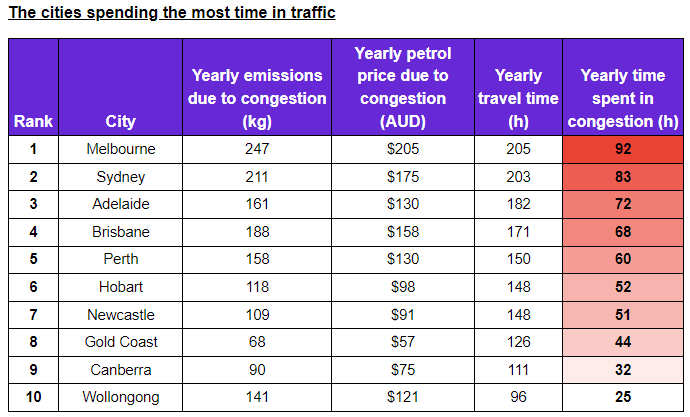
Sydney comes in second with 83 hours of traffic per year, according to the study, March 8th was the worst day for traffic in 2023, with 25 mins 10s to drive 10km, compared to the average of 22 mins for Sydney. City dwellers spent $175 on fuel last year due to congestion. Wednesday 5-6 pm is reportedly the worst time of the week to travel due to high traffic levels.
In third place, Adelaide spends 72 hours in traffic per year, equating to three days. The evening rush adds 10 mins to each 10km trip, meanwhile, the morning adds nine minutes. In Adelaide, Thursdays had the worst rush hour between 4-5 pm where 10km took an average of 25 mins to travel.
Canberra was the best of the mainland capitals with just 32 hours spent in traffic congestion.
Car drivers are reminded that rather than their vehicles being ‘in traffic’, they are traffic. Everyone pays the price for lack of genuine action on transport reforms.
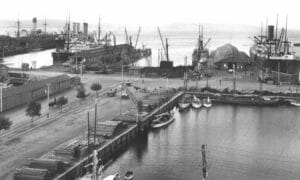
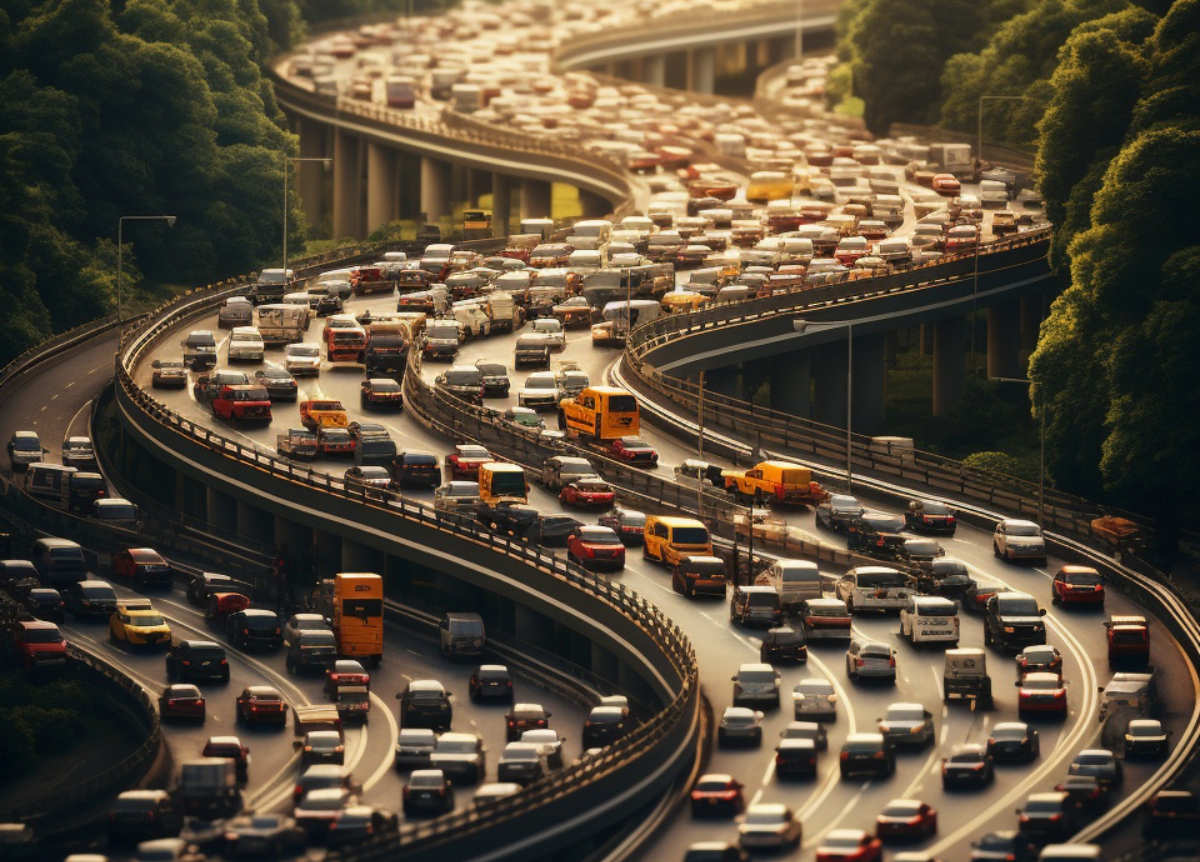
Despite the puerile clinging to 1950s transport thinking, so-called transport expert Bob Cotgrove’s daft lobbying for urban freeways will only create the kind of nightmare freeway congestion as shown above. They do everywhere else, so they will here.
Ask anyone, or ask yourself, what’s your favourite city centre feature? Franklin Square? The waterfront? The Mall? Salamanca? The Cenotaph? Hunter Street? I’ve yet to hear anyone say Sultan’s multi-storey car park.
Cities should not be traffic sewers. Cities are, after all, where things stop. People stop to work, study, dine with friends, attend cultural venues. Boats stop to unload goods and passengers. Leaders stop to gather, trade, plan and decide.
The bustle of great cities is the combined buzz of footfall, culture and ideas, not a slow-moving stodge of mobile cages delivering one prisoner each (with bonus serve of toxic exhaust and tyre particles).
A much more coherent and plausible vision of modern transport for Hobart was launched by the RACT five years ago.
Go on, read it and undertand it. Or at least watch the video summary (see below). Apart from a small amount of progress on River Derwent ferries, most of the good ideas are yet to be seriously addressed.
The transport planning alone is a complete mess. What planning? Who honestly knows what our transport is going to look like in 25 years? If we don’t know what we want to build, how will we get there?
When will Hobartians wake up and demand a transport system that is fit for purpose, not ‘just roads’?
Methodology
The locations covered in this study include Melbourne, Sydney, Adelaide, Brisbane, Perth, Hobart, Newcastle, Gold Coast, Canberra and Wollongong. Not all areas are covered in this study due to data availability.
Traffic data was obtained from navigation app Tom Tom. All data was collected on 9 September 2024 and is subject to change.
Alan Whykes is Chief Editor of Tasmanian Time and gets around by bicycle, car, public transport and on foot.