
When writing of the high level of corporeal punishment prevailing in Tasmania during the 1830s, eminent historian Manning Clark mentioned a violent incident, and its outcome:
Three men in a chain gang, who had been sentenced to be flogged, attacked the flagellator and cut his throat. Another flagellator promptly flogged the men, who were later tried, convicted and executed.
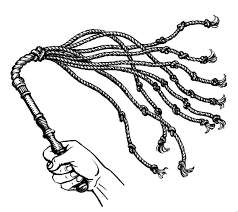
Given the huge scope of Clark’s five volume work, he simply moved on. But what were the circumstances of this incident, which took place on Tuesday 10 August 1830? Who were the three men involved and what were the consequences for each of them? In addition, another man was involved, Constable Phillip Clarke—what happened to him?
As background, corporeal punishment inflicted upon male convicts in that era aimed for discipline and reformation. However, in Australia, a convict’s master could not decide to apply the whip – as occurred in America. Instead, a legal process had to be followed whether the convict worked on private assignment or for the government, albeit, where flogging was more frequent. Also the legal system favoured the citizen; if a convict was sent to the local magistrate they were likely to come before the master’s or mistresses’ neighbour, and the jurymen, if any, might be likewise!
Regarding the underlying principle of penal discipline, historian Henry Reynolds, wrote:
violence was central to the system and … its purpose was to instil a sense of communal terror. The minority of heavily punished convicts were not just unfortunate victims who fell by the wayside, they were necessary for the whole system, which needed backs to bloody, bodies to weigh down with chains and necks to snap on the gallows.
Reynolds also cited a settler named, George Hobler, who sought ‘subordination and civility’ from his convicts. To achieve this Hobler would have someone flogged ‘now and then’ to ensure he ‘extracted a fair proportion of labour’ from his labourers in return for making them ‘more comfortable than honest labourers at home’.
The source of Clark’s story appeared in the Hobart Town Courier on 14 August 1830. It reported the stabbing of the flagellator, noting that indeed another scourger went on to inflict the ‘cat-of-nine-tails’ on each of the three convicts, 25 times;
A horrible attempt at murder was made on Tuesday morning. William Carlow, the flagellator, and Constable Clarke, were conducting three men to the chain gang at the [Hobart] Battery who had been sentenced to be flogged. When they had nearly reached the spot one them named [William] Wilson, going behind Carlow, suddenly seized him by the head and with a sharp knife endeavoured to kill him by cutting a large gash in his throat, while another named [James] Mountshire tried to stab the constable in the side. They all turned and ran off, but were speedily caught, and after undergoing their sentence, were committed to gaol to be tried for the attempt to murder.
The unnamed third convict involved was Edward Wise, and all three of them had refused to work, which was classed as ‘insubordination’, hence the impending flogging. Even so, another local imprint, the Colonial Times, reported that they were being marched back to the hulk Sophia, which had recently been readied to accommodate convicts working on creating Salamanca Place.
Knowing what was coming, Wilson apparently asked Carlow to ‘give it to them as easy as he could’. But Carlow refused, explaining that he ‘must do his duty’, because if he was seen to hold back then he could be flogged himself! At which Wilson drew a ‘large clasp [folding] knife from his pocket’ and ‘exclaiming with an oath that if he would not give it them softly, he would not not give it them at all’. He then cut Carlow’s throat, leaving him in a ‘dangerous state’.
Thankfully, on 27 August, the Tasmanian reported that Carlow was ‘perfectly recovered’, thanks to the skill of two local surgeons. The newspaper added that the medical men had found the ‘cut to extend completely across the throat, which it had separated in a frightful manner.’ Their surgery had been successful, ‘without the slightest inflammation’, and within twenty four hours ‘Carlow was entirely out of danger, indeed in rapid progress of recovery.
William Carlow, had been born in Portsmouth in 1801, and worked as a painter and glazier until transported for life for burglary in 1824. After arriving on the Woodford, perhaps his employment as scourger came about because the ‘fore and middle finger’ of an unnamed hand were ‘crippled’. Yet, soon after this near-fatal episode he was made a javelin man [prison guard].
Cutting short a lengthy record of incidents, Carlow had been made a constable in the Field Police for a short time in 1828, but suffered the treadwheel for two weeks in 1829 for being AWOL. In 1833 he gained a seven year sentence for stealing a wine bottle, yet, he was again used as a flagellator of his fellow convicts. He also suffered time on the treadwheel and or at hard labour in chains. In addition, one period of 30 days solitary was divided into three ten day stints, separated by one week each.
Worse was to follow; in 1836 Carlow was found guilty of forgery and gained another life sentence. Yet even at Port Arthur he was the flagellator once again, although he too was whipped for misconduct. After an early release, by 1844 he was a constable again – only to be just as soon dismissed. A ticket-of-leave was issued to him in 1849, but in 1858 Carlow was again sentenced to spend three years at hard labour in chains.
Despite receiving yet another ticket in June 1860, by November he earned twelve months hard labour for absconding – ticket holders had to regularly report to the police. In 1862 he again attempted forgery and received three more years at Port Arthur. Carlow’s final certificate of freedom was issued in June 1866. But he was soon back, admitted to Port Arthur’s Pauper’s Depot in February 1867. Where he was described as ‘almost helpless for years’, he died there in 1872.
Returning to the ensuing trial, held on 25 September, it was heard before a seven-man military jury, because citizen juries were still years away. There were eight witnesses, including Clarke, and Carlow himself, with Wilson formally charged with ‘intent to murder’. Although, in the end he was found guilty of only ‘cutting and maiming’. Mountshire was found not guilty of stabbing Clarke, but guilty of ‘aiding and abetting’ Wilson. Edward Wise, was acquitted, as uninvolved in the violence.
As was common then, on 8 December Chief Justice Pedder finally handed down dozens of sentences. About Wilson and Mountshire, whom he described as ‘deluded men’ for asking for an easy flogging, Pedder said;
[They] required his particular notice, … for in this instance, it was the peculiar atrocity of the act which called for… the severest penalty of the law. At one point of the trial, although he could entertain no doubt of the extreme degree of guilt attaching to Wilson, he had felt some slight hope that Mountshire might not be found a full participator in the horrid and wanton outrage that had been committed; but a Jury, after a patient and impartial investigation, had come to the conclusion that he was equally guilty, with the man who struck the murderous blow, … it must not be forgotten, that Mountshire was found with his knife prepared and ready, at the very moment that Wilson had used his, with a murderous intent.
Pedder then went on to criticise Wilson and Mountshire for attacking Carlow, who was ‘the mere instrument of their punishment; and that too, not by his own choice’. Actually, Carlow had been the recognised flagellator of his fellow convicts, since, at least, 1829 – and was again the scourger in later years.
Pedder ‘exhorted the two prisoners to prepare for the doom that the horrid barbarity of their conduct had entailed upon them.’ In reply, Wilson sought to mitigate his actions, saying that he had been ‘driven to a state of desperation’ because ‘he had not been furnished with shoes for upwards of a twelve-month previous to his refusal to work’. His plea was ignored.
Back in their cells, Wilson and Mountshire waited until 23 December to learn that the Executive Council had decided that only one of them would have their sentence commuted. Somewhat of a qualified Xmas present, Mountshire was instead to be ‘pardoned on condition of transportation for life’. In the colonial era this meant a minimum of fourteen years. On the other hand, it was decided that Wilson’s death sentence was not to be ‘interfered with’.
While Carlow, the victim of this violence, was obviously no saint, what of the three convicts involved? William Wilson, from York, was a 26 labourer when sentenced to 7 years transportation in 1824 for stealing a silk handkerchief. He arrived in Tasmania on the Lady East. Even earlier, before his transportation he had been a soldier, but for attempting to desert, he received 500 lashes.
However, obviously craving freedom, Wilson repeatedly absconded, and so received frequent floggings – seven times; 25, 25, 25, 50, 25, 50, 25, 50 lashes. One such whipping of 25 lashes was for breaking his irons and trying to escape, and another 50 lashes for breaking out of gaol! Reason enough to ask Carlow to go easy on him for his eighth flogging…
James Mountshire, a brickmaker, who had been transported for life for stealing two blankets, arrived on the Bengal Merchant in August 1828. Even before this he had been imprisoned in England, where he was whipped, and was soon in trouble in Tasmania. As early as December 1828 he gained three months on the chain gang for neglect of duty and using insulting language. During a stint in leg irons, in May 1829 Mountshire attempted to escape, only to earn 50 lashes. Several other misdemeanours saw him spend two weeks on the treadwheel, followed by more lashes, and yet more stints on the treadwheel.
Mountshire also worked hard labour on the ‘water cart’ and on the ‘charcoal gang’. After relocation to the Sophia, he joined Wilson and Wise in refusing to work. Hence being marched back to the hulk to be flogged ‘in the presence of his gang’ – as a supposed deterrent to them. To conclude his brief profile, Mountshire’s record notes other punishments. Such as, being sent to Grass Tree Hill road gang, even though his ‘crime’ [taking money from another convict] was dismissed. Finally, in 1845 he was imprisoned for two months – reason unknown.
Edward Wise was transported for seven years for stealing wearing apparel, and arrived in Tasmania in 1825 onboard the Lady East – as did Wilson. A ‘shoemaker’s boy’, he was only 14 years old, but because Point Puer – for juvenile prisoners – was still a decade away, he received no separate treatment. In fact, he had been flogged for ‘blasphemous language’ while onboard a British hulk even before his transportation.
The first misdemeanour on his Tasmanian convict record was only a reprimand for missing the compulsory church muster. But things got worse for Edward. In early January 1826 he received 25 lashes for ‘disobeying orders’. Then in May he was put on the chain gang for three months for absconding, and in June 1830 received 50 lashes for inciting fellow prisoners to ‘ill-treat’ another convict. He was also sent to the St Peters Pass road gang before being relocated to the hulk Sophia.
However, even though Edward’s role in the ensuing violence was minimal, his convict career went downhill, being immediately put back in leg irons. Next, from November 1831 he repeatedly absconded from the chain gang, and so was sentenced to transportation for life. Escaping again, a detailed description of Wise was published as a runaway, with a £2 reward for his apprehension. Once recaptured, he was sentenced to be hanged.
But, in April 1832, Wise got lucky – again. Chief Justice Pedder advised the Executive Council that he doubted that the death sentence was correct for merely absconding. And so a month later Lt-Governor Arthur concluded that Wise was ‘not legally convicted’ of a capital crime. Instead of execution he was to be sent to Norfolk Island for life – but, given its bad reputation, was this actually luck…
Returning to Wilson, his execution is noted on his convict indent. On Christmas Eve 1830 the Colonial Times wrote about two executions, and concerning Wilson it noted that;
At about a quarter past 8 o’Clock, this morning, the dreadful sentence of the law was carried into execution upon the bodies of two misguided criminals, the trials of whom we fully noticed in a late number; Wilson was found guilty of an attempt to murder a person named Carlow, a flagellator, while in the execution of his duty; … Up to the last moment of their lives, these unfortunate men appeared penitent and resigned to their fate, and ascended the fatal platform with great firmness.
To strike a lighter tone; as asked above, who was Constable Phillip Clarke? He too was a serving convict, although quite surprising in Clarke’s case. As a 21 year old weaver from Manchester, he has been transported for life in 1823 for highway robbery, which was a capital offence. And his gaol report describes him as ‘one of the worst characters’. Once in Tasmania he initially worked in the hospital, but for being AWOL he was dismissed and sent to the ‘Paddock Gang’.
For several other incidents Clarke was, merely ‘reprimanded’ or ‘admonished’, including drunkenness, which usually invoked the lash. But in April 1829 he was caught breaking and entering, for which he suffered 50 lashes and two weeks on the treadwheel. Later that same year he suffered 25 lashes for setting a dog on some sheep. Made worse perhaps because the sheep were owned by Lt.-Governor Arthur!
Sometime later Clarke became a constable, and married in December 1831. The couple were obviously both illiterate, as Phillip and his bride, Sarah Hurst, [transported on the Mellish], could only place their mark ‘X’ on the marriage documents. In mid-1835 Clarke received a conditional pardon, and gained his Free Certificate in July 1840, after which the couple left Tasmania for Victoria.
Finally, as quoted above, Manning Clark suggested that three men were executed, but, in fact, only William Wilson suffered the ultimate fate. James Mountshire and Edward Wise, were luckier – at least initially. True, Carlow, the flogger, was saved by the surgeons, only to have his convict record lengthen thereafter and die a pauper.
Terry Newman was the Parliamentary Librarian, publishing works including Becoming Tasmania; renaming Van Diemen’s Land. Since retirement he continues researching convicts and colonial citizens of Tasmania. Recent items include a story in the 2018-19 Van Diemen History Prize and three on the Female Convicts Research Centre website.