
Greg Pullen’s opinion article ‘Massaging the Marinus Message’ (Tasmanian Times 18 April 2023) makes some good points. All in all, he sees the project as a potential white elephant.
His main points – if I read him correctly – include the uncertainty of mainland Australia needing Tasmanian electricity when it could produce it cheaper itself; the inefficiency of converting electricity to hydrogen or ammonia in Tasmania (and possibly elsewhere); and the environmental cost of many more privately owned wind turbines and public transmission lines so Tasmania could export electricity.
Adding to all this uncertainty is the further uncertainty of the cost-sharing arrangement of the Marinus cables and therefore payback times. These cables also have a limited lifespan.
A better alternative would be for Tasmania to focus on a non-polluting and self-sufficient energy system in the knowledge that we need to stop running transport and agriculture on imported fossil oil and gas.
Pullen is hinting the whole time that the Marinus profit-oriented business venture is the wrong approach to an essential service like electricity – and I strongly agree with that point.
My long-held view is that essential service like electricity should not just be government owned but should be run for the benefit of the community at the lowest cost rather than by a government corporation that seeks profits for governments to subsidise other things.
There is a strong case that such essential services are better left to the Australian government with its unlimited fiscal power (see below) rather than cash-strapped state governments that are never adequately funded.
But even before we go down that road we should be formulating an overarching plan for a sustainable society in the context of the many existential threats we currently face.
These threats include catastrophic climate change; the biodiversity crisis; and the other seven ‘planetary boundaries’ that Earth System scientists say we shouldn’t cross (fresh water use, toxic chemicals, phosphorous use, etc). Then there is the nuclear war threat.
The Tasmanian government seems to have no plan to create a sustainable society and arguably doesn’t even ask what that would look like – or how high the risk of collapse now is.
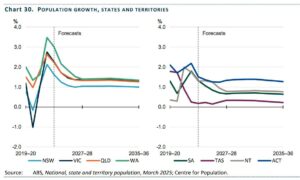
Its priorities seem to be increasing the size of the Tasmanian economy (measured by Gross State Product) and the Tasmanian population in the blind faith that that is how we always achieve progress or wellbeing.
Rather, increasing economic growth and the population will mean more energy use and more environmental destruction – if the federal State of the Environment Report 2021 has any credibility. Increasing general wellbeing and happiness is a different thing and is not dependent on endless and ultimately destructive growth.
Put another way, mainstream economics and its blinkered view on growth as the only viable option is both dangerous and wrong.
That is the correct context in which to view the Marinus Link and its assumptions that we still live on a planet with endless resources that we can exploit indefinitely. And who cares about non-human sentient creatures if they are in the way?
It is as if politicians and their advisers never learn.
As we detail in the book Sustainability and the New Economics (Springer, 2022) we have had 50 years of warnings about the coming collapse due to unsustainable growth. These warnings have been confirmed by further research time and again.
Even without scholarly research, it must be obvious to the average person that the promise of the post-World War II hyper-industrial expansion has come at a shocking cost to both the natural and built environments and the new promise of ‘green growth’ is an illusion that never materialises.
Even in the narrow sense of non-fossil fuel energy sources such as solar and wind (and electric cars) there is massive uncertainty about the available resources needed to build the gigantic global infrastructure (and replace it every 25 years). The work of metals and resources expert Dr Simon Michaux is relevant in this regard and his opinion is increasingly being sought by national leaders.
As Dr Mark Diesendorf outlines in our book, non-fossil energy sources (mainly wind and solar) are not replacing fossil fuels fast enough because they are chasing a receding target because of energy demand growth via economic growth.
The solution is to curtail the size of human societies in proportion to available resources – sustainably used. That is already happening to some extent in many high-income nations and is a necessary condition to improving general wellbeing.
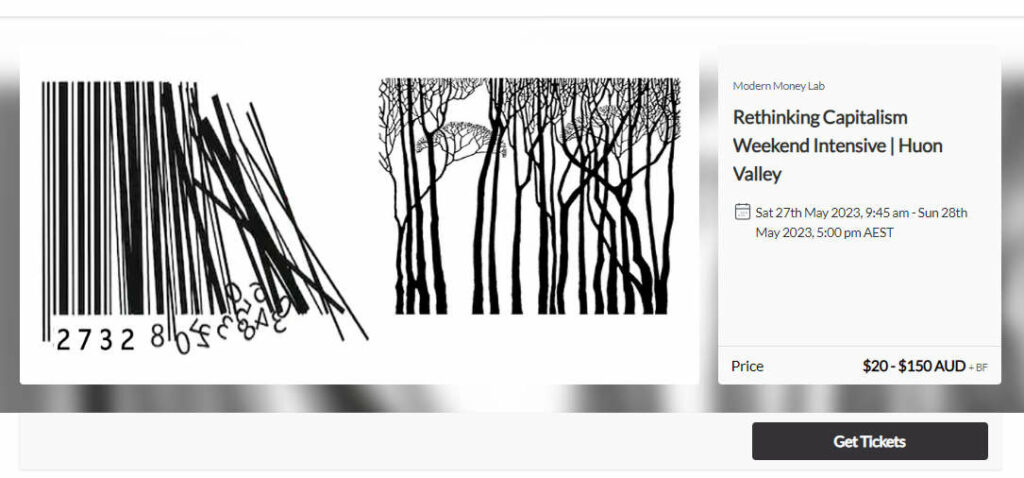
As to how the economics of this would work – achieving full employment, low inflation, manageable debt, trade balances, sustainable government finances etc – those in Tasmania’s south can come to a weekend workshop at Ranelagh on 27-28 May 2023 to hear economist A/Professor Steven Hail of Torrens University explain how modern economies actually work and how governments like the Australian government can never run out of money – although we can easily run out of resources and collapse.
Tickets and further information: https://circulareconomyhuon.org.au/
Stephen Williams is a Tasmanian journalist and author. He is co-editor of the book Sustainability and the New Economics (Springer, 2022). He is also a committee member of Circular Economy Huon.