With local government elections due later this year, we thought we’d offer some tips for candidates on dealing with the media.
This is not about campaign strategy as such – that’s up to you! – although there is a bit of overlap. Anyway here’s a short guide to perhaps get the best kind of exposure for your campaign.
Launch? – Unless you are a high profile candidate (or party endorsing candidates) running for one of the major councils – Hobart, Launceston, Devonport, Burnie – it is unlikely any media would attend a launch. If you want to hold a launch event for your supporters and so on, that might still be a good idea.
Photo – Have a photo of you available, or better still a few. Avoid the grim passport-style photo. Without being too hokey, get a photo with something that gives you a bit of context. If you are a cafe owner, for example, get a photo inside or in front of the cafe.
Brief – Describe yourself briefly. A paragraph is probably sufficient, say a hundred words. Say something interesting that reveals your character. Make sure it is well-written; if this is not your strength, find a friend to proof-read and edit it for you.
Be yourself – Any material you put out should be authentically you. Don’t ‘try for a look’ that just isn’t you, or venture into areas where you aren’t confident. Close your eyes and try to picture Jacqui Lambie: can you picture her, and describe her character to someone else? Of course you can. So there you have it.
Media release – Yes do send out a media release announcing your campaign. It should give a little background (see Brief above), then have some direct quotes about issues that matter to you. Avoid being vague: “I’m concerned about housing” doesn’t tell anyone whether you think there’s too much or not enough, what you’d do about it, and so on.
You should raise what you see as being the main issues of the election. Try to avoid sloganeering. See also the sample media release at the bottom of this article.
Approaching journalists – Send end out your media release by email to chosen journalists. Send it as text in the email, not as an attachment. No, we are not going to give you a list of media emails, and we do not suggest you send it to every email you can find. The reality is that there is very little coverage of local government in Tasmania. Find the few journalists and publications who are interested and phone the reception of their organisation to get a contact. If your local radio station for instance doesn’t cover council issues there is no need to bug them.
Tuesday, Wednesday and Thursday are good media release days. Time your send for 8 or 9 in the morning so it’s still high in the inbox when a journalist gets to work, but before they head out.
Don’t ‘follow up’ your media release with a phone call, that’s just rude and unnecessary. Don’t offer to meet for coffee, etc.
Stunts & Gimmicks – Unless you are experienced at this type of campaigning, we would suggest not concocting stunts to try to attract media attention.
Prepare – Get answers ready for issues you might be asked about. This is good practice anyway for dealing with voters, and having an effective presence at candidate forums, but essential for dealing with media.
Issues – You are probably more likely to garner coverage if you step up on topical issues. Keep an eye/ear on current affairs and what is going on in council meetings. Find an issue that is getting media coverage and send out a statement with your position. Note that time is often of the essence. For example if a council has a hot debate at a Monday night meeting and the issue is clearly controversial, don’t wait until Friday to send out your statement.
Finding allies and making joint statements is also a tactic you might consider. You can also add your issues statements to your social media channels and your website if you have one.
Pursue opportunities like letters to the editor, live talkback radio and so on. The more often you have a go, the more likely you are to get some space.
Don’t fudge on difficult issues. Politics is where decisions are made, not avoided. Even if they disagree with you, people (voters) appreciate knowing what you stand for.
Social media – You should focus on perhaps two social media platforms, selected on the basis of the voters you think you can attract. Twitter has a politically active crowd, but lower user numbers than other major platforms. Facebook has a lot of users, but increasingly the active ones are ‘older’ and young people are elsewhere. Instagram, Snapchat and TikTok skew more heavily to that demographic, but you need to be good with visual material to be effective there.
Sharing – If you do appear in a media story, share it. Sharing is nice 🙂
We’re not, as Tony ‘Onion’ Abbott might have said, the suppository of all wisdom. So if you have other insights, please share them with us.
Media release – Martin Cash, independent candidate for Glenorchy City Council, 14 June 1862
Time for Glenorchy to Cash In
Former bushranger Martin Cash has announced he is standing as an independent candidate for the Glenorchy City Council.
Cash believes his experience will be an asset to a council that has struggled with poor management.
“I’m a man of action,” Cash said. “The people out there know that. If they want a fighter in their corner, I’m their man.”
Cash was born in Ireland but has lived in Australia since he was 20. Apart from Tasmania, he has also lived in New South Wales and Norfolk Island, and in New Zealand where he managed several businesses.
Although best known for escaping from Port Arthur across Eaglehawk Neck, Martin Cash has a genuine affinity with the common Tasmanian in these difficult times.
“It’s not been easy being an ex-bushranger,” he said. “It’s been tough. I know what it’s like. We’re all struggling with housing costs, transport expenses, the availability of good social services.
“These are basic issues and I believe Glenorchy can do a lot better. The main problem is not enough revenue for the council; we need simply need more cash in. I will push to introduce metered parking for horses, to improve the revenue side of the budget.
“There other major problem is expenditure waste. I will also ask every ratepayer to provide a suggestion as to how we can improve efficiency. I will listen, then act.
“I stand for accountability and fairness. And I want change, because it’s time for change. These gentlemen in their smoking jackets have all been there far too long.
“I know about change because I’ve changed. I’ve been bad, and I fixed my life. I can do the same for this council, which badly needs some fixing.”
Martin Cash is married with one child, and lives in Derwent Park where he enjoys tending to his garden and reminiscing about avoiding the gallows.
Martin Cash is available for interview in person or by email or telephone, when invented over a hundred years later: [email protected]; 0400465387 (0400HOLDUP).
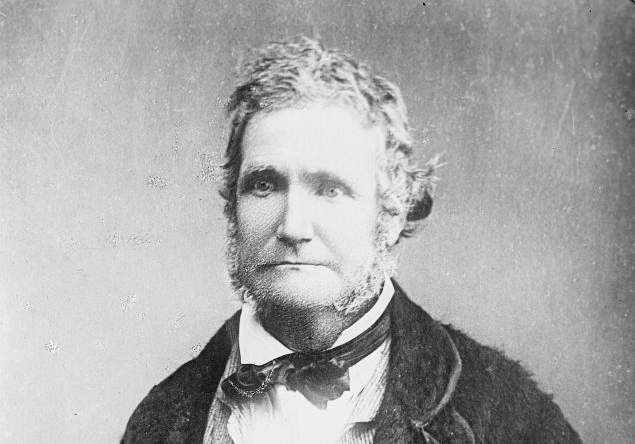
Featured image above: Martin Cash, who really could have used a better candidate photo.