Media release – Neighbours of Fish Farming, 5 March 2022
Gutwein’s Garbage
UN’s global plastics treaty signs another death knell for industrial salmon farming.
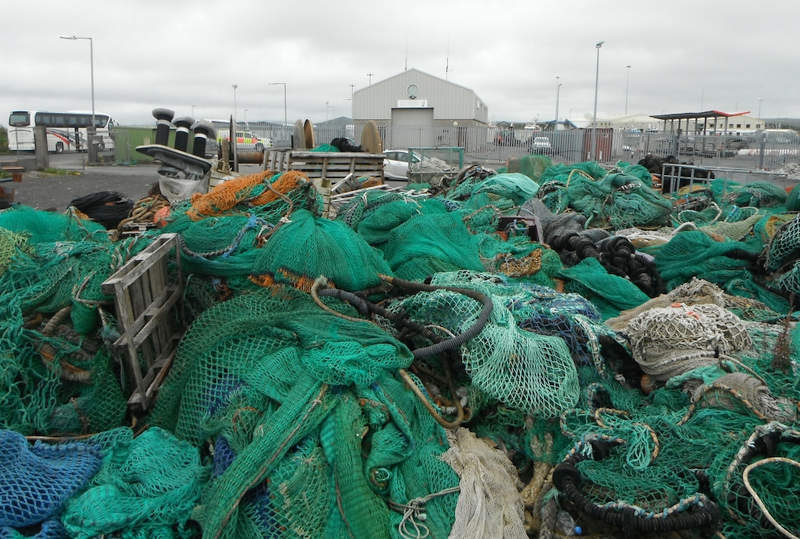
Tasmanian salmon farms reported a whopping ninety cubic tonnes of plastic marine debris from their industrial salmon cages in 2021 alone. The industry plans to install hectares of additional plastic netting downstream of each farm.
All Tasmanians should be sceptical of any promises made by the industry to manage their marine plastic, where a culture of mismanaged offcuts allows debris to enter the water ways.
The UN Environment Assembly’s (UNEA) announcement yesterday to create a global plastics pollution treaty is the most significant environmental deal since the Paris accord. It will have serious consequences on economies and businesses around the world, including for the Tasmanian salmon industry.
“Plastic pollution,’’ the UN stated, “is a planetary crisis on par with climate change and biodiversity loss.”
The treaty, to be enacted by 2024, includes legally-binding policy covering all levels of plastic manufacture, use and disposal in business and industry, the world over.
NOFF secretary, Glenn Sanders, says the industry’s contribution to plastic pollution needs careful monitoring by regulatory authorities that have shown little interest in the industry’s impact on Tasmanian waterways. Legislation offers token fines for large debris only and this is not satisfactory.
Users of Tasmania’s once-pristine beaches and waterways can testify to aquaculture debris being found far from fish farms. Token clean ups on popular beaches while debris ends up on remote coastal locations is not a real plan.
While the world is looking urgently for a plastic solution, the Tasmanian Government is ever-ready to listen to the excuses and hollow promises of an industry steeped in secrecy and collusion.
“The salmon industry watchdog says the industry’s heavy reliance on plastic from the construction of its salmon cages to the ropes and other infrastructure are a major cause of large and small plastic debris and a source of micro plastics as lost and deteriorating equipment disintegrates.
“The salmon industry’s reliance on plastics in its equipment is one more reason what this industry is so damaging to Tasmania and to the state’s reputation,” Mr Sanders says.
Premier Gutwein has chosen to ignore the mountain of plastic debris piling up every year—disintegrating rope that finds its way into the stomachs of birds and fish, netting that catches and drowns whales and dolphins, and huge lengths of heavy poly pipe: a serious hazard for boats large and small, especially at night. There is no reporting currently required for vessel altercations. This is a major safety breach and doesn’t serve the boating community of Tasmania.
Mr Gutwein should seriously consider the legacy of his leadership of the state of Tasmania while the world looks to solutions to the most significant environmental crisis ever faced. It is time to acknowledge that fully land-based operations— increasingly used overseas— are the only solution to keeping plastics and further damage out of our waterways.
Media release – UNEP, Nairobi, 2 March 2022
Historic day in the campaign to beat plastic pollution: Nations commit to develop a legally binding agreement
Heads of State, Ministers of environment and other representatives from 175 nations endorsed a historic resolution at the UN Environment Assembly (UNEA-5) today in Nairobi to End Plastic Pollution and forge an international legally binding agreement by 2024. The resolution addresses the full lifecycle of plastic, including its production, design and disposal.
“Against the backdrop of geopolitical turmoil, the UN Environment Assembly shows multilateral cooperation at its best,” said the President of UNEA-5 and Norway’s Minister for Climate and the Environment, Espen Barth Eide. “Plastic pollution has grown into an epidemic. With today’s resolution we are officially on track for a cure.”
The resolution, based on three initial draft resolutions from various nations, establishes an Intergovernmental Negotiating Committee (INC), which will begin its work in 2022, with the ambition of completing a draft global legally binding agreement by the end of 2024. It is expected to present a legally binding instrument, which would reflect diverse alternatives to address the full lifecycle of plastics, the design of reusable and recyclable products and materials, and the need for enhanced international collaboration to facilitate access to technology, capacity building and scientific and technical cooperation.
The UN Environment Programme (UNEP) will convene a forum by the end of 2022 that is open to all stakeholders in conjunction with the first session of the INC, to share knowledge and best practices in different parts of the world. It will facilitate open discussions and ensure they are informed by science, reporting on progress throughout the next two years. Finally, upon completion of the INC’s work, UNEP will convene a diplomatic conference to adopt its outcome and open it for signatures.
“Today marks a triumph by planet earth over single-use plastics. This is the most significant environmental multilateral deal since the Paris accord. It is an insurance policy for this generation and future ones, so they may live with plastic and not be doomed by it.” said Inger Andersen, Executive Director of UNEP.
“Let it be clear that the INC’s mandate does not grant any stakeholder a two-year pause. In parallel to negotiations over an international binding agreement, UNEP will work with any willing government and business across the value chain to shift away from single-use plastics, as well as to mobilise private finance and remove barriers to investments in research and in a new circular economy,” Andersen added.
Plastic production soared from 2 million tonnes in 1950 to 348 million tonnes in 2017, becoming a global industry valued at US$522.6 billion, and it is expected to double in capacity by 2040. The impacts of plastic production and pollution on the triple planetary crisis of climate change, nature loss and pollution are a catastrophe in the making:
- Exposure to plastics can harm human health, potentially affecting fertility, hormonal, metabolic and neurological activity, and open burning of plastics contributes to air pollution.
- By 2050 greenhouse gas emissions associated with plastic production, use and disposal would account for 15 per cent of allowed emissions, under the goal of limiting global warming to 1.5°C (34.7°F).
- More than 800 marine and coastal species are affected by this pollution through ingestion, entanglement, and other dangers.
- Some 11 million tonnes of plastic waste flow annually into oceans. This may triple by 2040.
- A shift to a circular economy can reduce the volume of plastics entering oceans by over 80 per cent by 2040; reduce virgin plastic production by 55 per cent; save governments US$70 billion by 2040; reduce greenhouse gas emissions by 25 per cent; and create 700,000 additional jobs – mainly in the global south.
The historic resolution, titled “End Plastic Pollution: Towards an internationally legally binding instrument” was adopted with the conclusion of the three-day UNEA-5.2 meeting, attended by more than 3,400 in-person and 1,500 online participants from 175 UN Member States, including 79 ministers and 17 high-level officials.
The Assembly will be followed by “UNEP@50,” a two-day Special Session of the Assembly marking UNEP’s 50th anniversary where Member States are expected to address how to build a resilient and inclusive post-pandemic world.
NOTES TO EDITORS
- Quote from the Government of Japan: “The resolution will clearly take us towards a future with no plastic pollution, including in the marine environment,” said Tsuyoshi Yamaguchi, Japan’s Environment Minister, whose draft resolution contributed to the final resolution. “United, we can make it happen. Together, let us go forward as we start the negotiations towards a better future with no plastic pollution.”
- Quote from the Government of Peru: “We appreciate the support received from the various countries during this negotiation process,” said Modesto Montoya, Peru’s Minister of Environment, whose draft resolution, proposed with the Government of Rwanda, contributed to the final resolution. “Peru will promote a new agreement that prevents and reduces plastic pollution, promotes a circular economy and addresses the full life cycle of plastics.”
- Quote from the Government of Rwanda: “The world has come together act against plastic pollution – a serious threat to our planet. International partnerships will be crucial in tackling a problem that affects all of us, and the progress made at UNEA reflects this spirit of collaboration,” said Dr Jeanne d’Arc Mujawamariya, Rwanda’s Minister of Environment. “We look forward to working with the INC and are optimistic about the opportunity to create a legally binding treaty as a framework for national ambition-setting, monitoring, investment, and knowledge transfer to end plastic pollution.”