Transcript of address – Susie and Wei Cai 30 November 2021
Suzie Cai’s Address to Planning Commission re Gorge Hotel Proposal
Thank you for giving me the opportunity to address the Tasmanian Planning Commission.
I would like to start by thanking the Commissioners for the difficult and important role they have in Tasmania’s planning system. Planning is complex, and trying to achieve good planning outcomes while balancing competing interests is not an easy job, so I commend you for the work you do.
My husband and I contend that the Gorge Hotel Specific Area Plan does not meet the requirements of an SAP.
In our representation we approached this from two perspectives. The first is what we see as the broad purpose of a planning scheme amendment, and the second is in relation to the specific provisions of the Land Use and Planning Approvals Act or LUPAA.
What I would like to do in my submission today is outline the arguments we made in our representation, outline the response from the proponent and Council planning officers, and explain why we believe our arguments still stand.
Despite what has been put forward by the proponent and the council, we do not concede any of the arguments in our representation.
Let me start with broad planning objectives. For an SAP to be supported it needs to achieve a strategic planning purpose. The proponent needs to establish reasons why—in strategic planning terms—the site the SAP applies to needs to have a different set of rules to the remainder of the zone.
It is not good enough to seek to have an SAP adopted simply because you want the rules changed to support the development you are putting forward. The question—therefore—that a planning authority, or the Commission, needs to address is what are the unique characteristics of this site that need to be promoted or defended by the proposed SAP?
The question of uniqueness needs to be addressed because of the importance of maintaining a consistent approach to planning and development throughout the City of Launceston.
Obviously, Launceston City Council agrees, because a consistent approach to planning and development is one of the objectives in their Strategic Plan.
In their initial submission on the SAP, the proponent did not explain what these unique characteristics were.
If they did, it was buried deep somewhere in their 531 pages of documentation and we must have overlooked it, but you would think this would be an important argument for the proposed amendment and would have been made more prominent.
In response to our representation, the proponent argued that there were three unique characteristics to the site:
One—topography. They said that the site is at one of the lowest elevation points in the Tamar Basin which means it has the capacity to better absorb the additional height component than more elevated sites.
Given the area around the site is relatively flat, and is not obscured by any nearby elevated areas, I fail to see how this ‘absorption’ effect would happen. There is nothing unique about the topography of the site as it’s at a similar elevation to much of the surrounding area.
Two—the proponent said the site is largely vacant and encompasses a relatively large area of land titles within a single ownership without constraint by heritage built form which presents a unique opportunity for redevelopment. While I don’t claim to know a lot about the heritage constraints on other lots of a similar size, I think the rest of the argument is quite disingenuous.
The planning system should not give preference to developers according to ownership. And the planning system affords the same development potential to any site regardless of whether it is developed or undeveloped.
Three—the proponent said the site is located on the edge of one of the city’s premier attractions, being the Cataract Gorge.
If the issue here is access to views of the Cataract Gorge, it is worth noting that the entrance to the gorge sits on the edge of the mouth of the Tamar River, and this provides numerous vantage points from which the gorge can be appreciated.
As for visiting the gorge, given the ease of transport within Launceston proximity is not likely to be a big drawcard for visitors.
Unlike the proponent, Council planning officers did not attempt to identify these unique characteristics. Instead, their report argued that the implementation of an SAP does not rely on promoting or protecting the unique features of a site.
We disagree. How can you achieve a strategic planning purpose, if you cannot justify why an SAP should apply to the particular area it is proposed for, and why that area needs to receive a different planning treatment to the remainder of the zone?
If the area to which the SAP applies does not have unique characteristics, and the SAP does not rely on these characteristics, then the zone provisions should apply and the SAP is not justified.
A key argument that was put forward by the proponent in support of their proposed planning scheme amendment is that it resolves an inconsistency in the Tribunal’s interpretation of the planning scheme. As we explained in our representation, there is no inconsistency in the Tribunal’s interpretation between the Gorge Hotel decision and the GP (Fragrance Hotel) Hotel decision, and even if there was the proposed amendment does not resolve it.
I won’t repeat our arguments for this because they are made out in our representation. Neither the proponent, nor council planning officers have made any effort to rebut what we said on this point. But while they haven’t tried to rebut this point they haven’t conceded it either, so I’m highlighting it for the Planning Commission in the hope that you won’t rely on this particular argument from the proponent.
I will now turn to the specific requirements of an SAP as outlined in LUPAA.
These requirements make specific reference to economic impact, but also indirect reference to economic impact through the Northern Tasmanian Land Use Strategy and the provisions of Schedule 1 of the Act.
The economic benefits of the proposed Gorge Hotel are not in dispute. However, in our representation,we questioned why a similarly economically beneficial development could not be achieved on the same site under the existing provisions of the planning scheme.
The proponent’s response said that achieving the number of rooms needed with access to views and natural light was not achievable with a height of 12 metres. Reference to the acceptable solution of 12 metres is misleading, as they may still be able to propose a development with a height somewhere between the 12-metre acceptable solution and their proposed height which meets the performance criteria in relation to streetscape and character.
But why this site?
The economic question in relation to the demand for visitor accommodation needs to be seen as a city-wide issue. Visitors tend to travel around and spread their spending to multiple venues and attractions—their economic input tends not to be localised.
The simplistic argument that taller, or bulkier, buildings provide greater development potential and therefore more economic potential could easily be applied to any part of the city. But it also overlooks the fact that such developments would be allowed in some parts of the city because they would be in keeping with the streetscape and character. The GP (Fragrance Hotel) Hotel decision demonstrates this.
While the proponent has talked up the economic benefits of visitor accommodation on the proposed site, they have not addressed the potential for visitor accommodation developments of a similar scale throughout the city. The economic development potential they seek can be realised elsewhere, and the proposed site is not unique in its potential to derive economic benefit from visitor accommodation.
We made some comment in our representation about the potential social impact of the SAP, and the reason why maintaining streetscape and character is important for social outcomes. The proponent and planning officers have basically provided two arguments in response.
First, they argue that the area has no streetscape values and is of low urban quality.
This is an urban environment in which people live, work and recreate, whether they attend Launceston College, walk or play in the park or dine in our restaurant or other nearby restaurants. The depth of feeling expressed against this proposal from members of the public who enjoy this area indicates to me that they feel there are streetscape and character values worth protecting.
Failing to protect these values would have a negative social impact in terms of their enjoyment of the area. We do not accept that, for a development of such height and bulk as this amendment allows, the Council as planning authority should be relieved of the requirement to consider whether it is in keeping with the streetscape and character of the area.
The second argument, put by the planning officers, is that visitor accommodation uses by their nature promote social interaction, therefore the amendment would bring social benefits.
This may be true, but what they have failed to address is the variety of potential developments allowed under the existing provisions of the planning scheme that could also promote social interaction. In other words, a visitor accommodation development may promote social interaction, but it is not necessary to promote social interaction, nor is the proposed amendment.
In our view, the proponent has failed to justify abandoning the Performance Criteria in relation to maintaining streetscape and character for a tall, bulky development that fits within their proposed building envelope. In trying to justify the proposed SAP, the proponent claims that the Tribunal did not reject the Gorge Hotel proposal on amenity grounds. So they are implying that streetscape and character is not an amenity consideration.
Why were provisions for maintaining the streetscape and character of an area written into the scheme if not for the purpose of maintaining the pleasantness of the streetscape and therefore the enjoyment of the area for nearby residents and the general public?
This is clearly an amenity consideration.
Both the proponent and council officers note that a building of a particular height is rejected under the planning scheme because there are not buildings of similar height in the area, implying that this is some kind of deficiency in the scheme.
But this is exactly what these provisions set out to achieve—to ensure there are not buildings that in terms of their height, bulk and form dominate the streetscape, as this impacts on visual amenity and detracts from the attractiveness and pleasantness of the environment. And this amenity impact affects not just residents’ enjoyment of the built environment but that of the visitors the proponent is so keen on attracting.
I trust that the Commissioners will see this proposed SAP for what it is.
- It does not achieve a strategic planning purpose.
- It cannot be justified on economic or social grounds.
- All it achieves is facilitating a proposed development which was rejected for good reason by the Tribunal.

Newsletter item – Launceston Heritage Not Highrise, 6 December 2021
Gorge Hotel amendment
The Tasmanian Planning Commission’s Public Hearing into the Launceston City Council’s proposed change to the 2015 Launceston Interim Planning Scheme, Amendment 66 SAP (Specific Area Plan) was adjourned to a date yet to be decided, the hearing simply ran out of time to hear all those who wished to question or cross examine the proponent’s (JAC Group/Dean Cocker) expert witnesses.
At the commencement of the hearing Chairman John Ramsay advised the public hearing was being held in Launceston because of the very obvious public concern surrounding the issue which was good news: ‘your voice was heard’! Appreciation of the decision that the hearing be held in Launceston was expressed to the Chair at the conclusion of the second day, and it certainly was appreciated as it enabled so many of us to attend which would not have been the case if it had been held in Hobart.
The Tasmanian Planning Commission was represented by a panel of three lead by John Ramsay, Launceston City Council (the Planning Authority) was represented by Richard Jamieson, Iain More and their legal representative Glynn Williams and the JAC Group by Dean Cocker and their legal representative Shaun McElwaine plus their seven expert witnesses, all in all a formidable team.
A good turn out of LHNH Representatives was evident and they certainly made their presence felt with numerous questions/cross examinations.
Cross examination of some of the ‘expert witnesses’ certainly revealed some ‘very’ interesting information, for example:
- Under intense cross examination from Lionel Morell, Dr Wayne Griffioen of Tasman Geotechnics Pty Ltd admitted that building the proposed hotel on the soft silt sediment found at the site during their two 50 metre test bores drilled ‘would be challenging’.
- Photomontage expert witnesses Edmund Ng and Matt Walker when asked how much of the sky would be obscured in at least one of their excellent images responded anywhere between 30 and 50%.
- Alex Brownlie (planner) acknowledged a viewpoint from the new bridge was not included but could have been.
- Expert witness economist Mr Buckmaster, who had apparently conducted a survey in to the economic aspects of constructing the proposed hotel, acknowledged that hotel occupancy in Launceston was currently ‘very low’ and had been for the last couple of years but followed this up by advising the Launceston would require an additional 525 rooms by 2030.
- Expert witness Alex Brownlie for consultants GHD advised the proposed hotel would be ‘big’ and would ‘certainly change the character of the area’.
- Richard Jamieson of Launceston City Council advised, after somewhat denigrating the Margaret Street area (much to our disgust) that Launceston Council hoped ‘that if approved it might act as a catalyst for further such buildings’! This is not the way to bring about change to the area. Put it forward to the Launceston community properly Launceston Council – not by the stealth of this amendment.
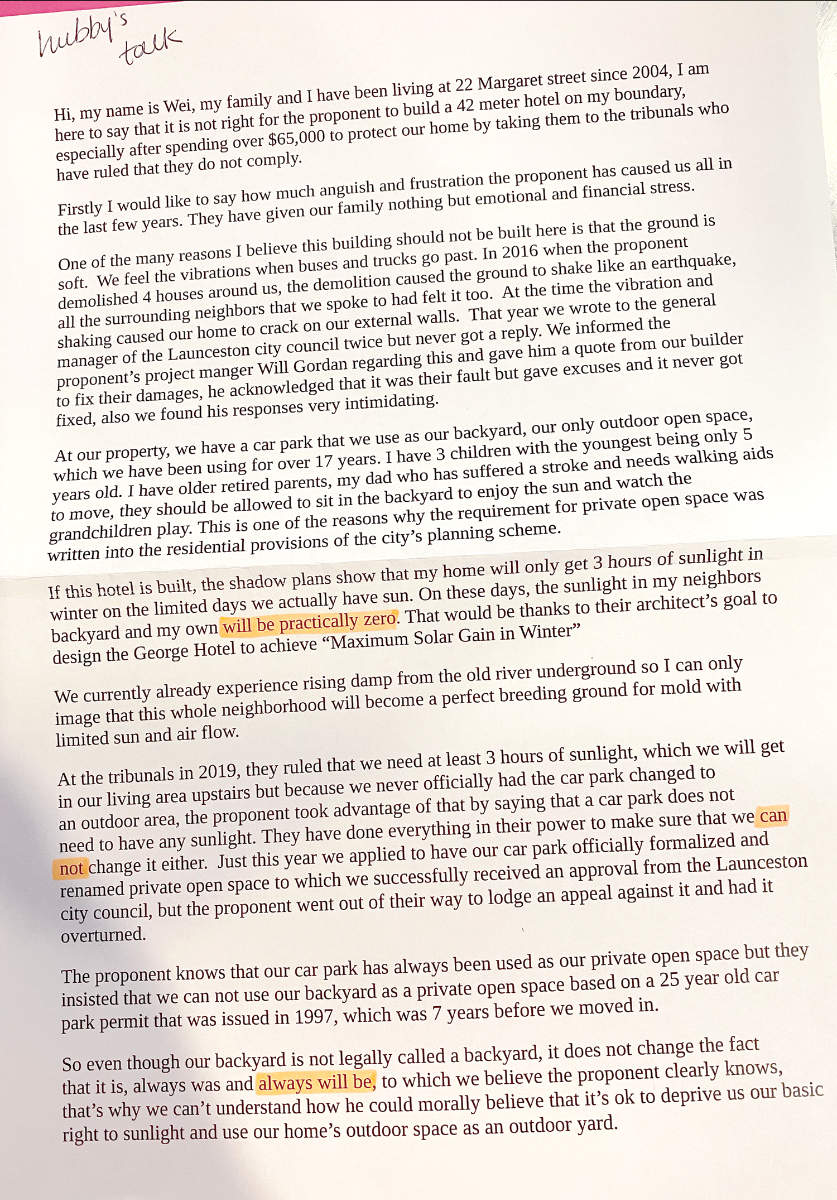
Day two concluded with a very passionate and heart-rending verbal representation from Susie Cai and her husband Wei in which she succinctly described the significant pressure the family had experienced from the proponent over recent years leaving no-one in any doubt how traumatic this had been for them providing plenty for the Commission to contemplate as they drove back to Hobart at the end of the day!
We have no idea when the hearing will resume, Shaun McElwaine asked the Chair if they would do their best to resume before Christmas to which the Chairman responded that they would but in reality, given all the circumstances, that will be very difficult so we’ll just have to be patient and wait and see what eventuates.
Given the Chair’s earlier comments regarding the reasons for holding the hearing in Launceston it would be wonderful if we could actually swamp the hearing location with as many bodies as possible to justify that decision. This may provide another opportunity for those representors who would like to speak in support of their representation so please give that some thought while we await advice of the date of the resumption.
If you were one of the 60 representors to the amendment you will receive notification of the new hearing date. If you were not, we will send out an email and you may request the Planning Commission permission to attend.
Overall we were pleased with the leeway given to attendees to ask questions and the patience shown to non-experts when we did so. Whilst the proceedings included planning speak not always easy for the concerned citizens in attendance, the panel fully understood their role in getting to the bottom of the matter both technically and by hearing from the community. The Planning Commission process is an important and precious part of our democratic planning process.
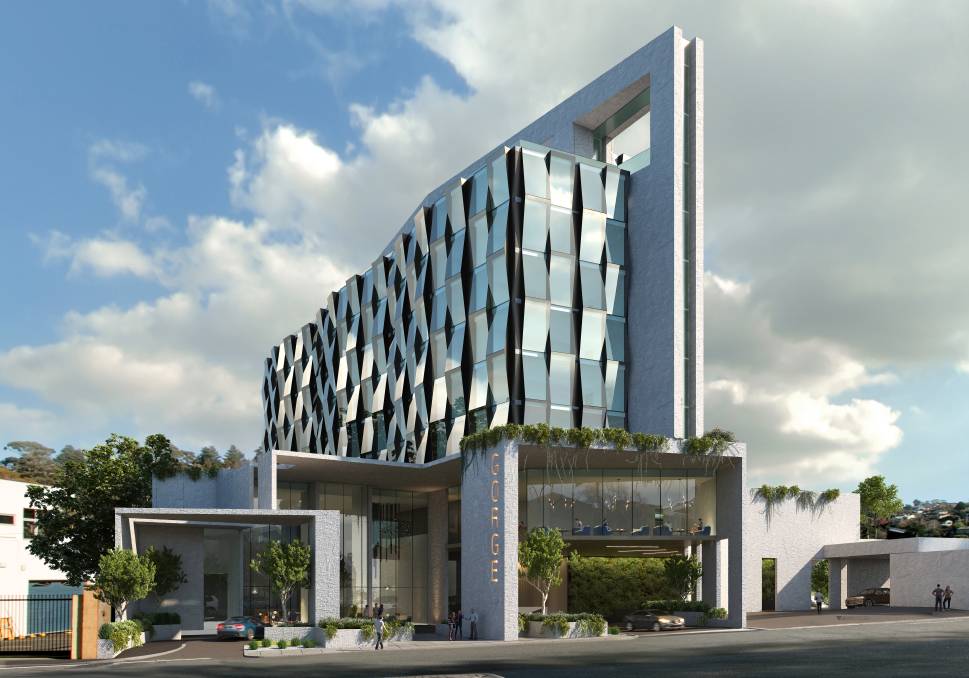
Lastly, observing Lionel Morrelin action was a learning experience for a number of us. And at times it was good to observe a witness being grilled by him. We even had one architect working live with their 3D model to fit the existing Gorge plans into the proposed amendment. It was this that enabled those present to actually see how the amendment would allow a bigger development than the George hotel pictures used in publicity for this amendment; we were left wondering why and what for?