For the budget outline, link to budget papers and the Premier’s statement, see here.
The below responses were posted in order received.

Statement – Tania Hunt, Youth Network of Tasmania (YNOT) CEO, 26 August 2021
Youth Peak Comments on State Budget
The Youth Network of Tasmania attended the Budget Community Group Lock-up before the release of the 2021-2022 Liberal State Government Budget on Thursday, 26 August 2021.
This Budget contains record investment by the Tasmanian Government to improve the health and wellbeing of Tasmania’s children and young people and will support the successful implementation of the Tasmanian Child and Youth Wellbeing Strategy Action Plan 2021-2025.
YNOT congratulates the Tasmanian Government for its commitment and future focus on our most important asset – our children and young people. We are particularly pleased to see targeted investment in supporting young people aged 16-25 years to navigate work, education and training in a COVID changed landscape through investing in youth navigators, youth connectors and the fit for work project. We are also pleased to see a significant investment in the areas of youth mental health, housing initiatives and youth participation and engagement activity.
Our young people deserve the services, supports, policy settings and opportunities to live a great life on their island home. This Budget is encouraging and will support us in working together for our next generation.

Media release – Cassy O’Connor MP – Greens Leader, 26 August 2021
Gutwein’s Band-Aid Budget
After eight years of underfunding health, housing, education, skills, and corrections, the Liberals have delivered a Band-Aid Budget. They continue to play catch up on key social infrastructure.
Once again Peter Gutwein’s Budget has failed the key leadership test of addressing the climate emergency as we recover from COVID-19. Just as he failed to show up to the Greens’ climate emergency declaration debate, Peter Gutwein has failed with the State Budget.
Instead of ending native forest logging, the Gutwein Liberals continue to subsidise the climate destroying native forest industry – with $8M of public funds going to Forestry Tasmania, and millions supporting the industry through other initiatives.
In a time of climate crisis, the Liberals have cut funding to Water Resource Management, while total irrigation increases.
Once again, we see vast sums poured into roads, with not enough on public transport, pedestrian and cycling infrastructure. Although a little is better than nothing at all.
There is nowhere near enough in this Budget for housing, and what’s being spent is happening too late. The need is now, and it is urgent. The Liberals helped create the housing crisis, and now they’re refusing to take the steps required to fix it.
Under the Liberals, many children in government ‘care’ have been failed. This Budget doesn’t go close to employing the number of child safety officers needed, instead propping up the sick Ashley Youth Detention Centre.
There are some real positives scattered through the State Budget – energy efficiency upgrades for low income households, funding for solar schools as well as an investment in school trauma specialists and speech pathologists, bringing medical cannabis in line with national standards, carbon farming grants, emergency food relief and stamp duty waiver on electric vehicles along with other Greens’ policies.
It seems our Alternative Budgets aren’t as kooky as the Liberals claim.
While the Premier has taken some small steps, we encourage him to read some more of our policies.
Unfortunately, however, this Budget puts pokies ahead of people, roads and bridges ahead of social infrastructure, and climate-destroying industries ahead of new ones that would deliver long-term, sustainable jobs.
The decision to give massive tax breaks to Federal Hotels instead of investing more in hospitals, schools, and climate action is a black mark against this Premier’s name that Tasmanians will not forget.
Rosalie Woodruff MP
As the first Liberal Minister for Climate Change, Peter Gutwein should be doing everything he can to keep carbon stores in the ground and protect natural systems. In a time of climate emergency and biodiversity crisis, there is no justification for native forest logging.
Once again, funding for threatened species protection is grossly insufficient. In a biodiversity crisis, we should be investing in monitoring the hundreds of threatened species and developing recovery plans – but instead the Liberals have decided they will no longer take responsibly for the loss of plants and animals.
After years of underfunding restorative justice while the prison population ballooned, the Liberals have finally put a paltry amount back into reducing reoffending. It’s a drop in the ocean to deal with the need their tough on crime policies have created.
The Liberals have yet again claimed they are spending big in health, but Tasmanians have heard that claim for the last seven years, and know it’s never been met with follow through. Once again, the Liberals have failed to invest in critical new hospital facilities in the North and South, such as the Hobart Repatriation Centre.
There’s an underinvestment paramedics and ambulances to the tune of $100M. We’re in the middle of a health crisis that’s putting lives at risk, and we will be forcing more people to wait in pain for treatment.
It’s extremely concerning to see the lack of dedicated funding for increased staffing of nurses and midwives. If the Liberals were serious about making the health system better, they would be ensuring our hospitals, health centres, and ambulance service are fully staffed.
This Budget should have supported all Tasmanians doing it tough. But instead the Liberals have continued to line the pockets of their big business mates and pay back election debts.
Peter Gutwein’s eighth Budget tries to deal with their past mistakes, but is nowhere near bold enough in a time of global heating and raging social inequality.
Today’s State Budget is not the strong direction lutruwita/Tasmania needs to ensure no-one is left behind. The Greens look forward to delivering our fully costed Alternative Budget next week.

Media release – independent Member for Clark, Kristie Johnston, 26 August 2021
Budget Treats The Symptoms, Not The Disease
The Independent Member for Clark, Kristie Johnston, said today’s flashy budget was a patchy mix of big spending announcements and worrying omissions. She said it seemed to have something for everyone, but will it be enough and will it go to the right places?
Ms Johnston said she was encouraged to see funding in several areas:
- Some health initiatives, including $160 million for elective surgeries and endoscopies, $50 million for mental health services, and $110 million for the second stage of the RHH redevelopment;
- $5 million to increase literacy coach services in schools;
- The establishment of a Disability Services Commissioner; and
- A range of capital projects for local community groups and organisations in Clark.
“But Tasmanians’ money needs to be spent wisely, carefully and in the right places,” Ms Johnston said.
“I’m concerned money is not being targeted at the root causes of our social and economic needs, but on bandaid solutions.
“There is still not enough commitment and funding on preventative health measures such as community care. For example, in the context of the $10.7 billion health budget, less than $2 million a year is provided for the ill-health prevention and community-based wellbeing program.
“That is nowhere near enough. A mere drop in the ocean.
“Health is more than the need for more hospital beds, it’s preventing people needing to go to hospital in the first place.
“The Government has invested on big ticket capital projects such as new prisons and road infrastructure projects, but has not adequately funded programs that would reduce the need for these investments in the first place. This is a pattern in the budget.
“In addition, we have a problem with a government that ducks scrutiny and is sensitive to criticism, which is a worry when it goes into big spending mode.
“The Integrity Commission needs reform and decent funding, while watchdogs such as the Auditor-General has not seen a material increase in its budget. Given the huge sums spent on roads and buildings, the establishment of a State Engineer office would have given the public more confidence that their money was being spent wisely, but unfortunately that appointment has been ruled out by the Premier.
“I would like to see us learn from our past mistakes, but I’m not sure this budget does that.
“We should stop throwing more and more money at an acute health system that continues to fail and instead invest in keeping people well.
“We can stop the urban sprawl and start thinking about an holistic approach to housing and transport in our cities and towns. We must utilise our existing northern suburbs rail corridor by investing in light rail, which would re-shape Hobart and provide millions of dollars in economic stimulus, as well as providing higher amenity to our residents and visitors and a catalyst for 4,600 new homes and 1,200 new jobs.
“We should stop turning minor offenders into hardened criminals through an out of date criminal justice system. It costs over $120,000 a year to keep a prisoner in jail. And yet we keep creating more and more prisoners. And that doesn’t factor in the cost to the community of increased crime.
“We can stop the robbery of our most vulnerable citizens by a greedy and immoral poker machine industry.
“I challenge the Premier and his Government to shift their focus from treating the systems to actually addressing the disease in the first place – address the causes of hardship in our community and make a sustainable and real difference in the lives of Tasmanians.”

Statement – Adrienne Picone, CEO, TasCOSS, 26 August 2021
TasCOSS MEDIA RESPONSE: 2021/22 State Budget
- There are significant initiatives in this budget that will benefit Tasmanians who are experiencing disadvantage in our community, however as important as these dollars are, we need to ensure this funding is making a real and lasting difference to the lives of Tasmanians struggling to get by day-to-day.
- TasCOSS welcomes the announcement of funding that sits behind our industry’s workforce as announced at the State Election — $3.3 million over three years to address the current skills shortage and create 4,000 new jobs by 2024 to meet rising community demand.
- This investment in the ‘care economy’ — in the wellbeing of our people — is not only the right thing to do, but will also generate a significant return on investment for government by keeping people well and bringing more money into the state’s economy.
- Tasmanians have consistently told us that in order to live a good life — a life where they have hope for the future — they need to be able to afford the basics, have a healthy body and mind and a place to call home.
- Tasmania’s long-acknowledged housing shortage is not getting any better and this budget only plans for a third of the homes we know are needed to address this crisis.
- TasCOSS looks forward to working with government on the development of The Tasmanian Housing Strategy to create more opportunities for secure and affordable housing for Tasmanians.
- As welcome as today’s announcements are, the lives of Tasmanians in the most vulnerable circumstances won’t change overnight.
- As funding is rolled out, we need to measure progress against metrics that actually matter — metrics that measure the wellbeing of our greatest asset: our people.
- Their voices need to be central as services, programs and supports are rolled out in the coming months.

Shane Broad MP, Shadow Treasurer, 26 August 2021
Gutwein’s broken Budget mortgages Tasmania’s future
Premier and Treasurer Peter Gutwein will plunge Tasmania into further record debt, delivering a State Budget that mortgages the state’s future.
Shadow Treasurer Shane Broad said Mr Gutwein had today revealed growing and unprecedented debt over each year for the foreseeable future in a broken Budget that also slashes future funding for critical infrastructure that the Liberals promised just months ago at the state election.
Dr Broad said taxpayers would fork out more than $300 million over the next four years to service the debt Mr Gutwein and the Liberals had now imposed on them.
“Tasmania’s debt will spiral to $3.5 billion by 2025 and it’s taxpayers who will foot that bill but not once today during his Budget speech, did the Premier make mention of this,” Dr Broad said.
“Ignoring the problem is not a Budget strategy.
“And Tasmanians will have little to show for it considering Mr Gutwein has today confirmed that he will not deliver on the crucial infrastructure projects – that’s housing, hospitals, roads and ambulance stations – that he promised he would build in his con-job election campaign.
“This is a government that has time and again proven itself incapable of delivering the important infrastructure a rapidly-growing Tasmania requires and deserves and today’s Budget has underlined that going forward convincingly.
“The Liberals promised to keep Tasmania net debt free and they failed.
“They made huge promises on infrastructure at the election and they are now reneging on that to the tune of $650 million.
“But the biggest broken promise of all was Peter Gutwein’s claim that he was a good budget manager. He is not.”
27 August 2021
Gutwein’s Budget shame
Premier Peter Gutwein is misleading Tasmanians when he tells them the Budget will be back in the black by 2024-25.
The simple fact is in 2024-25 Tasmania will be more than $3 billion in debt and borrowing another $420 million. It’s what his own budget papers say.
Shadow Treasurer Shane Broad said Tasmanians would see through Peter Gutwein’s shameful spin.
“Tasmanians aren’t stupid, they know that if our debt is going up every year by hundreds of millions of dollars, we are definitely not back in the black,” Dr Broad said.
“Premier Gutwein’s Budget fantasy plan relies on borrowing money every year for four years, including $420 million in 2024-25 when we are all hoping COVID is well behind us.
“If he keeps going at that rate, Treasury tells us we will hit $30 billion in debt before we know it, ten times more than what we will have at the end of this four-year period.
“How can Mr Gutwein, who has now been Treasurer for over seven years, continue to put the state in this position?”
Dr Broad said Mr Gutwein continues to say everything is good, yet the state’s finances were showing otherwise.
“This is Premier Gutwein’s eighth Budget and Tasmanians have every right to ask where the state is headed under his watch.
“No more can the state rely on GST revenue, with the State and Federal Liberal Government’s combining to leave Tasmania high and dry.
“This Budget has created more questions than answers, and after failing to mention debt in his speech yesterday it is time Mr Gutwein stopped avoiding the problems and started to address them.”

Statement – Dr Annette Barratt, AMA Tasmania spokesperson, 26 August 2021
A BUDGET FOR TODAY, BUT MORE NEEDED TO MEET THE NEEDS OF TOMORROW
AMA Tasmania welcomes the increased investment in health services as announced in the budget to help alleviate immediate pressures in our hospitals today. However, more needs to be done to prepare for tomorrow.
We have a population growing older and sicker each year, increasing demand on our services, which have not been keeping up – hence our elective surgery lists have blown out, and our emergency departments are at breaking point.
We need more vision, more action, more investment.
ICT (Information and Communications Technology)
All parts of Tasmania’s health care system, primary and acute, are linked and depend on each other to meet patient needs and yet cannot talk to each other electronically; this can only be achieved by investment in IT infrastructure and ICT strategy.
We welcome the government’s ongoing commitment to improving the Human Resources ICT systems and the additional $15m to start work on a 10-year Digital Health Transformation Plan; however, we cannot stop there.
Disappointingly, this budget does not go anywhere near delivering the $400m investment for the virtual hospital of the future the AMA has repeatedly called for. We are beyond pilots; we want action.
Such investment would help deliver services to you in your home, allowing you to better manage and monitor your chronic health conditions. It would also help lessen your reliance on a physical hospital bed when you are sick if care can be delivered to you with other supports from your own bed, e.g., remote monitoring of blood pressure that reports to your GP (General Practice) or Hospital care team in real-time.
A $400m commitment would transform the way we deliver health services now and into the future.
Hospitals
The commitment to increase the number of beds in our hospitals is critical to help to address bed block within the EDs (Emergency Departments) and enable more elective surgery to be performed on Tasmanians, who have been waiting far too long to get life-changing treatment.
It is important to note that the increased investment in elective surgery will impact admissions in our EDs (Emergency Departments) that are already struggling to cope with demand. This is because a portion of patients will need to be re-admitted for further treatment post-surgery. At this point, all hospital admissions come through the ED (Emergency Departments). Hence the need for more beds to be opened throughout the hospital so patients can be admitted and not left to wait far too long in a bed blocked ED is critical.
But those beds can only be opened if we have the doctors, nurses, and allied health staff to staff them. We will not recruit and retain the promised 280 additional FTE health staff unless we are serious about ensuring they receive pay parity with other states.
We are competing for the same limited resources of doctors across Australia. Few doctors will move to Tasmania when at the absolute best, they will receive a $100,000 pay cut and, at worst, have their salary halved.
A system that depends on locums is not the answer.
The $20m equipment fund is welcomed, and the commitment to a new angiography suite and equipment upgrade is important. We would urge the government to complete planning works for the new angiography suite as quickly as possible. 2023/24 is a long time away from these much-needed services.
Clinical Services Plan
AMA Tasmania is committed to the principle of providing the right care at the right time in the right place for all patients. This can only be achieved with an effective State-wide Clinical Services Plan. The government has committed to undertaking this work; therefore, we are disappointed to see no reference to this in the budget and trust that the work will be done as it should underpin future infrastructure planning.
Health Infrastructure
Launceston General Hospital
While we welcome the ongoing commitment to expand the LGH (Launceston General Hospital), the state-wide clinical services plan should be developed as soon as possible to help inform the building works. Instead, we have local masterplan clinical service planning being done to fit the building footprint, without the larger piece of State-wide CSP work to inform it.
North-West
We support some ongoing investment into the Mersey and North-West Region to ensure they can provide the best service possible for today. However, again there is no vision in terms of the needs of the North-West for tomorrow.
The AMA strongly supports a single new hospital for the Northwest Coast and is disappointed there is no funding in the budget to help progress the early consultation phases with the community.
The government can no longer ignore the need to seriously investigate a single hospital for the North-West, considering COVID and the problems they have faced this year with old infrastructure and insufficient staff to keep all services going. COVID has highlighted just what happens when a health care system is built upon casual or temporary workforce arrangements.
Royal Hobart Hospital
The continued investment in the RHH (Royal Hobart Hospital) is critical, particularly the expansion of the ED and ICU (intensive care units). The RHH ED currently has 31 beds and often double the number of patients who need them. However, the AMA wants the thirty-year master plan to be accelerated in its totality to enable all parts of the hospital infrastructure to meet today’s and tomorrow’s needs.
Support for General Practice
We need to think differently about how we most effectively mobilise our workforce and utilise available resources in Tasmania to ensure Tasmanian’s remain well and out of the hospital. Some conditions, e.g., minor fractures, infusions, wounds, asthma, and diabetes, do not always require admission or treatment by a medical specialist in a Tasmanian Public Hospital; however, currently, these patients end up in the public hospital system because there is no alternative.
AMA Tasmania notes the additional $5m for General Practice to enable them to extend hours of operation and bulk bill health care card holders after hours. This funding must be available on an equitable basis to all GP practices that offer extended hours and not just new services. Currently, this is not the case, with only new practices being eligible for the funds. This will drive existing practices already offering this service out of business.
It is also important that access to after-hours radiology and pathology services is supported for GPs (General Practitioners) to access x-rays and blood results in the community rather than having to refer patients to the already overcrowded EDs.
While we do not oppose the extended hours GP initiative, AMA Tasmania urges the government to establish and fund GP led primary care short-stay units across the state. These would be staffed with Specialist General Practitioners drawing upon their skills and capabilities and supported by hospital medical specialists. These centres would manage a host of medical conditions and discharge patients back into community care within 24 hours.
Rural Hospitals
We welcome the additional staff to provide for a safe staffing model in district hospitals. It is vitally important that the Rural General Practitioners who support these hospitals are not forgotten through this process. They are not adequately recompensed for the work they do caring for patients in these facilities, which is not helping to attract and retain their services in these facilities.
Single Funder Model for Health
Improvements across all aspects of the Tasmanian health care system would be best delivered through the federal and state governments reaching an agreement on a single funder model for the entire health system in Tasmania. This would bring primary health delivered by General Practice under the same umbrella as services provided in the acute system. The left-hand does not know what the right hand is doing, and systems are disjointed and operating under different expectations leaving GPs, other health workers and patients confused.
Mental Health
AMA Tasmania welcomes the commitment to the ongoing funding of the Housing and Accommodation Support Initiative.
CAMHS (Child and Adolescent Mental Health Service)
The $41.2m committed to the implementation of the review into CAMHS is welcomed. AMA Tasmania calls on CAHMS to ensure that more than one child psychiatrist supports the North-West region. A single person service is unsustainable.
Acute Mental Health
The expansion of Mental Health hospital in the home program to the North-West is welcomed. However, more inpatient beds are required, especially at the RHH, where mental health patients continue to spend far too long in the ED waiting for admission into the hospital. This can be for days which is not good for their mental or physical health, and blocks beds for other patients.
A clinical services plan is also required for mental health services to determine the service gaps in the system and how many health staff are needed to deliver services. We know of services that rely on one consultant psychiatrist, which is unsustainable, and mental health teams that lack key nursing and allied health staff. Like in the acute care sector, unless we start to address the salaries of these health staff, including doctors, we will fail to attract and retain the doctors, nurses, and allied health staff we need.
Alcohol and Drug Services
AMA Tasmania acknowledges the additional $10m to be spent in the non-government sector on residential beds and other NGO initiatives. We are disappointed that increased expenditure is not promised for the government detox services at St John’s Park. The Alcohol and Drugs Service needs more staff from administration to clinicians, and it desperately needs new premises to provide detox services.
Social determinants of health early childhood initiatives
Welcome the investment in the Child and Youth Wellbeing Strategy. Supporting the first 1000 days of a child’s life will help to lead to better long term health outcomes for our children. The emphasis on helping vulnerable families is particularly welcome to provide that critical care for young children in their infancy and early childhood.

Media release – Australian Education Union Tasmania, 26 August 2021
State Budget fails Tasmanian students and educators
The State Budget’s failure to deliver for students and schools is a step backwards in the state’s economic rebuild and will worsen Tasmania’s chronic teacher shortage.
The has slammed Thursday’s Budget hand-down for failing to address the growing issues threatening student learning and leaving schools funded below the minimum national funding benchmark.
Education is the single most powerful driver for improving economic and social outcomes in Tasmania, including health, life expectancy, happiness and productivity.
AEU Tasmania President David Genford said the state government should be investing more in public education to strengthen Tasmania for future generations.
“But instead, this government has blatantly ignored the ongoing stresses and untenable working conditions our educators are facing day in, day out,” he said.
“It was the educators in our schools that have helped us through COVID, but instead of being recognised, they have seemingly been forgotten about. We cannot continue to ask our educators to work beyond their means without the in-class support they are crying out for.”
“This Budget fails to have the foresight to address our teacher shortage and won’t help our teachers who are suffering from extreme workload concerns.
“This was an opportunity missed by the Government, as teachers and support staff now will continue working in a system that leaves every school and every child nearly ten percent short of the minimum funding they need.”
Mr Genford said while some small increases to trauma and disability funding were welcome, the state’s teacher and support staff shortage would get worse before it gets better if the Government continued short-changing students.
“Children are forced to wait 18 months or more to see a school psychologist or speech pathologist, but this Budget offers nothing to change that.”
“Tasmanian teachers are the lowest paid nationally, and we’re hearing increasing cases of teacher burnout and heightened stress levels” he said.
“At a time when far less young Tasmanians are commencing education degrees and one in three teachers are leaving the profession in their first five years, we can’t afford to ignore the ballooning teaching crisis or we will risk more talented teachers leaving the profession.”
Mr Genford welcomed investment in TAFE but said the state government’s privatisation plans for the public education institution were a slap in the face to hardworking TasTAFE teachers and staff.
“Given the current difficulty in attracting TasTAFE teachers from industry, the Government’s privatisation plans and attacks on conditions will make it impossible to attract the promised 100 extra TAFE teachers.”
“The Government needs to sit down with us, with teachers and with staff to fix the mess they’re making and ensure important investments are not wasted.”
“The Government promised Centres of Excellence, but that’s champagne spin on a beer budget – TAFE infrastructure remains underfunded and lacks consultation with teachers.”

Media release – Mental Health Council of Tasmania, 26 August 2021
An ambitious investment in Tasmania’s mental health and wellbeing
The Mental Health Council of Tasmania (MHCT) welcomes the funding announced as part of today’s budget, aimed at improving the state’s mental health system and creating better mental health and wellbeing outcomes for all Tasmanians.
The announcement follows MHCT’s recent advocacy campaign, ‘A Tasmanian State of Mind’. This campaign called for an increased emphasis on supporting all Tasmanians to stay well, by empowering individuals and communities to maintain and boost their mental wellbeing, while also improving access and provision of much needed mental health services.
MHCT CEO, Connie Digolis, acknowledged that while the Government’s investment in mental wellbeing and mental health services is welcome, it won’t be without its challenges, “These ambitious initiatives are set to be a game changer for everyone’s mental health and wellbeing, and today’s budget is a very promising start. This is bigger though than a budget or election cycle – for these initiatives to be successful there must be long-term commitment to working together and ensuring the best mental health and wellbeing outcomes for all Tasmanians.”
Today’s budget includes an investment of over $100 million for mental wellbeing and mental health supports and services, including:
- $50 million for state mental health services, including funding towards the CAMHS reform project
- $2.2 million for community mental health services, to address increasing demand
- $1.9 million towards the implementation Tasmania’s Peer Workforce Strategy and a Youth Peer Worker model
- $7.8 million to continue and expand new mental health services put in place in response to the pandemic, including MHCT’s #checkin campaign, and the 1800 ‘A Tasmanian Lifeline’ phone service
- $8.5 million to establish Hospital in the Home in the North West
- $5.1 million to establish an Emergency Co-response model in the South; and
- $2.1 million for the Housing and Accommodation Support Initiative (HASI) to assist people living with mental ill-health to recover in the community.
Throughout recent MHCT consultations with communities across the state, Tasmanians have consistently emphasised the importance of mental health and wellbeing. Ms Digolis said that she is pleased that the Government has listened and is taking action, “The mental health and wellbeing of Tasmanians is intrinsic to how we function as individuals, as communities, as an economy and as a society. Through initiatives that increase mental health awareness and understanding, we empower all Tasmanians with the tools they need to look after their mental wellbeing. That is why this whole of population approach is vital to the future of our state.”
Having developed Tasmania’s Peer Workforce Strategy in 2019, Ms Digolis said MHCT were looking forward to implementing it, “We are excited to bring Tasmania up to speed with the rest of the country by implementing the Strategy and embedding Peer Workers at all levels of care. The unique skills and insights of Peer Workers are invaluable in supporting others on their own recovery journey,” said Ms Digolis.
MHCT looks forward to working with the Government, it’s members and stakeholders as we work together to build a mental health system that supports all Tasmanians now, and for generations to come.

Media release – Aboriginal Land Council of Tasmania, 26 August 2021
No funds for Aboriginal development or Treaty in Tasmanian budget
Land Council Chairman Chairman Michael Mansell said “Aboriginal people will be bitterly disappointed to again miss out on financial help from the government for community development and is concerned no funds have been set aside for a treaty.”
Mr Mansell said, “Aboriginal people cannot improve our outlook in life while the government funds other initiaves but ignores the needs of Aboriginal people. In the budget of 2019/20, for example, the government initiatives were:
- $6 million for the Government’s Strategic Growth initiative;
- $4.4 million for the Tasmanian Trade Strategy;
- $4.4 million to support Tourism and Hospitality Supply;
- $4 million to establish Brand Tasmania; and
- $2.8 million for the Defence Strategy
Aborigines have never received anything like that and have missed out again this year.
We support the idea of a Treaty but the making of it requires resources. In Victoria, the government allocated $44.443m over 3 years for Truth-telling and $23m for a Treaty council to consult with Aboriginal people. No finds have nbeen set aside in this years budget to support a report towards a treaty to be delivered to the Premier in October. The failure to set aside funds for a treaty is a serious concern.”
Mr Mansell also said Aborigines are being denied a fair share of the revenue raised off stolen Aboriginal lands.
“Out of $7.257 billion revenue raised from lands taken from Aboriginal people, only $269,000 is allocated direct to Aboriginal people. $116 million is raised through land tax, the land that Aborigines have never been compensated for.
$10.2 million is allocated for management of TWWHA because of its Aboriginal values, but not a red cent is set aside for Aboriginal management.”

Media release – CPSU, 26 August 2021
GUTWEIN’S THANKS TO PUBLIC SECTOR JUST LIP SERVICE
Premier Gutwein opened his budget speech by saying that Tasmania’s future would be secured by, ‘providing better and more modern services to the Tasmanian community,’ but went on to announce a budget that, apart from Health, did little to deliver on that vision.
Quotes Attributable to Thirza White:
“This budget represents a missed opportunity to address the lessons of the COVID pandemic. Premier Gutwein has continued to pursue privatisation and outsourcing despite public services being the success story of the pandemic.”
“Today we expected to see recognition of the public sector workers who have steered us safely through this pandemic. It turns out a ‘thank you’ was all he had to offer.”
“The devil is in the detail and the further you dive into this budget the more the story is a continuation of the same – corporate welfare, hidden cuts, entrenchment of insecure work and continued defunding and privatisation of services”.
“We support Premier Gutwein’s commitment for a modern public service; besides health, Premier Gutwein has rocked up empty handed.”
“The Premier is forecasting 28,000 new jobs through millions of dollars of investment – but fails to create much-needed jobs in our own public sector, which he could deliver immediately.”
The Gutwein Government announced that it wanted to be a ‘government of conviction and compassion,’ instead he has continued to cut, defund and privatise critical services which are barely hanging on.

Media release – Tasmanian Small Business Council CEO, Robert Mallett, 26 August 21
Small business a big winner from State Budget
Tasmania’s small business sector is the big winner from today’s budget, according to Tasmanian Small Business Council CEO, Robert Mallett.
“The announcements today set in concrete the promises made during the election period and should support Tasmanian small businesses economic growth and the mental heath of their operators.
“There is a lot to like about this year’s budget. The economic forecasts are fantastic, and if accurate, small business has a lot to look forward to,” Mr Mallett said.
“Unemployment will be half what it was forecast to be in last year’s budget, while economic growth is expected to hit four per cent this year.
“There are a number of welcome initiatives in the budget too. Such as the $2 million small business incubator, more funding for Business Tasmania and financial counselling for those businesses that have been hit hard by COVID.
“With significant spending on building and infrastructure we believe that Tasmania’s 38,000 small businesses will be the big winner.
“One of the next tasks is to ensure that the infrastructure projects are written with the small business sector in mind and that as many small operators have the confidence to spend valuable time completing the tender documents.
“Another one will be to ensure that every Tasmanian who wants to escape the uncertainties of mainland Australia and come home to work, is able to.”
Comment – Saul Eslake, economist, 26 July 2021
Tasmanian state budget analysis
The 2021-22 Tasmanian State Budget is an uncharacteristically big-spending affair with some $2½ billion in new spending over the next four years funded by ‘windfall gains’ from Tasmania’s share of GST revenue, and buoyant stamp duty collections together with $500-$600 million more borrowing than had been previously envisaged – although because last year’s deficit was a lot smaller than previously forecast, the State Government is still able to project lower levels of net debt than it did in last year’s Budget.
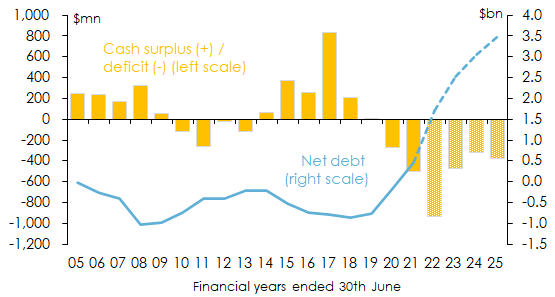
The Budget paints an optimistic, but not unrealistic, outlook for the Tasmanian economy. But there’s no appetite for any meaningful state tax reform – which leaves Tasmania’s finances vulnerable in the event that the GST ‘winds’ blow in a different direction, as might.
For my complete Tasmanian Budget Analysis visit https://bit.ly/38fVqY4.

Media release – National Trust of Australia (Tasmania), 26 August 2021
Lifeline In State Budget for Tasmania’s Heritage
The National Trust of Australia (Tasmania) welcomes funding announced in the 2021-22 Tasmanian Budget with an additional $300,000 provided on top of the state government’s current annual contribution of more than $312,000 per year, effectively doubling the trust’s state government support for 2021-22.
The funding announcement recognises the significant challenges faced by the Trust and other organisations reliant on tourism and volunteering as a result of the COVID-19 pandemic, as well as recognising the benefits of protecting our unique heritage spaces.
National Trust Tasmania Chair, Nicholas Heyward, thanked the government for it’s significant investment in Tasmanian heritage.
“We are thrilled that the Tasmanian Government is backing the trust with an additional $300,000 which will enable us to restructure the organisation and continue to work towards an economically sustainable model for Tasmania’s largest heritage organisation.”
“The National Trust has faced significant challenges as a result of the COVID-19 pandemic and the various flow on effects to tourism and the economy.”
“We look forward to continuing to protect, promote, and celebrate our unique heritage,” he added.
The Trust looks forward to working closely with the government as we recover from the impacts of the pandemic and work towards a sustainable, dynamic trust that celebrates the heritage of all Tasmanians.

Media release – Brighton Council, 27 August 2021
Jobs Hub funded in Budget
Brighton Council has welcomed the State Government’s funding in yesterday’s Budget for the South-Central Jobs Tasmania Hub based at Brighton.
The funding will support regional employment initiatives already in place and provide a boost for local job creation and placement.
The Brighton-based Jobs Hub will cover the Central Highlands, Derwent Valley, Southern Midlands and Brighton municipal areas where the councils have joined together to form the sub-regional group.
Chair of the sub-regional group and Brighton Council General Manager ,James Dryburgh, said the Jobs Hub would build on the success of the group’s current workforce development project.
“The State Budget funding is recognition of the commitment and success to date of our four councils working together to identify and develop employment opportunities in the region,” Mr Dryburgh said.
“Given the region’s socio-economic profile, there is a significant potential workforce in the region that, because of social and educational disadvantage, has been unable to take advantage of growing employment opportunities.
“As well, employers in existing and emerging industries have often found it difficult to find suitably trained and qualified local employees.
“The four councils are working proactively to lift employment opportunities for people in their municipalities while providing potential employers with suitably trained, employment-ready employees.
“The Jobs Hub will enhance the sub-region’s workforce development project and support the connection between education and training organisations, job seekers, employment providers, the three tiers of government and employers.”
Mr Dryburgh said the workforce development project had enjoyed important initial success and the confirmation of funding and establishment of the Jobs Hub would provide a vital boost to this activity.
Media release – equality, 27 August 2021
TAS GOV BUDGET BOOST FOR LGBTIQ+ INCLUSIVE SCHOOLS PROGRAM WELCOMED
The Tasmanian Government decision to foster greater LGBTIQ+ inclusion in Tasmanian schools with a budget allocation of almost half a million dollars has been welcomed by LGBTIQ+ community leaders.
The funds, made available as part of the Premier’s Child and Youth Wellbeing Strategy, will go towards the existing Valuing Diversity Framework currently being implemented in schools by LGBTIQ+ support and training organisation, Working It Out, and are in addition to existing State Government funding for that program.
Working It Out, CEO, Dr Lynn Jarvis, said,
“Working It Out is delighted to receive additional funding for our vital work in helping make Tasmanian schools safe, supportive and inclusive places for young LGBTIQ+ people.
“When schools are inclusive it means LGBTIQ+ students have improved mental health and can reach their full educational potential.”
“It also means the entire school community experiences less disruption from prejudice, discrimination and bullying.”
Working It Out will receive $450,000 over the next two years.
Equality Tasmania President, Rodney Croome, also welcomed the funding, saying,
“We are pleased the Tasmanian Government’s commitment to child and youth wellbeing extends to LGBTIQ+ young people.”
“It is a wonderful coincidence that the funding has been announced at the same time as Wear It Purple Day which is a national day for supporting LGBTIQ+ young people.”
“The funding made available for fostering inclusive schools shows how far Tasmania has come since it was the last state to decriminalise homosexuality, but is also a reminder of the challenges to be overcome before all young people are treated equally.”
This post is being updated as new statements are received.