Sunlight was peeking through clouds as the warm-up games took place in this year’s so-named Festival of Football. Better known as a Tasmanian home-away-from-home for AFL club Hawthorn, Launceston’s York Park this time had a mysterious rectangle marked out in the middle of the giant oval.
The early bird spectators politely clapped the locals off the pitch as Olympia women had the best Launceston City and then Kingborough Lions scored an upset over titleholders Devonport Strikers in the men’s game.
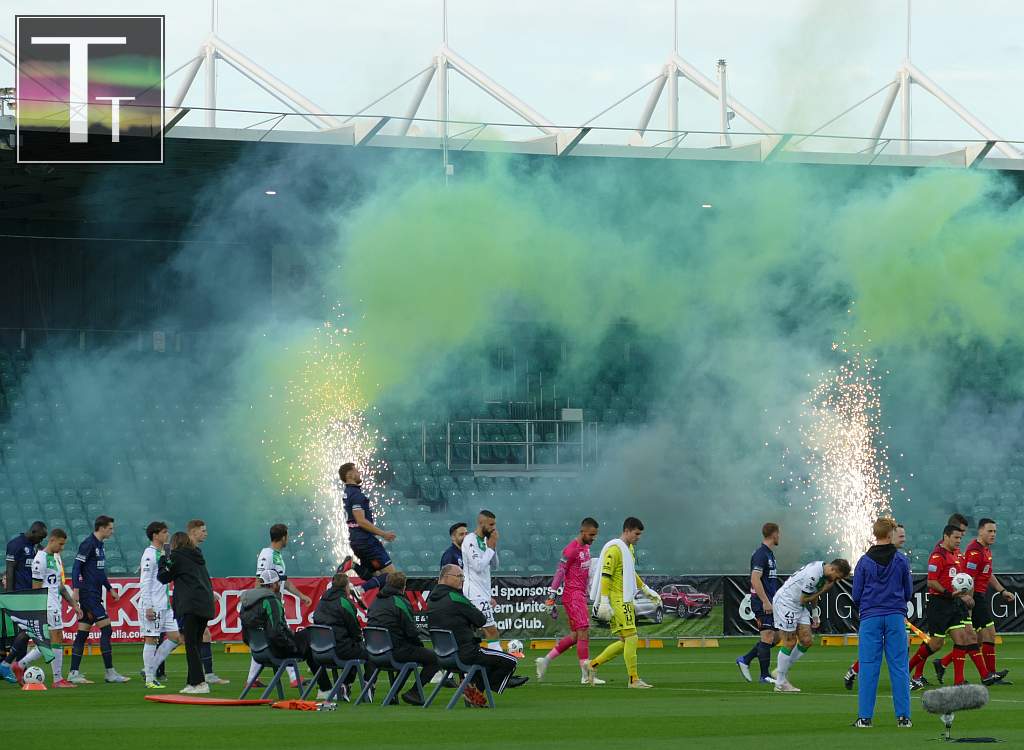
The big game however was not just Western United against Central Coast Mariners. The big game was exactly that: the big game. Professional football. A presence of national-level sport in Tasmania.
The underlying tension as I watched the game unfold came from the fact that we’ve been here before. Melbourne Victory swanned in to Tasmania in 2012, announcing a three year deal.
“The club will make a significant financial contribution to Football Federation Tasmania’s new state-wide competition in return for naming rights – to be known as the ‘Victory League’ – while also having a hands-on approach to the growth and development of football right across the state.
Victory will also embark on an annual pre-season tour in Tasmania, which will include games in the north and south of the state, while players and coaches will be made available for local football events as well as grass roots and community initiatives.”
All that indeed happened, and at the end of it they rolled up their navy blue carpet and walked away. The two A-League matches they played at the then Aurora Stadium proved to be the only ones ever played in the island state. Until Western United walked in.
Another swan-in?
Western United’s entry was April this year as they played two games in four days in Launceston. The deal with the state-government is for the same again next year, plus a W-League match as well. Of course the entourage also does some youth clinics. All this – or only this, depending on your perspective – for $480,000. On the surface, it looks far thinner than the Victory deal.
Western United come across as an opportunist club. Initially they were born of the A-League’s desire to have a club to tap into the great migrant football culture west of the central business district, the zone that hosted clubs like Melbourne Knights and Sunshine George Cross in the old NSL.
The grand plan however is very much tied in real estate. If we can unravel the details enough we can see that an A-League club is the bait to get the local council to treat favourably a major land development deal. That deal will in turn finance the stadium.
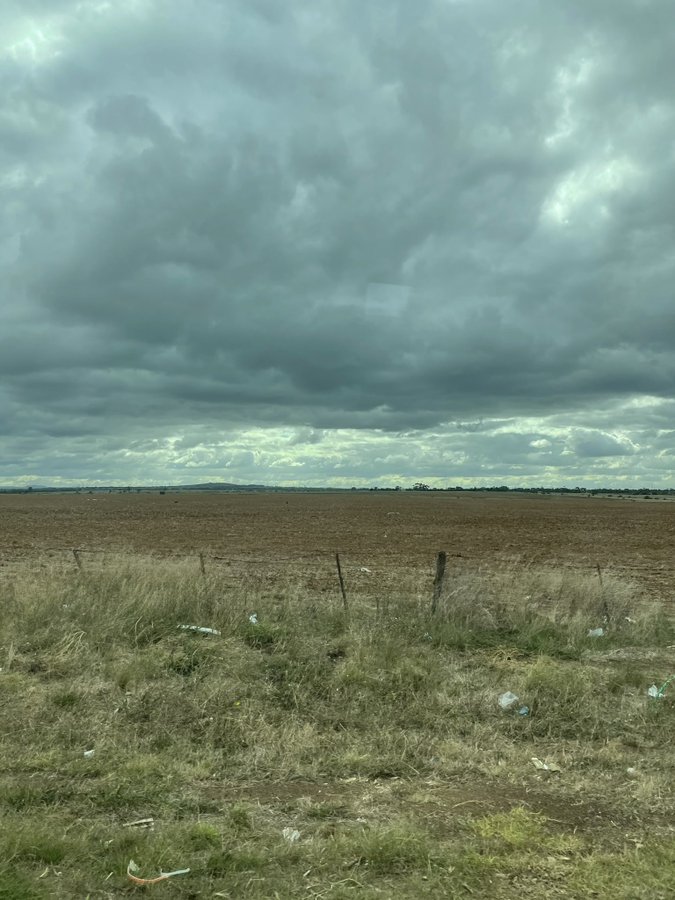
Build it and they will come? Image courtesy Dragan.
The ABC said last year: “Essentially, Wyndham Council — the fastest-growing area in Australia — has given a 100-hectare paddock to the Western United team. The sale of the majority of the land to developers, beyond the land used for the stadium, will pay the up-front costs of the venue. The concept is that a profit is made when vacant land is developed into commercial and residential options, and that profit goes to the development of infrastructure rather than into a shareholders’ pockets.”
That’s not really our business, but two years into the ‘deal’ and the site is still a paddock. For two seasons, and at least for the next few, Western United has been a-wandering. So far they have clocked up ‘home’ games at Geelong, Ballarat, Footscray, Melbourne Rectangular Stadium and now Launceston.
It’s understandable that if someone is offering a wad of cash to play a few games in Tasmania, they might as well pocket that.
With one of their ‘home’ games at MRS this year attracting under a thousand spectators, a new record low for the A-League, it’s not as if takings are badly sacrificed by rolling the roadshow into Launnie. We can’t be sure how well they did out of selling merchandise down here, but it looked to be okay.
But again, Western United’s wellbeing is not our prime concern. As their website states, “Western United Football Club is the A-League club that represents the people from the west of Victoria – urban, regional and rural.”
Even nearly half a mil of Tasmanian payola doesn’t get us a mention. But then, the Premier had his photo op with a green and black scarf just two weeks before the state election, so maybe that was it?
Football Federation Tasmania have at least publicly supported the Western United arrangement, perhaps so as not to jeopardise political support for a rectangular stadium. Both Liberal and Labor parties made election commitments to that end, so it would be unwise to derail the new-found enthusiasm for throwing money at football.
On the national stage
The bad smell about the Western United presence is that it’s very akin to that of AFL club North Melbourne, who have been pocketing Tasmanian money for a few games a year in Hobart since about 2012. North Melbourne get a ‘second home’, a few Tasmanian memberships, and the AFL gets to hold up a fig leaf. With Hawthorn’s presence at York Park in the north, also with our largesse for a few games a year, the AFL aspiration is ‘being serviced’.
Neither North Melbourne nor Hawthorn have advanced the cause of Tasmania having its own AFL team. While there is a little movement at the station on that front, it’s happened despite not because of the two ring-ins.
It seems unlikely the presence of Western United is going to be a catalyst for a Tasmanian team. It may even be, well, an own-goal. With match attendances of under 6,000 across the two games in Launceston this year, there may be an argument that crowds here are not ready to sustain an A-League team.
Former Tasmanian Premier David Bartlett said last year he believed that the establishment of the NBL franchise the JackJumpers would lead to basketball being the number one sport in the state within five years. I think that’s not going to happen, but of more concern is that cricket (Hobart Hurricanes), basketball and perhaps AFL are going to hoover up all potential major sponsors before football can get its boots on.
How much work on an A-League bid would $480,000 have bought us? A lot more than zero, which is the current state of our efforts. Or it might have bought a top notch full-time development officer for five years or so, to work with developing our local talent and advancing them along existing pathways.
One plus for the A-League of the coming national second division is that it will provide a platform for either South Hobart or Devonport Strikers to make that step. And will delay the A-League’s need to consider a Tasmanian A-League side for quite a while. If promotion-relegation is adopted, perhaps it never will be.
We know that Roman emperors kept the populace happy by organising handouts of grain and organising spectacles, hence the term panem et circenses (bread and circus).
Will the state and local governments of Tasmania actually work with the football community to develop our game in a coherent fashion? Will they support what is actually needed, or just what can be pulled out conveniently in election cycles? Or is it going to be just the green and black circus of Western United?
TASMANIAN TIMES: Photo Essay – Western United in Launceston.