For the official Australian Government budget overview, including graphs, figures and short descriptions, see https://budget.gov.au/2021-22/content/overview.htm
https://youtu.be/i4CWkk9dWK8
Media release – Peter Gutwein, Premier, 2 May 2021
Federal Budget 2021
The Tasmanian Liberal Government welcomes the strong investment in the 2021 Federal Budget that will help create jobs, strengthen our economy, and deliver the essential services that Tasmanians need.
With the economy bouncing back and significant increases in consumer spending, the Australian Government has forecast GST pool growth averaging 6.7 per cent from 2019-20 to 2024-25. This includes growth of 15.8 per cent in 2020-21.
Tasmania’s share of the GST pool is expected to remain relatively consistent at approximately 4.1 per cent over the Budget and Forward Estimates period, providing increased GST revenue to Tasmania of $846 million to that estimated in the recent Pre-Election Financial Outlook.
Total Payments for Specific Purposes to Tasmania have also increased by $163 million over the same period, including $53 million for education and $10.5 million for the extension of the Jobtrainer program.
We particularly welcome that the Budget provides additional support for addressing women’s safety and family violence, as well as other measures to support women.
Changes were announced to superannuation to help women boost their retirement savings. The removal of the $450 per month superannuation threshold will expand the superannuation guarantee, improving coverage and increasing retirement savings, particularly for women.
The Budget includes a statement on women’s safety and health, with funding of a further $1.1 billion through the Women’s Safety Package to address and prevent family and domestic violence. The Commonwealth Government is also committing $146 million to enhance national law enforcement child protection capabilities.
There is also $10.7 million over four years from 2021-22 to establish Veteran Wellbeing Centres in Tasmania and South-East Queensland that will provide veterans with access to local support services.
The Tasmanian Government also welcomes the retention of the Low and Middle-Income Tax Offset for the 2021-22 financial year to stimulate the economy and put downward pressure on the cost of living across the State.
This will impact almost 210,000 Tasmanian taxpayers with the average earning full-time worker in Tasmania to receive the full benefit of $1080 per year.
Further, a major measure to continue to support all Tasmanian businesses includes the one year extension to 30 June 2023 of the instant asset write off for the full cost of capital assets to help businesses with cashflow.
The Budget also includes an additional $322.6 million investment in roads and infrastructure that will reduce congestion and travel time, while creating jobs for Tasmanians across the long term.
We also welcome the massive investment into aged care, with over $17.7 billion committed across the Budget and forward estimates to employ more staff into the sector, and reduce the backlog for those needing help to stay in their own home.
With an older and more vulnerable population and with an estimated over 8000 Tasmanians utilising aged care services, this is very good news for Tasmanians and their families and will address skills and staff shortages, helping the sector with their needs well into the future.
Additionally, the changes to superannuation will allow retirees to downsize their family home five years earlier at age 60, allowing them to boost their super while importantly, freeing up more housing stock for Tasmanian families.
The first-home guarantee will also be expanded with another 10,000 places made available, allowing even more people to build a new home, or purchase a newly built home with a deposit of as little as five per cent.
These measures will complement our initiatives to boost housing stock and alleviate housing stress across the State, including boosting the First Home Owners Grant from $20,000 to $30,000 and increasing the property value threshold for our 50% stamp duty concession for first home buyers and pensioners downsizing.
The changes to childcare will also be warmly welcomed by Tasmanian families. These changes mean that over 7000 Tasmanian families will receive a 95 per cent subsidy for their second and subsequent children.
This Budget delivers for Tasmania and is another demonstration of State and Federal Governments working together to Secure Tasmania’s Future.
Media release – Tasmanian Liberal Senate Team, 11 May 2021
Budget 2021-22: Leading Tasmania’s Economic Recovery
Tasmania’s post-pandemic economic recovery received a boost tonight with a raft of investments for our state.
The 2021-22 Budget supports Tasmanian households and businesses, with funding for important infrastructure projects, investment in essential services, and improving health outcomes for Tasmanians.
Budget investments for Tasmania include:
- $322.6 million for priority road projects – such as Midland Highway Upgrades, Bass Highway Safety and Freight Efficiency Upgrades Package, South Arm Road Upgrades and Tasmanian Freight Rail Revitalisation – to support economic recovery and jobs;
- Extending the eligibility of the Tasmanian Freight Equalisation Scheme assistance with $89.3 million over four years;
- Support for vulnerable veterans, with $10.7 million over four years to establish Veteran Wellbeing Centres in Tasmania (shared with South-East Queensland);
- An estimated $12.8 billion in GST payments from 2021-22 to 2024-25;
- Health funding to increase by $39.5 million from 2021-22 to 2024-25, with major commitments including National Health Reform funding, COVID-19 public health response, public dental services for adults, community health, hospitals and infrastructure projects; and
- Around 220,000 low- and middle-income earners will receive tax relief of up to $1080 for the 2021-22 financial year.
Tasmanians will also benefit from the Government’s $1.7 billion national investment in child care to cut the cost of living for families and to boost workforce participation.
The Budget is also focused on new apprenticeships and traineeships, higher education short courses and supporting the safety of women and their children from family, domestic and sexual violence.
This Budget will continue the work the Morrison Government has already started in securing Australia’s recovery, ensuring Tasmania’s economy continues to recover.
For more information visit www.budget.gov.au

Media release – Andrew Wilkie MP, Independent Member for Clark, 11 May 2021
WHAT’S LEFT TO DO ON THE BASS HIGHWAY ANYWAY? DIAMOND-ENCRUSTED CAT’S EYES?
The Federal Budget is good so far as it starts to address serious problems in areas as diverse as aged care, the NDIS, mental health, skilling workers, childcare and the treatment of women.
Yes it’s regrettable that it’s taken a global pandemic; the shocking revelations of the abuse of women, older Australians and those with a disability; and the looming election to force such a budget. But to be fair this is a welcome change in direction by a conservative government.
Tasmania will benefit from a boost in GST and specific purpose payments, and the tax relief I helped deliver for small brewers and distillers. Hobart is also among the most popular destinations in the half-price airfare promotion that has sold 660,000 tickets.
However there are still significant gaps in the Budget, for example the lack of effective action on the housing crisis, protecting the environment and climate change. Moreover government pensions and payments, in particular JobSeeker, Age Pension and Disability Support Pension, remain poverty by design.
Tasmanians in particular will be disgusted but hardly surprised by the pork barrelling in the Budget. For instance the Government is again throwing millions at the highways in the marginal seats of Bass and Braddon, while failing to address the traffic congestion in Hobart, urgency of setting up the Antarctic precinct at Macquarie Point and undertaking the next stage of the Royal Hobart Hospital rebuild. What’s left to do on the Bass Highway anyway? Diamond-encrusted cat’s eyes?
Of course this Federal Budget rests on a population-wide vaccination program being in place by the end of the year and international tourism gradually recovering late next year. This will be the real test for the Federal Government, and one the public is counting on it to pass.
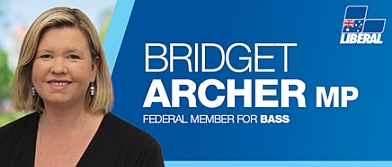
Media release – Bridget Archer MP, Federal Member for Bass, 11 May 2021
Budget 2021
Our plan to secure Australia’s recovery will rebuild the economy and create more jobs to ensure we come back stronger from the COVID-19 induced recession.
Federal Member for Bass Bridget Archer said the significant investment into the areas of women’s safety, aged care and health were of particular importance.
“Out in the community week after week, I have heard so mush positive feedback on our Government’s handling of the economy during the pandemic,” Mrs Archer said.
“As we look to secure our economic recovery, it’s important that the basics, such as keeping women and children safe against family and domestic violence, ensuring our elderly can live with dignity and respect and making certain that our community has greater access to health services is part of this plan.
“I am proud to have advocated for measures we see tonight including a more than $13 billion commitment to the NDIS, record funding in mental health, significant funding to preschools across northern Tasmania.
“Also, the investment of a further $1.6 billion to fund priority technologies including clean hydrogen and energy storage, an emerging market in our state.”
Among other key measures include:
- Investing $1.1 billion in women’s safety nationally, including Tasmania, delivering more emergency accommodation, more legal assistance and more counselling
- More financial support, including cash payments, for those escaping abusive relationships
- Record investment in Aged Care to help senior Australians
- Increasing the time nurses and carers are required to spend with residents
- Continuation of telehealth services until the end of 2021, with over 200,000 telehealth consultations delivered across northern Tasmania since the start of the pandemic
- $5 million towards the establishment of a Veteran Wellbeing Centre in Tasmania
Other investments into our region:
- An additional tax cut for low and middle income earners benefit by up to $1080 for individuals or $2,160 for couples. More than 40,000 taxpayers in Bass are expected to benefit from this tax relief.
- Boost to bulk billing rebates to provide more affordable healthcare
- Establishing the Family Home Guarantee, which will allow eligible single parents with an income under $125,000 to purchase a home with just a 2% deposit
- Increasing the childcare subsidies available to families with more than one child aged five and under in child care
- Abolishing the $10,560 cap on the Child Care Subsidy
- An extended and expanded JobTrainer Fund will support new places to upskill job seekers and young people. There are approximately 1,825 apprentices in Bass and these new measures will lead to more opportunities for apprentices and trainees with expanded wage subsidies.
- The continuation of tax incentives that will allow around 12,100 businesses in Bass to write off the full value of any eligible asset they purchase. Additionally, around 3,000 businesses in Bass will be able to use the extended loss carry back measure to support cash flow and confidence. This has helped businesses invest more in the local economy and to create local jobs.
- Additional $67.7 million to boost assistance under the Tasmanian Freight Equalisation Scheme. The scheme will be expanded to include eligible imported goods shipped to Tasmania via the mainland, where there is no Australian equivalent good
- Small brewers and distillers across northern Tasmania including Turner Stillhouse and Darby-Norris Distillers will benefit from a tripling of the excise refund cap from $100,000 to $350,000
“Budget 2021 demonstrates the importance of how strong economic management has allowed our country to be in a position to support Australians in the way that is has tonight,” Mrs Archer said.

Statement – CEO TasCOSS Adrienne Picone, 11 May 2021
TasCOSS 2021/22 Federal Budget Initial Analysis
- This budget provides welcome recognition that the health and wellbeing of our population underpins a healthy economy, not the other way round.
- In many ways, COVID-19 crystallised what is important in our lives, a healthy body and mind and a place to call home. To that end, it was pleasing to see the long overdue spending on aged care, disability, mental health and early childhood education and care. Moreover, a substantial investment in women’s safety and supporting services will go some way to creating a fairer and safer future for women.
- Disappointingly, this budget has failed to provide hope for the thousands of Tasmanians who are languishing on the public housing waiting list and struggling to get by on the Coalition’s paltry rate of income support.
- An investment in Tasmanians seeking work and social housing would have created jobs, provided economic stimulus, as well as given people the stability they need to fully participate in their community and the economy.

Statement – Brian Mitchell MP, Federal Member for Lyons, 12 May 2021
Budget roads spend is a con-job
Federal Member for Lyons Brian Mitchell says the Tasmanian roads package in the federal budget has been exposed as a “massive con job” on Tasmanians.
In pre-Budget leaks, the Government told Tasmanians it would be spending $322 million on Tasmanian roads.
“The detail in the Budget papers now reveals that just $4 million of the $322 million package will be spent in the 2021-22 financial year,” Mr Mitchell said.
“In the following year it’s $17m and the year after that $20m. These are paltry infrastructure numbers.”
“The reality of this pathetic roads package falls far short of the pre-Budget spin,” Mr Mitchell said. “It is a massive con job on the Tasmanian public.
“Just $96m of the $322m is budgeted to be spent over the next four years.
“The vast majority of it is on the never-never out in the eight-year projections.”
Mr Mitchell said Tasmanians would be expected to shoulder their share of repaying the Liberals’ eye-watering $1 trillion debt but were not receiving their fair share of the spending.
“Where has the money from this massive debt budget gone? Where is the benefit to Tasmania?
“Support for tourism has been cut, support for universities has been cut and next to nothing is being invested in infrastructure and roads. There’s nothing in this Budget for Tasmania but a $1 trillion hangover.”
The only mention of Tasmania was funding for the Midland Highway, and that’s not even new money. Once again Tasmania has been left off the map.
Nothing new for the East Coast. Nothing for the Tasman or Arthur Highways. Nothing for the Northern Midlands. Nothing for tourism. Nothing for health.
Regional tourism operators will be bitterly disappointed by the failure to extend the Spirits of Tasmania car and camper subsidy past June 30.
Tasmania’s Liberal MPs and senators should be embarrassed. Tasmanians will be expected to help foot the $1 trillion bill for a Budget that spends up big on the mainland but leaves Tasmania behind.
This budget is a con-job.
Media release – Australian Medical Students’ Association, 11 May 2021
AMSA – Investment in Mental Health Falls Short of Productivity Commission Recommendations
Australian Medical Students welcome the Australian Government’s record-breaking mental health investment as an important first step in meeting the Productivity Commission’s mental health report recommendations.
“Whilst we welcome tonight’s mental health funding announcements, higher investments will be necessary to achieve the benefits associated with the priority reforms as recommended by the Productivity Commission’s 2020 mental health report,” Sophie Keen, Australian Medical Students’ Association (AMSA) President, said.
“The allocation of $2.3 billion in funding the National Mental Health and Suicide Prevention Plan will be instrumental in designing a sustainable and effective mental health care system as outlined by the Productivity Commission.
“We are also pleased to see the Federal Government intends to establish a number of new adult and child mental health centres that focuses on providing care to Australia’s vulnerable populations including our First Nations and LGBTQIA+ populations.
“In the context of spikes of mental health access during 2020, it is vital that the Federal Government continues to support those who have had their mental health severely impacted by the pandemic.”
AMSA provided two recommendations in their Pre-Budget Submission to the Federal Government relating to mental health. These recommendations focused on investment in mental health care access for the general population, and training medical students to identify and respond to mental health care crises in themselves and others.
The Better Access initiative allows eligible people to access up to 10 individual mental health service sessions each year, with the availability of 10 additional sessions being made available from October 2020 until June 2022. An additional $111.4 million was allocated to the Better Access initiative in tonight’s Budget.
AMSA is the peak representative body for Australia’s 17,000 medical students. AMSA Mental Health provides resources to promote student wellbeing and promote mental health support services among students.

Media release – Australian Medical Association, 11 May 2021
STRETCHED HEALTH SYSTEM IS POWERING THE NATIONAL ECONOMY
Tonight’s Federal Budget rightly focuses on the nation’s recovery from the COVID-19 pandemic, AMA President, Dr Omar Khorshid, said.
“The Government has done a good job in protecting Australians from the global pandemic, and tonight’s budget continues spending on the COVID-19 health response,” Dr Khorshid said.
“Health has been Australia’s hero throughout COVID. Investing in health not only saves lives, it’s saving the economy. This Budget is clearly designed to help with the economic recovery.”
Dr Khorshid pointed to $17.7 billion in aged care expenditure and $2.3 billion in mental health care as supporting much needed improvements for access to health and aged care.
“The Government’s response to the Aged Care Royal Commission will help shore up the failing sector. Moving to mandate nurse-resident ratios is long overdue, but unfortunately we will have longer to wait until these measures are in place,” Dr Khorshid said.
“Additional home care packages will go a long way to clearing the waiting list of older Australians looking for support to stay in their own homes and avoid residential care longer.
“$365 million committed to expanded primary care support in aged care will also make it easier for older people to see their doctor.
“AMA has been campaigning for increased General Practice care in aged care, and we’ll now need to work on implementation details.
“Mental health investment and suicide prevention is a step in the right direction, with the Government readily agreeing more still needs to be done.
“The AMA has worked closely with the Government on reforms to the Prostheses List to manage the cost of private health insurance. The Budget commits to a reform process, with detail now needing to be confirmed.
“There is also a $50 million down payment for technology investment to proceed with voluntary patient enrolment in General Practice. Long overdue, voluntary patient enrolment is moving closer to being achieved.
“Yet with these improvements, our public hospitals and General Practices are at present beyond capacity, and this is at a time when we have virtually no flu and no COVID-19 in Australia.
“When our international borders eventually reopen, we will inevitably see the return of influenza and outbreaks of COVID. We’ve also been seeing growing chronic illness.
“Now is the time to be putting the health prevention and health infrastructure in place to build for the post-COVID future. It’s time to fund telehealth permanently beyond its current extension.
“Our public hospitals urgently need an additional injection of federal funding to address capacity issues that are leading to long waiting times in emergency departments and for elective surgery,” Dr Khorshid said.
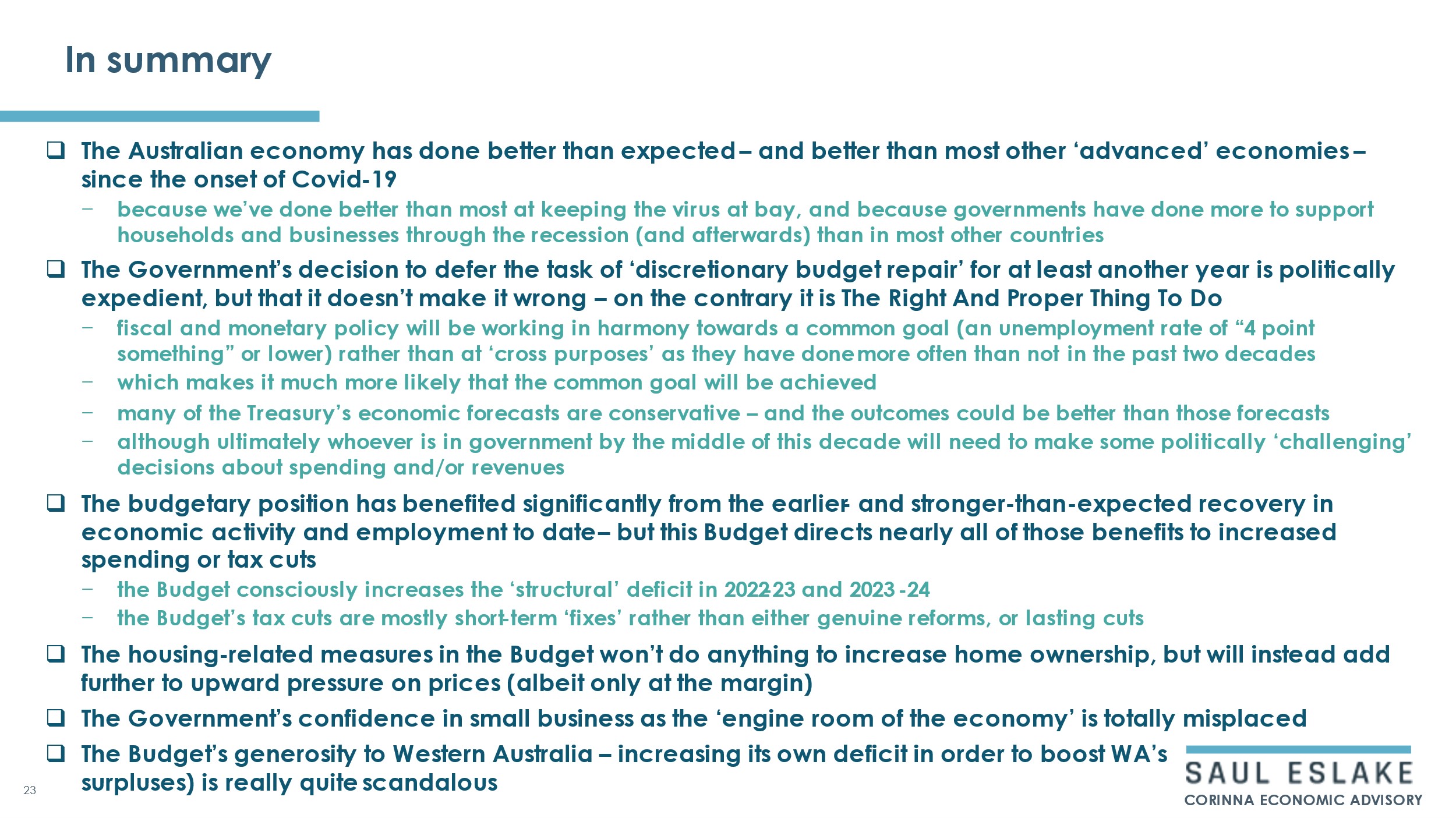
Commentary – Saul Eslake, Economist, 12 May 2021
Media release – Disability Voices Tasmania, 12 May 2021
Budget 2021: NDIS Dollars On Track But Scheme In Trouble
Tasmanians with disabilities get an NDIS boost, but already can’t find enough services to buy. Potentially 2,500 new NDIS jobs for Tasmanians – if they can be hired and trained. The government tones down its scare campaign about NDIS costs.
The Treasurer said last night: “Under the Coalition, the NDIS will always be fully funded.” and backed it up with an extra $13.2 billion over 4 years.
That’s about $115m in disability services and potentially 2,500 new jobs for Tasmanians.
“It’s a welcome change of tone after the scare campaign of the past few months.”, said David Morrell, spokesperson for Disability Voices Tasmania.
The government’s own Budget forecast says costs are only going up at a modest 3% a year in real terms, as predicted all the way back in 2017.
“Costs might be under control, but the NDIS is still in trouble in Tasmania.”, said Mr. Morrell. “The government needs to roll up its sleeves and fix it.”
Mr. Morrell listed the challenges for the NDIS:
- People are only spending 71% of the funds they’re allocated on average. They have the money, but they can’t get the services.
- We need more workers and the training to get them into the industry, especially outside Hobart.
- We need more help for people to use the NDIS. Easier administration. A services directory that works. Navigators to help people find their way through the system.
The answer is not the government’s plan for ‘independent’ assessments to give everyone a so-called fair umpire.
There is a danger this would involve:
- Cookie cutter assessments of people with complex needs.
- National contractors working to a price.
- Assessments done by phone because they can’t put staff on the ground in regional Tasmania.
Independent assessments like these do not give anyone a fair go at the NDIS.

Media release – Health & Community Services Union, 12 May 2021
Morrison’s Budget neglects aged care workers, again
This Federal Budget has fallen woefully short of providing desperately needed funding to the aged care sector.
“Again, the Liberal Government has chosen to neglect aged care workers in this Budget,” HACSU State Secretary Tim Jacobson said.
“Aged care has been in crisis for years and this funding package won’t change that. It’s yet another blow to aged care in Tasmania, where this crisis has a greater impact due to our older population.
“There is no commitment to permanent, better paid care jobs. Clearly, the Government’s plan is to continue exploiting the goodwill of an insecure, underpaid workforce of women.
“To properly attract and retain a dedicated workforce, the Government must commit to paying aged care workers more than $21 an hour. It had a chance to do that, and it failed.
“Committing to increased care minutes is entirely hollow unless you have a plan to attract and retain the workforce needed to provide that care.
“Modelling commissioned by our union found the need in residential aged care alone amounts to $20.4 billion over four years. This would create 59,000 skilled aged care jobs, provide a $5 per hour pay rise and provide residents an extra 89 care minutes per day.
“The Grattan Institute puts the total four year need at $28 billion, when the cost of home care is added. Scott Morrison and Josh Frydenberg have delivered a fraction of what’s needed.
“Aged care workers and residents had high expectations after years of banging the drum, giving evidence to the Royal Commission and pleading for change. Today, they are disappointed, but their will is not broken. We will continue fighting for a properly resourced aged care system.”