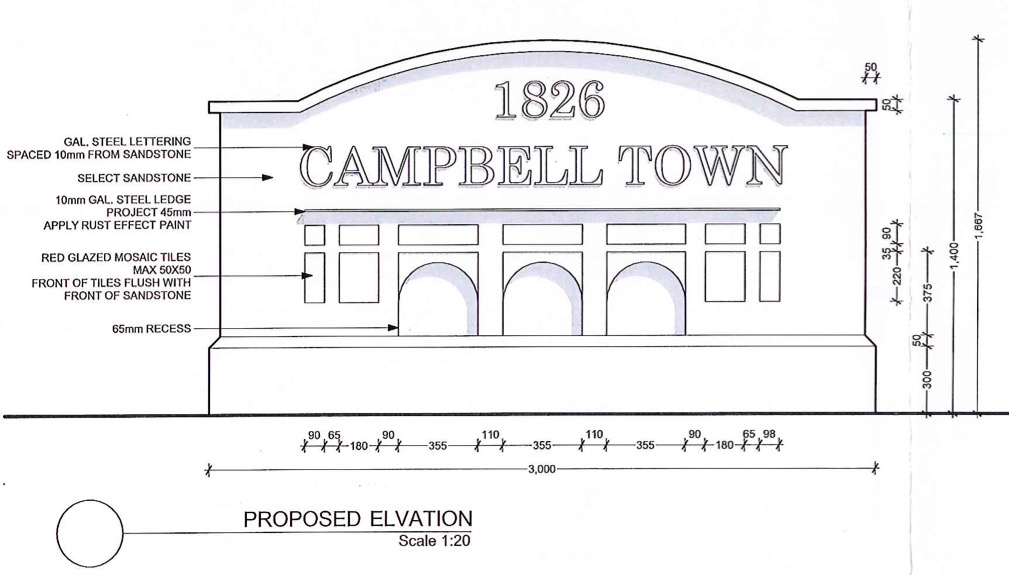
The year that a town was established is a matter of historic importance, especially on an island that brims with history, where history is industry for tourism.
The Northern Midlands Council is proposing to install two ‘entrance statements’ for Campbell Town, famous for its red bridge, and the trail of bricks in the footpath with the name and details of a convict on each brick.
The matter of the entrance statements will come before the council meeting on 15 March, as will the prospect of a dual name for the town (see key parts below).
Having been investigating when Ross was established, I had become aware of when Campbell Town began as a town, which can be read in the journal of Governor Lachlan Macquarie for 31 May 1821:
“Having determined on establishing a township on the north bank of the Elizabeth River, I have named it Campbell-Town in honour of Mrs Macquarie’s maiden name. This town is most admirably well situated in every respect, surrounded by a fine rich country and well watered.”
I was then surprised to see that the council were planning to have 1826 on the entrance statements, and raised this with the planners and councillors, as you can see in my submission, included below.
In my representation I asked the planners how they arrived at 1826 ….. but received no reply.
Wondering if this was when the town was gazetted, I wrote to the Nomenclature Board, and found out that:
Campbell Town (24523G):
Proclaimed Town of Campbell Town gazetted or proclaimed on 3/7/1866, Enlarged Statutory Rule No 100/1978.
Originally Municipality of Campbell Town. [Spelt as two words].
Named by Governor Lachlan Macquarie on 31 May 1821, after his wife’s maiden name (Elizabeth Henrietta Campbell).
The Elizabeth River was named by Macquarie on a previous visit (1811) after his wife’s Christian name.
For history of Campbell Town see M/253.
For information on Transit of Venus, see Oversize Cards Directory\941X Campbell Town.
Copy of old Town Plan in Northern Midlands Council correspondence file dated January 2010.
Northern Midlands Council Corres: 20100101. See LD Plan 515.
OK, so the town was gazetted in 1866, but I still don’t know where 1826 came from, which can also be seen in the current council-produced pamphlet for Campbell Town, with extracts included below.
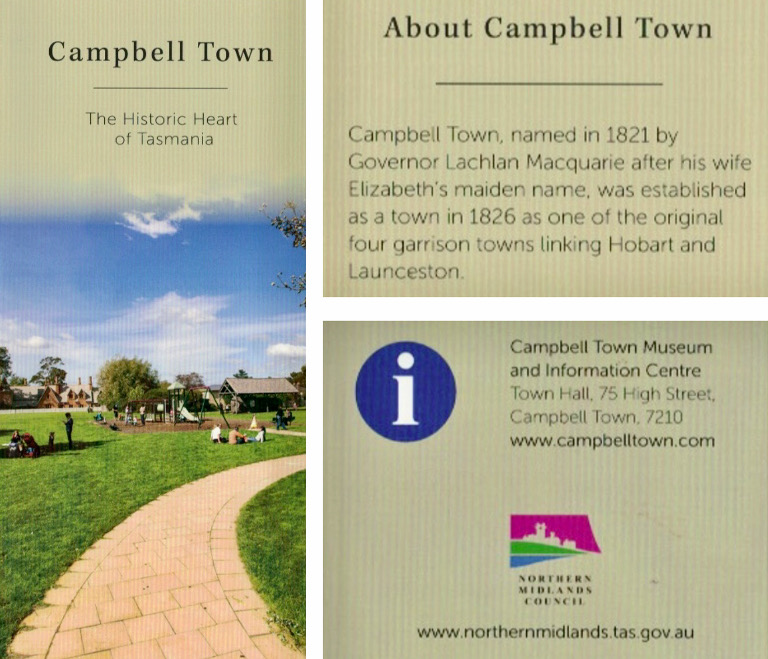
The pamphlet also states for Campbell Town: “established as a town in 1826 as one of the original four garrison towns linking Hobart and Launceston.”
Anyone with a nose for history must smell something really odd there, as the original four garrison towns between Hobart and Launceston were established in 1812, fourteen years earlier, at Brighton, Oatlands, Ross and Perth.
For a council that employs a heritage consultant to examine a newly discovered convict well in Perth, has two World Heritage sites, has the third oldest bridge in Australia in Ross, and the oldest bridge still in use for a main highway in Campbell Town, how could the Northern Midlands Council end up with a dog’s breakfast for heritage awareness?
Then, the council were only recently made aware that they were responsible for the historic bridge at Tunbridge ….. after how many decades?
There are many new entrance statements in the Northern Midlands, and I wonder how many may have the wrong year on them.
My recent investigations have revealed how Ross was established in 1812, when the garrison arrived, with quite a vibrant settlement springing up, with government stock yards, a tavern, and horse racing, all before 1821, but the Council has 1821 on the entrance statements for Ross, which was the year in which Governor Macquarie decided he didn’t like the name it had, and dubbed it Ross.
Macquarie wrote in his journal for 1 June 1821:
“Set out from Campbell-Town at 1/4 past 12 o’clock and arrived at the Govt. Stock-Yard in Argyle Plains at 1/2 past 1 p.m. disce. 7 miles only.”
Having just founded and named Campbell Town, Gov. Macquarie is already using the new name the next day.
I wondered if Ross may have been gazetted in 1821, but no, as the Nomenclature Board information shows that happened in 1866 ….. “Proclaimed Town of Ross gazetted or proclaimed on 3/7/1866”
As the Northern Midlands Council does not employ a heritage officer to check on all historic details in the district, should the Tasmanian Government assign a heritage officer to keep an eye on the council, and check all historic dates on entrance statements and in council-produced pamphlets ….. and also what heritage the council is responsible for?
Now I see that the council planners have decided that 1826 is the wrong date, and have decided that the entrance statements for Campbell Town should have 1821 on them, when the governor of Australia founded and named the town.
Will the councillors agree? The elected representatives are also being asked to consider a dual name for Campbell Town.
I have written to the Councillors and suggested two things.
If an Aboriginal name is added, the entrance statements should be readvertised (for design), as the extra wording will be a significant change to a sign on a highway. There will be a need for careful consideration of the graphic layout and lettering style, and the residents and ratepayers should not be excluded from the decision-making process with this.
I also suggest that the council needs to run a proper process of community consultation with all members of the community.
The dual name proposal has only come from one group in Campbell Town, which is a special committee of council, and therefore an arm of the council.
The Northern Midlands Council has a very bad habit of using the advice of a special committee as official community consultation, even though the committee members, all with their personal and vested interests, do not run consultation with the whole community.
The Ross Local District Committee gave their support for the dual naming of the Macquarie River, and this is now being progressed by the council, but the Ross community, not to mention all who live in the Northern Midlands, have not been consulted about this change.
What kind of democracy is that?
This secretive process delivers really bad planning, and alienates members of the community who later see the outcome that they had no say in.
Parking issues
This was seen when the Ross special committee made a quiet little suggestion to the council to buy privately owned land in Ross for a new town park.
“The vacant land next to the Hotel be purchased using the funds from the sale of the Ross School and developed into a town square.” – Minutes of the Ross Local District Committee, 20 January 2015
The council picked that up, bought the land, engaged a planner to create the design, and then presented the thing to the people of Ross as a done deal.
As Ross has over a hundred acres of public land, and many acres of public land near the Ross Bridge which should be developed as a heritage parkland, and with the old stables near the Ross Bridge, why buy privately owned land for a new town park, where a second public toilet will be built?
If anything, Ross needs a public car park. The old school oval is public, with the main public toilet next to it. Is the Council secretly planning to turn the old school oval into a public car park, being the only place available? The new land purchased would have served better as a public car park in Ross.
When the consultants sold their vision to the residents of Ross, this became a sales job, hiding the fact that the people had never been asked about the best options for the development of public parks in Ross, or where a car park could be located, and whether more land needed to be purchased, and a second set of public toilets built.
This is what happens when a small mob of self-nominated and unelected people have control over the planning of a town, and not being elected to this form of mini-Council, have no mandate from ratepayers, and are not accountable for their actions at an election.
When I raised this situation with the Minister for Local Government, Mark Shelton MP on 2 October 2019,
I was told: “The Northern Midlands Council is empowered to create special committees and is accountable for their purpose and membership. If other members of the community share your concerns, I expect they would be expressed to the council, as ultimately the test of community satisfaction is at each local government election.”
The current arrangement with community consultation focusing on a couple of people in a community branch of the council, ends up making the council unrepresentative of the people, in a process of rubber stamps that delivers more power into the hands of the General Manager ….. and leaves the elected councillors with less authority.
Hopefully, with the correction of an erroneous history date on the proposed entrance statements in Campbell Town, the council will wake up and remember that they represent those who elect them, not the special committees, and that community consultation needs to involve the whole community.
The echo chamber conversation between the Council and special committees, and calling this community consultation, is hardly a proper democratic process
I am surprised that the Tasmanian Government approves of this process, more a’kin to Animal Farm, or a communist party committee in China, than democracy in Australia. Is Australia turning into a clone of China, from the grass roots in the Northern Midlands, where all citizens are equal, but some are more equal than others?
NORTHERN MIDLANDS COUNCIL AGENDA ~ 15 MARCH 2021 …..DUAL NAME FOR CAMPBELL TOWN
Page 30, Agenda, 15 March 2021, Northern Midlands Council
https://www.northernmidlands.
RECOMMENDATION
That Council
i) adopt the Aboriginal and Dual Naming Policy.
And
ii) writes to the Tasmanian Aboriginal Centre seeking comment on amending the entrance signs to Campbell Town to display the palawa kani name pantukina.
ENTRANCE STATEMENT FOR CAMPBELL TOWN
Page 141, Agenda, 15 March 2021, Northern Midlands Council
https://www.northernmidlands.
RECOMMENDATION
2 Final Signage Information
Prior to works commencing on site, the proponent must submit for approval of Council’s General Manager, the finalised text and design details to be contained within the Panel component of the works.
Re: Representation
PLN-21-0002
Campbell Town Entrance Sign
https://www.northernmidlands.
Kim Peart
<<address>>
Wednesday 10 February 2021
Dear Planners,
How was the year 1826 identified as the founding year for Campbell Town?
I read in Governor Lachlan Macquarie’s journal for 31 May 1821 ….. “Having determined on establishing a township on the north bank of the Elizabeth River, I have named it Campbell-Town in honour of Mrs Macquarie’s maiden name. This town is most admirably well situated in every respect, surrounded by a fine rich country and well watered.”
So Campbell Town would appear to have quite a distinct date for its founding, birthday, and naming ….. 1821
Yours sincerely,
Kim Peart
Kim Peart is a long-time resident of Ross, a writer, a keen afficionado of Second Life, and the founder of Space Pioneers.