The Farewell Admonition appears in Thomas Reid’s 1822 book, Two Voyages to New South Wales and Van Diemen’s Land.
Thomas Reid
Thomas Reid lived between 1791 to 1825.
He was a capable naval surgeon, as well as a prison reformer who advocated the employment of prisoners in a rational manner (he believed this was a necessary step towards their reformation).
He was born in Ireland, and received his education near Ballinderry in the county of Tyrone.
Around 1811, he entered the navy. Then, in 1813, he passed examinations at the Royal College of Surgeons in London. He was admitted as a member in November 1815. He was then appointed as a naval surgeon in 1814.
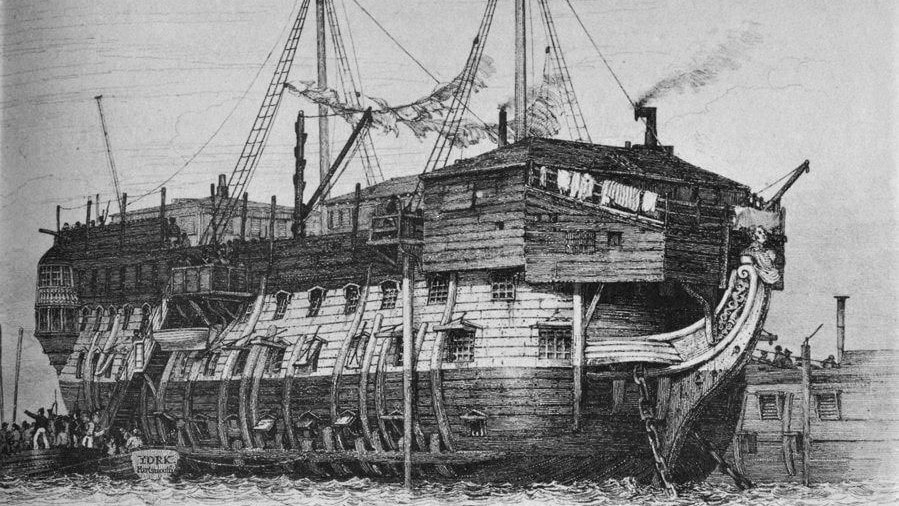
Reid was the surgeon-superintendent of the convict ship Neptune, which sailed from The Downs to Sydney between 1817 and 1818. He was also the surgeon-superintendent of another convict ship, named Morley, which travelled from London to Hobart Town in 1820 before sailing on to Sydney.
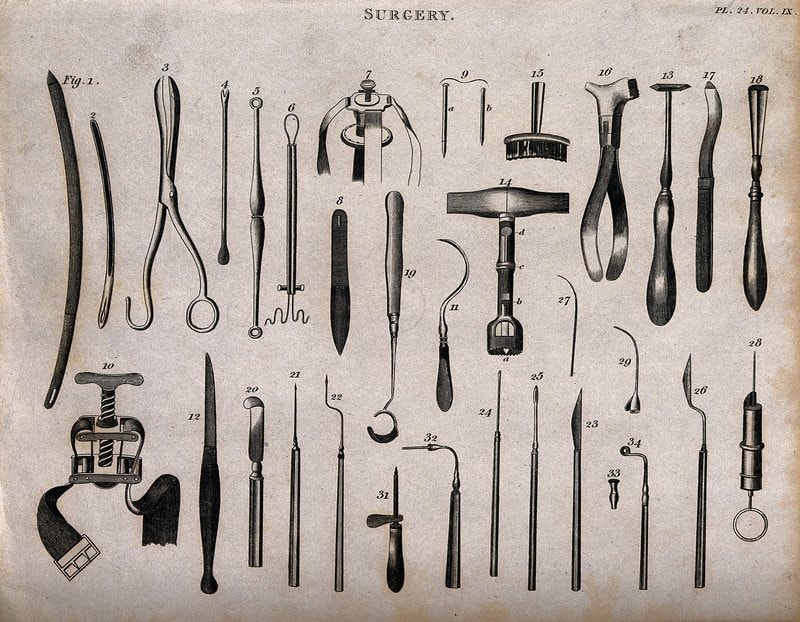
A 19th century naval surgeon’s instruments.
Reid was a close associate of Elizabeth Fry, who was a fellow prison reformer. It was in fact at Fry’s suggestion that he accepted the role of surgeon-superintendent for the above voyages. Reid later dedicated Two Voyages to New South Wales and Van Diemen’s Land to Fry.
Convicts and convictism in 1822
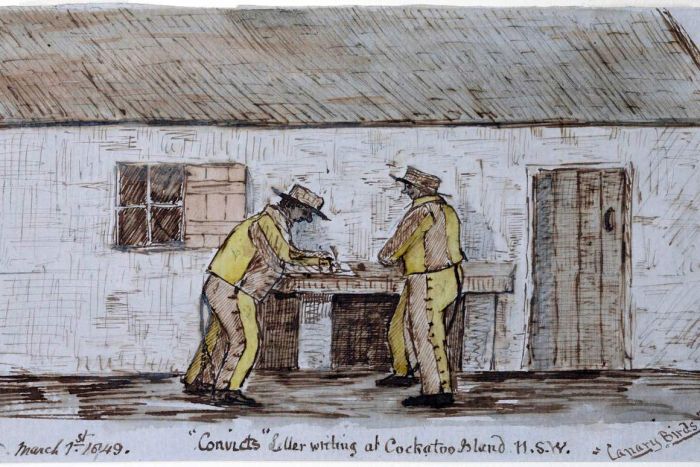
A drawing of two convicts.
Around 73,566 convicts were transported to Van Diemen’s Land between 1803 and 1853.
The Assignment System was in place when Reid’s Two Voyages to New South Wales and Van Diemen’s Land was published. When convicts arrived in Van Diemen’s Land, they were assigned to work for free settlers.
Robert Hughes writes in The Fatal Shore that the whole system was “luridly exaggerated” after transportation ceased, and people “did not bother [to take] the general experience of convicts” into consideration. Hughes explains:
“Despite all its imperfections and injustices, and the abuses of bad masters and the general harshness of antipodean life, [the Assignment System] did give a fresh start to many thousands of people who would have [otherwise] been crushed in spirit or confirmed in crime by long stretches in an English prison.”
He also says that the convicts were “far from being a mute mass.” They also had “a voice, or rather many voices,” because some of them described their experiences in letters, petitions, and other documents.
* * * *
The Farewell Admonition
Having now arrived at that destination to which many of us have for some time looked forward with anxious solicitude and uncertainty, I wish to avail myself of the present opportunity to offer a few reflections which have at different times occurred to me, respecting your future conduct and welfare in life. In putting together my thoughts upon this subject, it has been my aim to frame an advice for the moral guidance of you all, but more particularly of those whose tender years and inexperience may unfit them for performing a part on the great theatre of life, to which they will very soon be introduced. To use this world so as not to abuse it, is decidedly the most important lesson that either religion or philosophy inculcates; but it must not be denied, at the same time, that it is one of considerable difficulty.
It is not my intention to entertain you with a dissertation on speculative philosophy, or a discussion of theological arguments; I shall simply, for the sake of perspicuity, endeavour to observe a certain order in the arrangement of my subject; but my sole object is to solace your minds by explaining, as well as I can, the pleasing advantages which every one of you may receive from the doctrines of the Christian religion.
First, then, let me request your attention to the behaviour of one of your own sex, in whose situation, as a sinner, many of you, perhaps, will perceive a strong resemblance to your own. The transaction is recorded in the Gospel according to St. Luke, 7th chapter 37th and following verses, in these words: “And, behold, a woman in the city, which was a sinner, when she knew that Jesus sat at meat in the Pharisee’s house, brought an alabaster box of ointment, and stood at his feet behind him weeping, and began to wash his feet with tears, and did wipe them with the hairs of her head, and kissed his feet, and anointed them with the ointment. Now when the Pharisee which had bidden him saw it, he spake within himself, saying, This man, if he were a prophet, would have known who and what manner of woman this is that toucheth him: for she is a sinner. And Jesus answering said unto him, Simon, I have somewhat to say unto thee. And he saith, Master, say on. There was a certain creditor which had two debtors: the one owed five hundred pence, and the other fifty. And when they had nothing to pay, he frankly forgave them both. Tell me therefore, which of them will love him most? Simon answered and said, I suppose that he to whom he forgave most. And he said unto him, Thou hast rightly judged. And he turned to the woman, and said unto Simon, Seest thou this woman? I entered into thine house, thou gavest me no water for my feet: but she hath washed my feet with tears, and wiped them with the hairs of her head. Thou gavest me no kiss: but this woman since the time I came in hath not ceased to kiss my feet. My head with oil thou didst not anoint: but this woman hath anointed my feet with ointment. Wherefore, I say unto thee, her sins, which are many, are forgiven; for she loved much: but to whom little is forgiven, the same loveth little. And he said unto her, Thy sins are forgiven. And they that sat at meat with him began to say within themselves, Who is this that forgiveth sins also? And he said to the woman, Thy faith hath saved thee; go in peace.”
This interesting little narrative presents to us one of the most affecting pictures to be met with any where in Scripture. The life of this woman had been stained by the commission of crimes of the deepest dye in the sight of Heaven. Her heart was now filled with bitter anguish, and the keenest remorse, which left no room for hope in her bosom. She had long endured the wretchedness of a sinful life; the scorn of the world had often lacerated the finest feelings of her heart; her sense of shame was intense, and with the most profound humility she fell at the feet of her Redeemer, but dared not to supplicate or indulge a hope of mercy: she never ceased to wash the feet of Jesus with her tears, and to dry them with the hairs of her head; thus showing her repentance to be sincere: and she found mercy. Jesus did not reject her; but, with the tenderness of an affectionate father, pronounced those encouraging words, “Daughter, thy sins are forgiven thee.” Can any of you imagine the inexpressible joy, the heavenly rapture, that thrilled upon the heart and illuminated the hitherto darkened soul of this deluded sinner, when the eternal Son of God signified her pardon? It is quite certain, that, however greatly we may magnify the idea of her happiness, we shall fall short, infinitely short, of the delightful reality; for we are assured by divine authority, that “Eye hath not seen, nor ear heard, neither have entered into the heart of man, the things which God hath prepared for them that love him.”
We have every reason to believe that the shame, confusion, and sorrow, with which this unhappy woman was overpowered, were entirely removed at the very instant of pronouncing her forgiveness: for these soul-harrowing feelings belong to guilt; they are the price which must be paid for sinful pleasures; they are, in short, the only certain fruit that sin produces. These very feelings were intended by our Maker to stop us in the career of vice; from which having fairly turned, they disappear, and give way to that real, inward satisfaction which is the happy effect of sincere virtue.
I think we shall do well to pause here a moment, and inquire whether there were any other means by which this woman could have been released from the bondage of sin, and enabled to break the galling fetters in which she had long been bound in the slavery of Satan? To this it may be confidently answered, Undoubtedly not. There is no possibility of our heavenly Father being reconciled to us while we continue in the practice of sin. It does not even follow as a natural or necessary consequence, that our own mere repentance gives us any claim to demand forgiveness; it is alone to the wonderful goodness of God we are indebted for that mercy, who has been graciously pleased to promise pardon to the true penitent, on account of the atonement which Christ made for the sins of us all by his own sufferings.
Although in my former addresses, the subject of repentance was treated more at length, and made, I hope, clear to the understanding of you all, yet I am not aware that it is in my power to render you a more important service, than again to take here a cursory view of its most important advantages.
I enter on the consideration of this subject with the greater pleasure, because I am satisfied that my former arguments were not thrown away, and that with many of you the great work of repentance is already begun. If the conviction exist in your minds, that sin is odious, and destructive to the soul, no matter how alluring soever and deceitful its appearance may be, what can prevent you from extending your abhorrence of it a step further, which will bring you to conversion? To render penitence complete and effectual unto salvation, we must first discover the nature and enormity of our offences, in a perfect and lowly consciousness of our own sinfulness. A confused belief that we are not what our Maker intended we should be, will never produce that change in our hearts which is necessary to real repentance: we must have a particular and distinct knowledge of all our vices, and a thorough conviction of our iniquities. It is not enough that, with frigid soul and unmoved heart, we acknowledge in general terms that we are excessively wicked and corrupt,—that there is no good in us, and then to indulge in transient sorrow for a moment. This mode of action does not certainly deserve the name of repentance, and in the end, I greatly fear it will prove worse than useless; for it never fails to harden the heart, and to conceal from the sinner the true state of his soul.—In the Christian religion there is no composition, no arrangement, no trifling, no fluctuation, no dalliance with duties, no deference to darling vices: if the eye offend us, we must pluck it out; if the hand is sinful, we must cut it off. Better to merit Heaven by every suffering, than eternal punishment by every gratification.
It is no very uncommon thing to see persons deeply affected with sorrow and contrition for past misconduct, and sincerely resolve to lead a new life for the future, and yet their resolution fall to nothing in a very short time. This, I am apt to believe, will always happen whenever the love of the world predominates over the more sublime desire of inheriting eternal life. To make repentance sincere and efficacious, we must have constant recourse to self-examination, and a candid, impartial inquiry into the state of our own hearts. For this purpose, you must seek frequent opportunities of retiring from the bustle of the world, and accustom yourselves to meditate in secret. Should your poverty or occupation prevent you from setting apart a particular hour in the day or the week, you can subtract a few minutes from the ordinary time allowed for sleep, “to commune with your own heart, upon your bed.”
Reflect seriously, that another day or week of your life is gone; then examine how much you have gained by that time. “Have you conquered any bad passion to which you were addicted? Are you more pure and holy in your own eyes? Look back on your past life; trace it from youth, and put to yourselves the question, What have been its happiest moments? Were they those of quiet and innocence, or those of riot and intrigue? Has success in almost any instance realized your expectation? Where you reckoned upon happiness in the highest degree, have you not many times been disappointed and found least? Wherever sin or guilty pleasure formed a part of your projected schemes, did they not leave some unhappy impression on your minds that remained when the gratification was forgotten? Are you more the children of grace, than you were before you shed a tear for your transgressions? In a word, do you think you have made any progress in the journey of salvation?” These are questions of too much importance to the eternal welfare of every one of you to be regarded with indifference, or carelessly overlooked, because answers to them may excite confusion, or cover your cheeks with the blushes of guilty shame.
There is no dungeon cell so miserable, or no retreat so unsheltered, as not to afford some corner where prayer and devotion, the exercise of every duty of religion, may be practised. The sincere penitent will often be found to select the most humble and retired apartment as the hallowed spot for devoutly worshiping his Maker; and his earnest supplications for mercy and forgiveness, will be as acceptable as if they had issued from the most magnificent palace. Even in the darkest solitude of prison-gloom the inspiration of religion can be felt, and its operation on the heart acknowledged by the silent tear of contrition, and the melting of the soul in grateful adoration of its beneficent Creator.
That the assistance of the divine spirit is necessary to complete the work of repentance, and support our virtue, must not be forgotten. Without God we are utterly incapable of performing any good act. But this ought by no means to discourage us from undertaking and persevering in the glorious struggle; for we are assured that we shall not be left alone, but have the divine spirit always near and ready to assist us. If our own effort to repent and reform be sincere, we have no reason whatever to doubt that God will graciously aid our endeavours. “True repentance produces an entire change of heart and life; of views, desires and actions; a complete renunciation of all vicious pursuits and gratifications, with a firm resolution to keep the commandments of the living God; any degree of it that falls short of this, is not that repentance to which God has annexed the promise of pardon.”
Were my limits less contracted, I should endeavour to give some little description of the condition of the hardened sinner, and contrast his gloomy expectations and distracting fears of eternal punishment with the glorious hope of salvation, that heavenly sunshine which continually illumines and cheers the soul of the blessed penitent. Even as it is, a brief sketch of some of the most prominent features by which these two characters are distinguished may be allowed.
Here, then, I would beg leave to ask whether any of you really believe that the life of a wicked person can, under any circumstances, be truly happy? To this very important question past experience enables you all to return a direct answer: let me solemnly advise you, my friends, to put it seriously to your own hearts. Methinks, in the painful conflict that agitates and confuses 219your minds, I hear the still small voice of conscience answering for you, and whispering No. Do not, I beseech you, attempt to stifle these virtuous struggles of conscience to rouse the spirit within you from the fatal slumber of sin; but regard them as the warning voice of your merciful Creator and Redeemer.
But to return from this little digression: Let us suppose a bad man possessed of great affluence, and enjoying good health; let him mix with the giddy multitude, and drink as deeply as he pleases from the poisoned streams of sinful gratification, yet could we hear the true language of his heart, we should know from his own confession that he was far from being happy; that in the words of the wise king of Israel, “even in laughter the heart is sorrowful, and the end of that mirth is heaviness.” His mind is perpetually haunted with misgivings and slavish terrors, because guilt is always attended with suspicious alarm. He is afraid of his companions in crime, lest they betray him; and of those on whom he commits depredations lest they detect and punish him on the spot; and, what is still more cruel, he is afraid of himself. His conscience, when he does reflect, makes him tremble at the thought of divine vengeance directed against him for his sins, like the guilty king Belshazzar, who saw his dreadful doom traced by a hand upon the wall whilst he was impiously rioting in the midst of worldly pleasures.
Such reflections as these, are the certain attendants on a life of sin whenever the mind is roused into action; and there is no opiate that can keep the guilty imagination always asleep. There must be periods in the life of every wicked person, when he or she will be made dreadfully sensible of their degraded state; when they will be forced to drink to the dregs the nauseous cup of woe, in which a double portion of bitterness has been infused by the poisoning influence of sin. It is of such persons the sacred writer speaks, when he says, “The wicked are like the troubled sea when it cannot rest, whose waters cast up mire and dirt. There is no peace, saith my God, for the wicked.” To be alone compelled to brood over this black picture of human misery, would surely be dreadful punishment in this life; and, O my friends! can any of us fancy what it will be in that which is to come?
How infinitely more gratifying is the contemplation of the character and disposition of a truly good man, whose mind has been fortified by religion against every vicissitude of this uncertain life! His peace is not at the mercy of the varying circumstances of a world perpetually changing. He is well acquainted with the nature of true happiness. Afflictions do not overtake him unprepared; he knew that his Maker assigned him a particular duty during his pilgrimage on earth, and he is determined to perform it, whether it be pleasant or disagreeable, for he is certain that his labour will not be of long duration. He is taught by divine wisdom to form a true estimate of this world’s gifts, and he enjoys them with moderation and thankfulness: neither elated by success nor enervated by sensual indulgence, he meets adversity with the firmness of a Christian, and the confidence of a son of God.
From the above imperfect outlines, which are rudely and hastily traced, some idea may be gathered of the comparative condition of the hardened sinner, and the sorrowing penitent; and it is for yourselves to say which of them you prefer;—whether you will choose to exist for ever under the avenging displeasure of your omnipotent Father, surrounded by devils and infernal spirits, writhing under the most agonizing torture which you are assured will never end; or inherit a glorious crown of eternal salvation, and live for everlasting in the refulgent beams of heavenly favour, in company with the saints and angels, and the souls of the righteous purified and made perfect.
Is it possible that any of you can hesitate which of these conditions you would wish to be your own, at the awful hour of death, and the still more awful day of judgement? The question does not admit of a moment’s doubt. Who among us shall dwell with the devouring fire? Who among us shall dwell with everlasting burnings? Let me once more advise you, my dear friends, to persevere in the godly work you have so happily begun, that you may at the last day hear the Saviour of the world pronounce those ecstatic words, Daughter, thy sins are forgiven thee.
The next subject to which I am desirous of directing your attention, is the manner in which you ought to conduct yourselves towards your superiors; and the way in which your leisure hours can be most usefully employed: on both these points my observations must necessarily be brief. Moral government was ordained by God to maintain good order, and promote happiness among his creatures upon earth; and the end of society is mutual convenience and safety. The existence of society can only be preserved by judicious arrangement of its members, by assigning to each some necessary employment for the performance of which he may be better qualified than his neighbour, while he, on the other hand, engages in some useful service which the former did not understand, or was unable to perform. In this manner the business of life is executed, by one working and another instructing and directing.
Mankind has ever been disposed to pay respect to superior knowledge or wisdom; hence arose the distinction of rank, which it is our duty still to respect, for without it society would soon degenerate, and present nothing but confusion, or superiority secured by ferocious wickedness. Respect to our superiors implies obedience to the lawful commands of those who are placed over us. This duty is enjoined by the express direction of our Saviour himself. In the first epistle of Peter, chap. ii. verse 17, he says, “Fear God, honour the King;” and in the next verse, “Servants, be subject to your masters, with all fear; not only to the good and gentle, but also to the froward.” Seeing then that it is our duty to submit to the divine will, let us do it without murmuring, and resolve cheerfully and faithfully to perform our allotted part. To oppose the decrees of God we know is useless; and although providence may have given us an humble station in this world, let it be our consolation that in the next all earthly distinctions will be destroyed.
With respect to the employment of your time, very little need be said; indeed all I wish to urge might be comprised in the single gospel advice, “Be not weary in well doing:” and to this you have all shown a disposition during the voyage that does you infinite credit, and affords me inexpressible pleasure. The materials you had to work on were scanty; yet you managed to be seldom idle. Idleness is the bane of every social virtue; it corrodes the soul, poisons every innocent joy, and is the polluted fountain whence the foulest crimes are continually springing. Were we all to scrutinise our past conduct, there is not one of us but would be compelled to acknowledge that the hours of idleness were those in which we first meditated a departure from the peaceful paths of virtue. Whatever has occurred once, is liable to happen again: therefore our only security against temptation in future, will be honest employment. It was commanded by the Apostle Paul, that, “if any would not work, neither should he be allowed to eat.” If we do not contribute our part to promote the good of society, we cannot reasonably expect to be allowed a share of its privileges and advantages. Any occupation that is not absolutely vicious is preferable to idleness. I shall close my remarks on this head with the testimony of Solomon, who says, “In all labour there is profit, but the soul of the sluggard desireth, and hath nothing.”
I think a few moments may here be profitably spent in considering the sabbath, and meditating on the important duties we are called on to perform on that hallowed day of rest. To every one whom Providence in its infinite wisdom has placed in situations that require labour, it must be gratifying to reflect, that one day in seven is, in all Christian countries, fixed for them to rest from their daily employment, and in some degree to be on a level with those of more elevated rank and fortune, by furnishing to both an opportunity to supplicate the throne of mercy for pardon of their transgressions, and of uniting their voices in pious adoration of the divine Author of Nature.
Public worship holds out so many inducements and advantages, particularly to the lower classes of society, that it has always been matter of great surprise to me that they should ever be absent when they have it in their power to attend. In the tabernacle of the Lord, the high and the low, the prince and the pauper, the captive and the free, meet to perform the same labour, to discharge the same duty, and with the hope of receiving the same reward. God is no respecter of persons. That the public worship of the Almighty is an indispensable duty, no one dares deny who has not the hardihood to deny the Scriptures, and all divine authority. In 10th chapter 25th verse of the Hebrews we are expressly commanded “not to forsake the assembling of ourselves together:” and in Deuteronomy, 31st chapter 12th verse, is said, “Gather the people together, men, and women, and children, and the stranger that is within thy gates, that they may hear, and that they may learn, and fear the Lord your God, and observe to do all the words of this law.”
Some careless and unhappy persons, who, at the risk of eternal misery, trifle away their lives and spend the Lord’s day in frivolous, indecent, or sinful amusements, endeavour to patch up some lame excuse, such as, If they were to go to church they could learn nothing, for they already know all that would be said; and with respect to their amusements, If they were not engaged in that way, they should be doing something much worse. The conscience must be very dull and wretched indeed, that can be satisfied with such flimsy apologies. God will not pardon crimes merely because we might have committed still greater ones. Suppose a man were accused of robbery, and the crime clearly proved, would a judge and jury be satisfied of his innocence, and acquit him, because he did not also commit murder? Such arguments are too absurd to require serious refutation.
God himself has commanded a particular regard to the sabbath, and enjoined strict attention to public worship, and it is highly criminal in us to question his authority, or disobey his mandates. We may, however, be very regular attendants at divine worship, and yet be very bad Christians. It is not hearing a sermon, or muttering a few words as prayers, that will obtain for us the blessing of God. It is only the prayer of the heart truly pious, and the effusion of devout contrition, that can reach the throne of grace.
The object of religious institutions is to have our souls awakened and impressed with a just sense of our own unworthiness; to subdue the influence of bad passions; to have our minds stimulated to acts of charity, and our virtue strengthened against the temptations of the world and the flesh. I am firmly persuaded that none of you will ever be so impious as to make light or turn into ridicule the ordinances of religion and the attributes of your Creator; you may however meet with hardened wretches who will endeavour to destroy the last refuge of the miserable, their hope of salvation, by scoffs and jeers; let me counsel you against hearkening to such enemies. What can they offer that will compensate for the eternal destruction of your souls? Show the profligate scoffers that you defy their sneers,—that you are not such fools as to be cheated out of happiness by coarse jokes, or profane ribaldry. Prove to the world, that although you were deceived into error, in an unguarded hour, still the seeds of virtue are alive in your hearts, and that your greatest, your first, your last desire is to be reconciled to your heavenly Father.
All these salutary ends would be greatly promoted by acts of private devotion at regular and stated periods. I would therefore advise you never to retire to sleep without humbling yourselves before your Maker in prayer and thanksgiving for having preserved you through the day, and the first thing every morning to implore his blessing and protection. I am indeed more anxious to promote your welfare than I can possibly express, and the only return I expect for the care I have taken of you during the voyage is, that you will all continue attentive to religious duty; in which case you must all be happy.
I regret that time will only allow me to make a few superficial admonitory remarks on the propensity for drinking intoxicating liquors. The effects of this evil are so pernicious to society, so destructive of human happiness, and so entirely subversive of moral order and social virtue, that I deem it of the first importance to warn you explicitly against its poisonous and seducing influence. Were human beings desirous of degrading themselves below the level of the most grovelling animal that crawls on the earth, it would be impossible for them to adopt a plan so ready as that of drowning their faculties in stupifying spirits.
Drunkenness may very justly be termed the prolific parent of every vice and crime that can corrupt the soul, or disgrace the dignity of man; for in fits of inebriety what horrid deeds and hellish debaucheries have not been committed?—robbery, murder, incest, treason, and others still more shocking, by persons who in cooler moments, in a sober state, would have shuddered at the bare mention of such wicked and abandoned turpitude! It is not necessary that the bacchanalian votary should carry his extravagance the length of brutal, deadly drunkenness, to produce all the mischiefs I wish you to avoid. Long ere it gains this disgusting pitch, the worst passions of our nature will become inflamed to madness, – a state more dangerous to virtue than even confirmed sottishness. In proof of this, it need only be observed that the one is an incentive to every species of criminality by which the peace of society is disturbed, while the evils of the other are confined principally to the debased individual who gives himself up to such disgraceful practices. Who is there among you that has not experienced, either in her own person or some of her acquaintances, the ruinous effects of indulgence in this odious vice? Can one half of you lay your hands upon your hearts, and say, that indulging in this very propensity was not the cause of all the errors and misfortunes for which you have been dragged from the bosoms of your parents, husbands, and families, and for which you are now forced to seek refuge among strangers, far from the land that gave you birth?
Drunkenness in a man is so disgraceful that it can neither be defended nor excused; but in a woman it is always associated with abandonment and detestation. If I may be allowed to express my own feelings, I declare to you truly and candidly, that I would as soon see an infernal imp as a woman deprived of her reason by means of this deluding poison. It is hardly necessary to adduce proofs that this vice is forbidden by the command of God. In Ephesians, 5th chapter, 18th verse, St. Paul says, “Be not drunk with wine, wherein is excess;” and in 1st Corinthians, 6th chapter, 9th and 10th verses, “Be not deceived: neither fornicators nor drunkards shall inherit the kingdom of God.”
Those persons who abandon themselves to strong drink suffer, from spasms of the stomach, a degree of torture that cannot be borne, and to relieve which they must have recourse to a larger quantity, and this must be repeated and increased at stated periods, until the frail machine sinks under the constant stimulus, the infatuated victim having in fact committed self-murder. Of the innumerable mischievous effects and deadly consequences which every moment arise from drunkenness, I shall only mention two, namely, swearing and prostitution. On each of these sins I intend to offer a few brief observations, without any further reference to the iniquitous source in which they originate.
Persons who indulge in the vulgar habit of cursing and swearing, cannot, it is true, be accused of interested or selfish motives; they volunteer to drudge hard in the service of the devil, without fee or reward; without the least prospect of a moment’s satisfaction in this life or pleasure in the next. Could the common-place excuses of pleasure, profit, or any other temptation, be urged, there might be some shadow to obscure the reason for an instant: but here a sin is wantonly committed, which will powerfully assist to seal the condemnation of the wretch before his Maker, and can only render him despicable in the eyes of all who witness his impiety.
In the discourses which I have hitherto prepared for your use and instruction, I have been anxious that none of the opinions I advanced should rest on my own authority alone, which will account for the Scripture quotations with which they are every where interspersed. In obedience to this rule, I need only refer you to the 3rd article of the Decalogue, to prove the enormity of profaning God’s holy name: “Thou shalt not take the name of the Lord thy God in vain, for the Lord will not hold him guiltless that taketh his name in vain.” This sacred prohibition of the third commandment was recognised by our Saviour in the sermon he delivered on the mount, wherein he says, “I say unto you, Swear not at all; neither by heaven; for it is God’s throne: nor by the earth; for it is his footstool: neither by Jerusalem; for it is the city of the great king. Neither shalt thou swear by thy head, because thou canst not make one hair white or black.” Is it not shocking to see creatures formed after the image of God, and endowed with reasoning faculties, venting their insignificant rage in curses upon those around them, as well as on themselves;—often consigning their organs to the devil, and hideously imploring damnation upon their own souls?
Suppose God were pleased always to punish execration by granting the prayer of the wicked, how many wretches should we see with limbs and other members rotting off; with eyes melting out of their heads, and every other part essential to life, withering and consuming at their own unhallowed request! Could any be astonished if the earth were to open, and swallow up those depraved beings, who dare thus to provoke the vengeance of Heaven, and wantonly defy the majesty of God, as it did formerly upon Kora, Dathan, and Abiram, with all their followers? I recommend every one of you to read this interesting account; you will find it, I think, in the 16th chapter of the book of Numbers.
The next and last subject for our consideration is prostitution, which is more intimately connected with the text than any of those which I have attempted to discuss in the foregoing observations. Your behaviour on board has been so excellent, and in this particular so very exemplary, with scarcely even the shadow of suspicion, that it may seem cruel and unjust to touch upon it again. I confess to you candidly it has this appearance to myself; and were it not for the temptations to which I know many of you will be exposed, and the infamous arts which brutal sensual men will employ to seduce you from the pure paths of virtue and honour, into the devious ways of sin and death, I should not now awaken in your minds those agonizing feelings, which I hope and believe have long been tranquillized by the soothing influence of sincere repentance.
Believe me, my friends, I would most willingly spare any remark that can tend to excite a painful thought in any of your minds, could I in any other way strengthen your virtuous intentions, and the resolutions you have formed to resist every approach of vice, how alluring soever the appearance may be in which it can present itself. I am much more disposed to reprobate the atrocious artifices which designing men wickedly employ to ensnare innocent young girls into their hellish grasp, than to condemn the unsuspecting confidence which is too often reposed in their most serious promises and solemn oaths, and which has proved the ruin of many a well inclined and really virtuous woman. In the ill-advised steps which led to your present situation, and now cover you with shame and sorrow, have not many of you to accuse some foul seducer, some partner in your guilt, some false friend who deceived you with promises of pleasure and wealth, perverting your understanding, and blinding your judgement with idle dreams of ambition and happiness? And did not this deceitful monster, after he attained his own vile purpose, and plunged you into an abyss of misery, desert you? Nay, worse; have not the very men to whom you sacrificed your honour, been often the first to turn your enemies and open accusers? I am well assured that they have done so, and your present confusion corroborates the unhappy statement.
Such are the enemies by whom you may expect again to be assailed, to be again betrayed. If you value honour and happiness in this life, if you love virtue, if ever you expect to meet a just God in judgement, I conjure you, by every thing sacred, listen not to their artful tales,—be not entangled in their destructive net, for hell is open to receive every wretch whom they make captive.
I believe there are very few of you who have not pondered over your crimes; and your reflections, I doubt not, have given life to feelings of the deepest sorrow;—your tears have flowed,—tears of unfeigned penitence will ever be precious in the sight of your Maker;—I hope they will obtain for you mercy, forgiveness, and grace.
Are any of you acquainted with the indescribable sorrows to which unfortunate females are exposed? Yes; some, I fear many of you are; and can any of you think of following a life so accursed, without shuddering? It is impossible for those who happily are unacquainted with this worst and lowest species of infamy, to form any adequate idea of the misery of prostitutes—driven forth by an abominable procuress into the streets, where they are obliged to endure the pelting of the storm, and, while they shiver under the inclemency of a frosty atmosphere, are compelled to affect a smile of happiness which their hearts cannot feel, and to solicit the unhallowed embrace of a beast whom their souls abhor. The dismal receptacles to which they retire, after the weary and worse than slavish hardships of their nocturnal excursions are ended, are not less forbidding. They are forced by necessity to herd with loathsome wretches to procure a little morbid warmth, tainted perhaps with noxious effluvia, on a miserable uncovered pallet, where they lie crowded together, ghastly with hunger, stupified with poisonous spirits, rotting with loathsome disease, and nauseous with accumulated filth.
This is not an imaginary picture. Professional avocations have often made it necessary for me to witness scenes if possible more shocking. Many a time has my heart bled while contemplating the ravages of disease on young creatures withered in the spring of life, who once were lovely, and cheerful, and innocent, and good. I have a better opinion of you all, than to believe that your minds are so degenerate, that your souls are so truly base, as to wish to spin out a wretched existence, and die the most hopeless of all deaths in such polluted charnels. Would any of you wish a younger sister, or a beloved innocent daughter, brought up in a school so detestable? I am sure you would not. If there be any one present with feelings so unnatural, I hope God will give her a new heart. Are your own souls, then, less precious than those of your friends? Why should you strive to bring down that damnation on your own heads, that you could not wish to fall on your worst enemy?
Let me advise you, my friends, to give the foregoing thoughts some portion of reflection; they merit at least your attention, for they have been arranged entirely for your use, and put together under circumstances of considerable difficulty. Look back on your past lives, from which you may learn an excellent lesson, and then cast a glance on that portion of time which you may yet be permitted to enjoy; whether it shall be long or short, God only knows. What part will you then wish that you had acted? Not that of idleness and profligacy, assuredly.
It has been observed to you, by my good friend Mr. Reddall, that by good behaviour in the colony you may make reparation for the injury done to society, and benefit those of your fellow creatures who may have the misfortune to be similarly situated with yourselves, by securing to them the blessings which you have so happily enjoyed. If it can be satisfactorily proved that religious instruction is capable of working an entire and permanent reform in those ill-fated mortals who have forfeited the protection of their country’s laws, the attention of Government, and of the Nation generally, will be directed to the investigation of means to lessen the hardships they have hitherto been doomed to suffer; and the demonstration of a fact so desirable would give infinite delight to those benefactresses who take so much interest in your welfare. Can your minds be so depraved, as ever to lose the remembrance of the noble exertions used by these amiable ladies, particularly Mrs. Fry and Mrs. Pryor, to restore your peace of mind in this life, and secure your happiness in the next? Can any of you be insensible to that benevolent zeal which induced Mrs. Fry to visit you in this ship at times when several of her nearest relations were on their death-bed? Perhaps at this very moment she is supplicating Heaven that you may become thoroughly reformed, and, although the morning of your lives has been clouded by guilt, that joy and gladness may surround your setting sun. Perhaps also, at this very time, some of you have a parent, brother, sister, or some dear friend, lamenting your folly, and in secret silence offering the unavailing tribute of heart-rending and corroding tears over your sacrificed virtue. Are your souls so hardened that you will not do your best to dry up their tears? or will you by vicious practices infuse new bitterness into the cup of misery, and bring down their grey hairs with sorrow to the grave?
During my stay in the colony I shall have opportunities of hearing how you behave, of which, as well as of your behaviour during the voyage, I promise you I will make a faithful report to your friends in England, if God be pleased to allow me life to return thither. Virtue is now calling on you to walk in her salutary paths, and I beseech you, my friends, do not reject her heavenly invitation. Listen to the divine promise in 2nd Corinthians, 6th chapter, 17th and 18th verses, “Come out from among them, and be ye separate, saith the Lord; and touch not the unclean thing; and I will raise you, and will be a Father unto you, and ye shall be my daughters, saith the Lord Almighty.”
In the foregoing observations it has been my wish to avoid deep or abstracted argument, and I have urged no doctrine that is not supported by gospel authority or moral deduction. I thought myself bound, before we part, to give you such wholesome counsel as the promises of God hold out to repentant sinners, and my knowledge of the world enables me to lay before you. From the hour you came under my care, I have considered it as much my duty to protect your morals as to preserve your health; and I do not think that any of you are now sorry for the restraints that I deemed it necessary to impose on your actions. In the 3rd chapter of Ezekiel, 18th and 19th verses, you will find the following solemn declaration: “When I say unto the wicked, Thou shalt surely die; and thou givest him not warning, nor speakest to warn the wicked from his wicked way, to save his life; the same wicked man shall die in his iniquity; but his blood will I require at thine hand. Yet if thou warn the wicked, and he turn not from his wickedness, nor from his wicked way, he shall die in his iniquity; but thou hast delivered thy soul.”
On every man to whom the charge of many souls is confided, the above declaration imposes an awful responsibility, which if faithfully discharged gives him a claim to their gratitude. If any of you think yourselves benefited by my humble services, you can in no way show your gratitude so well, nor oblige me so much, as by making the substance of this discourse the rule of your future lives. Believe me, it will be of more intrinsic value to you than all this world’s riches.
It only remains for me to speak of the promise I made to you at the commencement of the voyage, that an impartial account of your conduct, while under my direction, would be given to the proper authorities under which you are to be placed.
A few there are who have, in some instances, transgressed against my directions; but by their unaffected sorrow, and subsequent good behaviour, I think atonement has been made. I have therefore the pleasure to say, that not one of you will be sent out of the ship at this place with an incorrigibly bad character. In making this report, favourable to you all generally, it is gratifying to myself particularly, since neither the feelings of my own conscience, nor the strictest truth, will be violated in the slightest degree. Some of you will be particularly recommended as meritorious characters: and if, during my stay in the colony, it may be in my power to be further useful to you, I desire every one of you to come to me, and make known your wishes; you will always find me most willing and anxious to contribute to your welfare to the utmost of my power.
I have trespassed a great deal too long upon your patience, and yet, I feel a painful reluctance to bid you farewell. In all human probability, this is the last time I shall have an opportunity of offering you, collectively, advice. I hope in God you will not stand in need of it. – That you may set an example worthy to be imitated by those who are to come after you, is, believe me, the most anxious wish of my heart.
And now, my dear friends, I must bid you farewell. May the Almighty God bless and defend you from every evil: and, although it is likely that I shall soon be far removed from you, I beg you to believe that I shall often think of you, and offer my humble but sincere prayer to Heaven for your prosperity here, and your happiness hereafter.