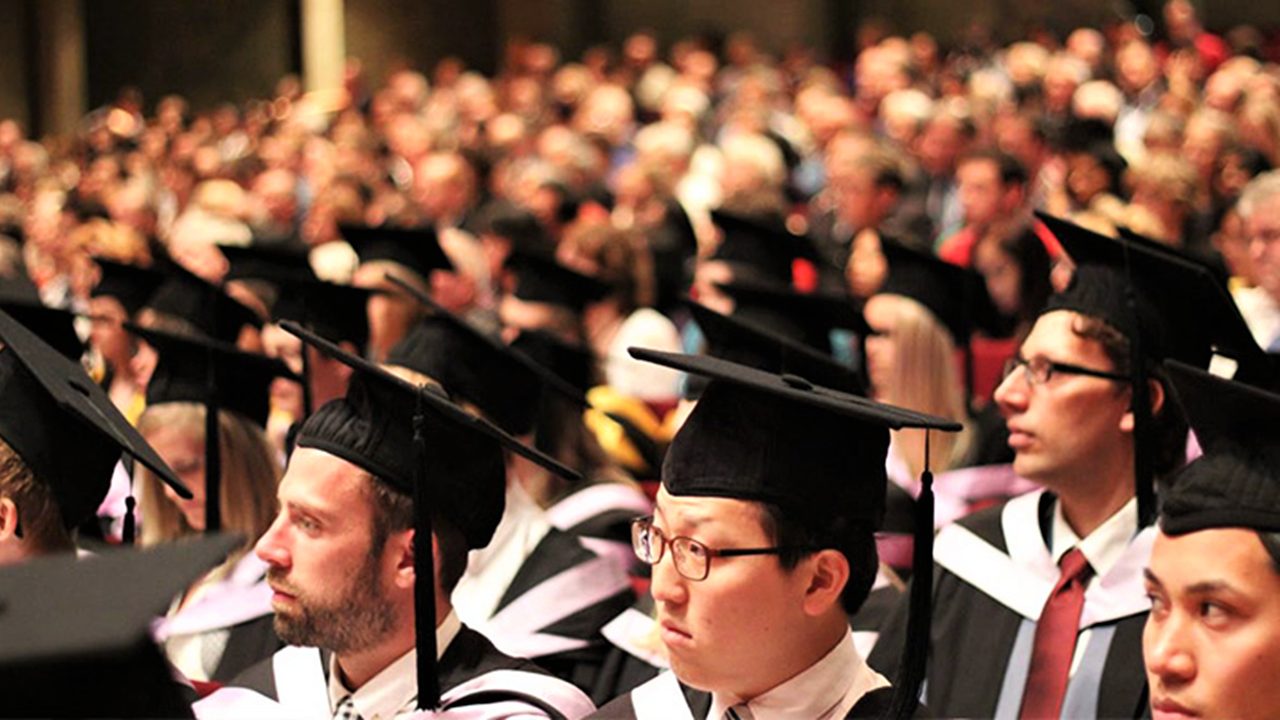
The latest round of UTas graduations finished on Saturday 19 December.
The graduation ceremony itself is one of great antiquity. Its essential features have been the same since the twelfth century, when the first universities came into existence. Its necessary constituents are the Chancellor, the academic staff, the graduands, and the public.
The Chancellor
When the Chancellor confers degrees, he says: “By virtue of my authority as Chancellor, I admit you to the degree of [name of degree].” These words are a translation of the Latin form used in the Middle Ages. Back then, the Chancellor’s authority to confer degrees came from the Church. The Church had a monopoly on education because it was the guardian of true doctrine, and clerics were among the small handful of people who could read and write. As a result, the only person who could appoint a teacher was the bishop of a diocese until the task fell to his chief secretary or chancellor.
As learning spread, teachers wanted a licence to teach everywhere, not just in one diocese. The Pope was the only person who could give them that. The Chancellor’s authority, then, came from the Pope. Since King Henry VIII created the Church of England, all subsequent universities throughout Britain and the Commonwealth realms have been created by Royal Charter. This is why the Chancellor does not wear ecclesiastical robes as they otherwise would have during the Middle Ages. Instead, they wear robes similar to those of the Lord Chancellor of England.
The academic staff
The second group participating in the ceremony is the academic staff.
In the twelfth century, they all would have been called ‘masters’, or MAs. Although they were not paid salaries at the time, they hired their own lecture rooms and charged their own fees. They also formed themselves into universities and became insistent that they, and only they, should determine who should be of their number.
Since this involved saying who should be teachers, the masters soon found themselves in conflict with the Chancellor. In the thirteenth century, they managed to persuade the Pope to declare that Chancellors should be obliged to confer degrees on all those nominated by the masters. This is why the masters examine the candidates, why the Dean (acting as their spokesperson) reads out the names of those who are to receive degrees, and why the masters at this ceremony watch to see that the Chancellor does what is required of him.
The graduands
Thirdly, the graduands.
The word ‘degree’ comes from the Latin gradus, which means ‘a step.’
When students are admitted to a Bachelor degree, they move one step up towards mastership.
When they are admitted to a Masters degree, they climb another step and become level with the masters, who then receive them into their universities.
The public
The public is the fourth constituent.
It has an important function because the whole point of the proceedings is that the students should be seen and heard by valid witnesses. The public hears the words of the Dean and the Chancellor and sees the new graduates dressed in their respective gowns or robes.
Academic gowns
Academic gowns are derived from the everyday dress of medieval clergy. In the Middle ages, the robes were worn closed at the front like a clergyman’s cassock. It was eventually decided that the front should be opened up to display the fine clothes the students are wearing underneath.
The gown’s hood was normal medieval headwear. It eventually acquired coloured lining. By the seventeenth century, the colours of the lining were strictly controlled so that the public could identify the university and the degree from the colour of a student’s hood.