
When it comes to LGBTIQ legal rights, Tasmania is another country.
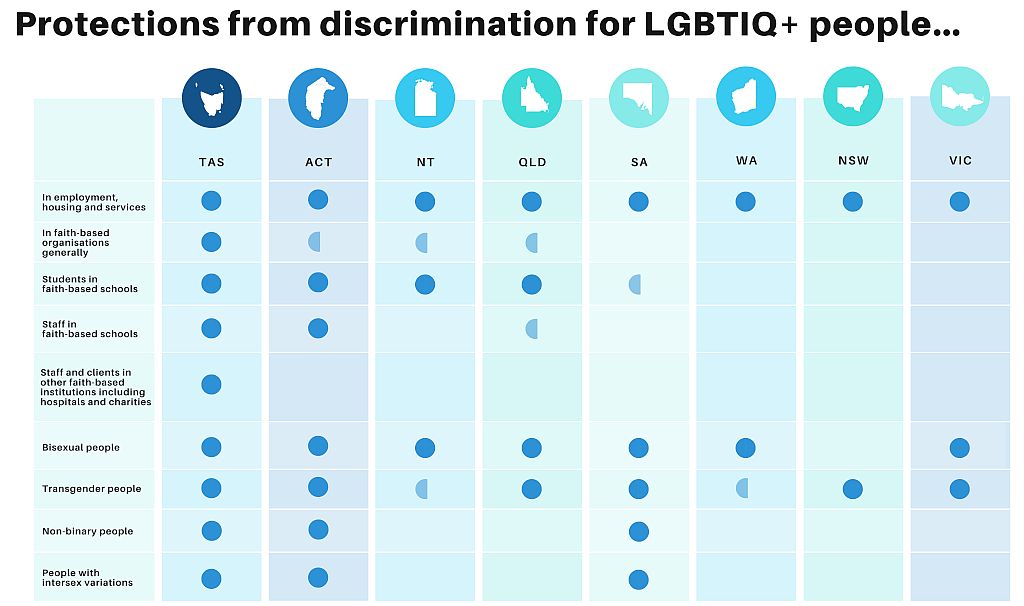
Tasmania not only has the strongest LGBTIQ human rights protections in Australia, the gulf between our laws and those in many other states is astonishing.
What makes this gulf all the more remarkable is that Tasmania was the last state to decriminalise homosexuality and the only state to criminalise cross-dressing.
In the 1980s and 90s resistance to those reforms involved the cruellest, most repressive and best-organised homophobic campaigning in modern Australian history. LGBTIQ activists were arrested for setting up a stall in a public market. Legislators called for homosexuals to be deported. Tasmania was jeered around the world as ‘Bigots’ Island’.
In a generation, we have gone from worst to best, from Alabama to Vermont as one American journalist put it.
Tasmania’s profound transformation highlights that far too little has changed in the other states, as well as providing valuable lessons about how that can be rectified.
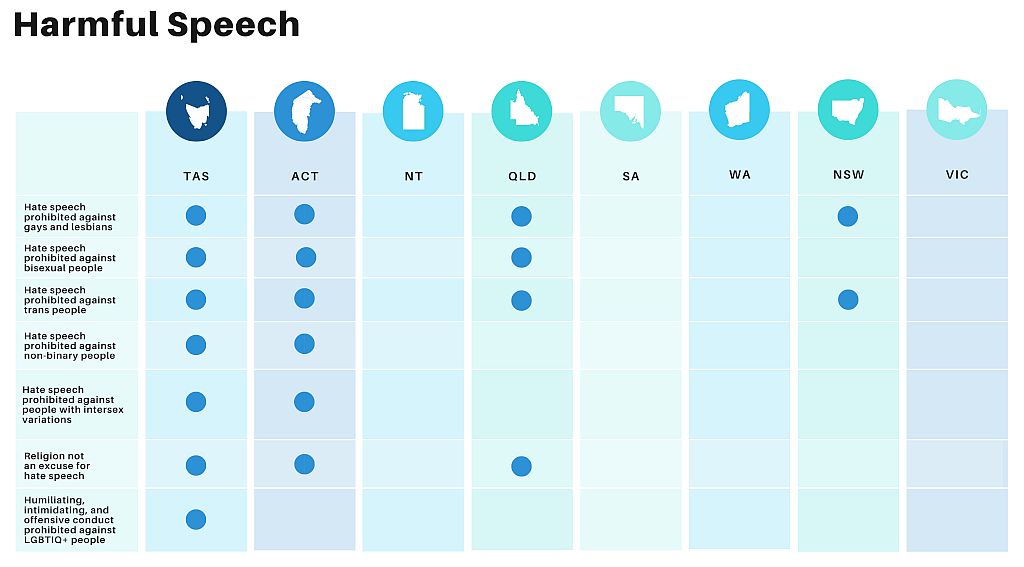
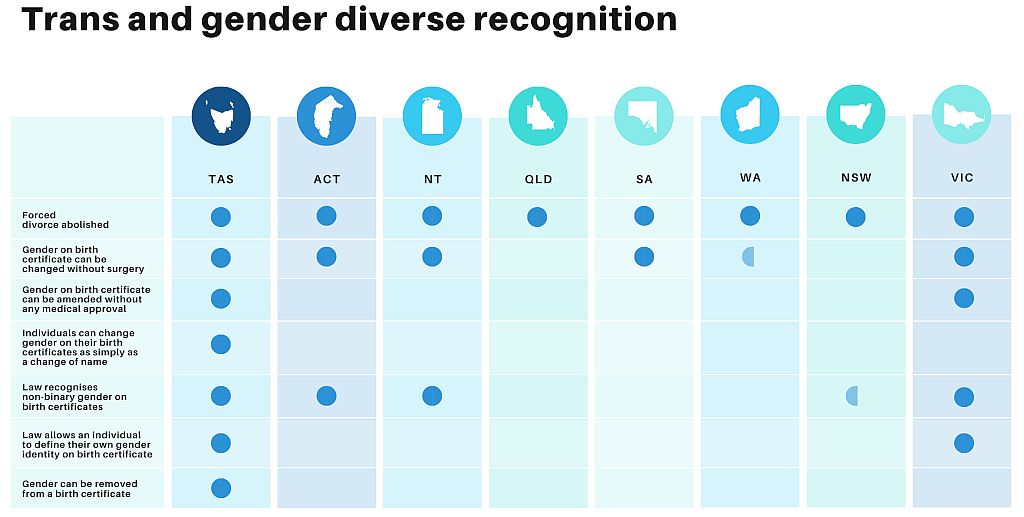
In this article there are three charts comparing Australia’s state laws on discrimination, harmful conduct and transgender rights. They summarise the detailed analysis of Alastair Lawrie who is one of Australia’s foremost experts on LGBTIQ legal rights. They illustrate just how deep the gulf is between Tasmania and much of continental Australia.
What these charts don’t show is that as well as having the best laws, Tasmania has often led the way. The Island enacted Australia’s first civil partnership law and was the first to move on same-sex marriage (it was the first state to recognise overseas same-sex marriages, to have both major parties in support and to introduce a same-sex marriage law). Tasmania was also the first state where the Premier committed to a public apology for historical gay and trans convictions.
When you lay all our gold-standard laws side-by-side another distinctive feature emerges: they are founded on a set of basic principles. Our relationship laws do not privilege cohabitation or conjugality when it comes to which relationships are considered worthy of recognition, effectively allowing Tasmanians to define for themselves which of the personal relationships is most important and deserves legal rights. Our discrimination laws do not allow discrimination against LGBTIQ people by faith-based organisations or in the name of faith. Our laws against harmful conduct prevent not only incitement to hatred but all forms of intimidation, humiliation and bullying against the widest range of people. Our gender laws not only allow trans people to amend their birth certificates without surgery, but allow anyone to remove gender altogether so they are no longer defined by it.
Individual choice, no religious privilege, protecting the vulnerable: these are the values that animate our laws.
In terms of practical impact on the lives of everyday people, our laws have proven themselves to be of great benefit. In the last two years, researchers at the University of Tasmania have conducted two studies comparing the experiences of LGBTIQ employees in Tasmania and other states, one focussing on the employees of faith-based organisations, and the other looking at employees generally.
In both studies LGBTIQ Tasmanians consistently scored higher than other LGBTIQ Australians when it came to feeling protected from discrimination and having equal opportunity in the workplace. The gap between Tasmanian and continental Australian LGBTIQ employees in faith-based organisations was particularly pronounced.
When it comes to policy, Tasmania has the most, and the longest-lived LGBTIQ / Government reference groups. Reference groups in health, police, education, justice and the whole-of-government go back, in some cases, a quarter century.
They meet several times a year with the whole-of-government group chaired by the Premier. These groups are responsible for Tasmania leading on everything from school inclusion, through police training to health policy.
In just the last few months, the State Government has developed a new mental health strategy with a particular focus on LGBTIQ mental health and is about to launch an LGBTIQ community survey to determine future priorities for its whole-of-government LGBTIQ strategy.
It has recently funded gender-neutral toilets in Devonport and LGBTIQ advocacy training statewide.
Such policy initiatives also occur in other states. What’s notable about Tasmania is that LGBTIQ initiatives like these are happening under a Liberal Government and have been happening for decades.
Most important of all, this transformation of laws and policies is based on a solid foundation of transformed community attitudes. When the campaign to decriminalise homosexuality began in 1988 only 31% of Tasmanians supported reform, well below the national average.
In the 2017 marriage postal survey Tasmania returned a Yes vote above the national average and second only to Victoria among the states.
The high Yes vote was despite Tasmania having a population that is Australia’s oldest, poorest, least educated and most rural. These are demographics which are traditionally seen as predisposing a population against LGBTIQ equality, but as Tasmania shows that doesn’t have to be the case.
We have truly earnt the title of the Rainbow Isle.
Tasmanians know how far we have come. That is why heterosexual decision-makers have said yes to plaques and monuments commemorating our transformation in Hobart, Ulverstone and elsewhere.
Foreigners can also see it. In 2014 a delegation of Hong Kong police visiting Australia chose to include Hobart on their itinerary because Tasmania has the best model for LGBTIQ / police liaison in the nation.
The religious right is also alert to the higher standards set in Tasmania. Stuart Robert, Lyle Shelton and any number of conservative pastors and prelates have singled out Tasmanian LGBTIQ laws for criticism.
There’s a reason Christian Porter’s Religious Privilege Bill explicitly targets only one state’s laws, Tasmania’s. Of all the states, Tasmania poses the biggest threat to those prejudices and privileges the anti-LGBTIQ right wants to protect.
Not everyone acknowledges Tasmania’s transformation and our leadership.
There is a culturally-entrenched habit of seeing Tasmania as the dark place modern Australia emerged from rather than the enlightened place it should move toward.
This is partly because the roots of many Anglo-Australian family trees lie in the gloom and brutality of Tasmania’s early convict prisons, and it is only later in Sydney and Melbourne that these trees bloomed.
Some Australians also have a habit of projecting on to Tasmania everything they don’t like about themselves, not least their prejudices against Indigenous people and LGBTIQ folk.
Whatever the reason, Australians are more familiar with seeing Tasmania in their rear vision mirror than on their GPS.
Because of these cultural biases, I’ve heard the Tasmanian achievement dismissed as a fluke, an aberration, a boast.
That’s frustrating, not only because it ignores facts, but also because it stops people asking the obvious and necessary question: how did Tasmania change so much and what can we learn from its success? That question is crucial to understanding how the rest of the nation can catch up.
I have often answered the question how did Tasmania transform? It’s time we heard from other people equally qualified to provide insight. That is why I asked several people who have been involved in Tasmanian LGBTIQ advocacy to write down what they believe is responsible for Tasmania’s transformation and what advice they have for other advocates.
Jen van-Achteren was a long-term board member of Equality Tasmania (then known as the Tasmanian Gay and Lesbian Rights Group) and is a member of Bi-Tasmania.
The gay law reform campaign and the awareness it raised meant, once it was achieved, the Tasmanian community was inspired; determined to ensure the hate and discrimination, witnessed during the public debate, no longer had any place.
The bravery and determination of LGBTIQ+ advocates and the respectful manner of their protests, awareness raising, on many fronts, and advocacy won the admiration of all, including opponents.
On our beautiful heart-shaped island, advocates supported LGBTIQ+ folk and their families to tell their stories to politicians – and to the media, community groups, their family and networks winning hearts and minds.
Advocates never compromised on reforms, did deals, sold out other community members or settled for incremental reforms. Our LGBTIQ+ community’s too small to be divided in its quest for human rights and dignity. As a result, unlike most states, all members of our community are protected, not only gays and lesbians. Appreciating each other’s experiences and opinion, working together for the benefit of all – including other minority groups, such as people living with a disability, where legislation or policy also impacts on them – is why we’ve now the best protections.
Stay vigilant, because the battle’s never over; hard-fought wins can be undone by fearmongering and new legislation. Really hear all points of view. Keep raising awareness, telling the stories of real people; respectfully, and with good intent. Your sincere actions just might open hearts and minds.
Lee-Gwen Booth was arrested defending the LGBTIQ rights stall at Salamanca Place in 1988. In her capacity as the secretary of the Tasmanian Gay and Lesbian Rights Group she spoke to a range of groups across Tasmania in the early 1990s.
Malcolm X said: “You can’t legislate good will – that comes through education.” Direct action is important in achieving legislative change. Willingly being confrontational, putting oneself in harm’s way, and even inviting arrest when necessary can help push the issues to the forefront of the political debate. It is also important to be relentless – to know what you want and to keep trying new strategies when old ones fail. Sometimes, as with Toonen v. Australia, you may succeed when the best minds say it’s a mistake!
However, as well as legislation, the goal should be to create a healthy, welcoming environment, a sense of belonging and community. Big splashy newsworthy events will get the nation talking, but it is not just the nation we need to affect. To effect lasting change, we need to bring the community with us. We need to consider the impact of our words and actions on the hearts and minds of those who are watching.
What we did right in Tasmania was to foster civil debate and personal connections. We were non-violent at our protests and rallies and tirelessly discussed the issues with individuals and groups. We deemed no group too unimportant or too small to be worthy of attention. We talked – and talked and talked – about our lives in Tasmania, about the pain anti-gay laws caused, about our hopes for the future. And, in so doing, we not only changed the laws … we changed our little part of the world.
Mike Cain is current a board member of Equality Tasmania. He took a landmark discrimination case against the gay blood ban in 2005.
Tasmania has leapfrogged the other states because of the invigoration of young people assisting change makers get messages off the ground, and because of parliamentary determination not to go back to the dark ages of pre-1997.
Like Darwin said it’s not the strongest species that survives, it’s the one most adaptable to change. Tasmanian advocates have modified their message and its delivery, grown with technology and the community as much as they’ve influenced it. Advocates are getting smarter and wiser, I think motivated by a passion not to return to the pre-1997 days.
We never give up. It can seem hopeless sometimes, like a wave crashing against the 12 apostles, a battle you might never win. But perseverance and gaining strength from rightness of the cause will get you through. Opponents want us to give up in the face of constant opposition and like tide, we will wear them down because our conviction is stronger.
Ange Dwyer is an academic specialising in criminology and a board member of Equality Tasmania.
The key reason I see that has situated Tasmania as having the best LGBTIQ rights laws in Australia is the level of advocacy work in this state. Tasmania has some of the foremost LGBTIQ advocates in Australia that have tirelessly driven the very challenging and opaque work of political advocacy
LGBTIQ advocates in Tasmania organise countless hours of meetings with politicians to gauge their positions on different legislative changes and to educate them about why this change is important and how it will impact the lives of LGBTIQ people. They organise media releases, rallies, pledge signings, media campaigns (including videos recorded by LGBTIQ people and getting others to donate their time to film/edit, and time on TV and radio), and expert panels (to name just a few!!) to educate the public and they seek support of politicians directly to facilitate these processes.
Tasmania has a unique position where advocates can quite easily access parliamentarians to have these conversations, but they work very hard – often with little thanks or return! This is not necessarily something that you could do so easily in Victoria, for example, where it might take months just to get a sit-down meeting with a parliamentarian. However, if you have a group of people that are tasked with regular catch ups with parliamentarians in a sustained effort, you can make change happen like that which happens in Tasmania.
Advocates in Tasmania are also well educated about the processes of advocacy work and how to do the work of educating politicians and getting legislation changes through the political process. These forms of understanding are crucial for the introduction of new legislation, but also for educating political figures about legislation changes being requested and why they are needed. Tasmanian governments cannot ignore calls for change on such a broad scale when so many advocates are seeking their time and investment in legislative change in an ongoing way.
The advocates in place now, with experience making legislative change happen, need to start educating future LGBTIQ advocates now! They need to have knowledge and understanding of political process and legislative change, and they need a collective of LGBTIQ people that have these skills and that can collectively educate and sustain the level of awareness needed of LGBTIQ issues on the political radar. LGBTIQ issues can be easily sidelined for more important issues when they emerge. It is only through continuing to visibly keep these issues in the political awareness that Tasmania is able to make change happen so effectively.
Michael Dempsey took a number of successful complaints about hate speech including against John Laws. He is a former board member of the Tasmanian Gay and Lesbian Rights Group.
Tasmania has built trust and confidence in the community that the LGBTIQ community and members matters, and that we are a better society for giving every opportunity for every person to thrive, whether young or old, new or born here, and LGBTIQ or not. That lead to a massive ground swell of support that Tasmania can be a shining beacon for an inclusive society. To para-phrase (pioneering Tasmanian wilderness photographer) Olegas Truchanas:
“Is there any reason why Tasmania should not be more beautiful on the day we leave it, than on the day we came?… If we can revise our attitudes towards the land under our feet; if we can accept a role of steward and depart from the role of the conqueror, if we can accept that man and nature are inseparable parts of the unified whole, then Tasmania can be a shining beacon in a dull, uniform and largely artificial world.”
Basically, the early advocates enabled those since to tell our story, by putting in place the legal protections to do so in the knowledge that we were secure in our homes, jobs and families. From that springboard, lots of other matters and short-comings could be tackled.
My advice, is follow your heart and dreams, tell your friends and family how you feel and what you want, contact politicians to have a meeting, and of course have fun.
LGBTIQ people are a long way from being free and equal. Prejudice, discrimination and stigma continue to nip at our heels and sometimes yell in our face. Indeed, across the western world resurgent anti-LGBTIQ prejudice is attacking our hard-won rights under the banners of “religious freedom” and the “gender binary”.
Tasmania is no exception. Powerful elements in the state government have sought to water down our Anti-Discrimination Act and remain unhappy about our landmark gender reforms. But so far they have failed thanks to our commitment to public education, our principle of not appeasing prejudice and the depth of commitment to LGBTIQ equality in Tasmania’s institutions and broader community.
On top of resurgent discrimination, there are also many important and urgent reforms we must move ahead on. These include a thoroughgoing ban on conversion practices and ideology that affirms LGBTIQ people, systemic LGBTIQ inclusion programs in all schools and adequate funding for LGBTIQ health services.
Some folk may think this article glosses over those problems and challenges. I may be accused of fostering a sense of complacency. But my intention is exactly the opposite. The point of this article is to inspire Tasmanians to work for greater inclusion and equality by reminding us how far we have come and how we got there. My intention is also to inspire LGBTIQ advocates in other Australian states. If we Tasmanians can do it, so can you.
I also want to show that LGBTIQ people do not have to accept reforms that are compromised and second-rate. Too many recent LGBTIQ reforms have been deeply caveated with religious opt-out clauses and the omission of difficult or controversial elements.
This was the case for the 2017 marriage amendments that contained “religious freedom” carve outs, the 2019 Victorian gender reforms that didn’t include the possibility of removing gender from birth certificates, and Queensland’s recent conversion practices ban that didn’t include religious settings where most conversion practices actually take place.
Tasmania shows we don’t have to accept these legislative indignities. Tasmania shows we can have full equality. Tasmania shows how much is possible when we act boldly and believe in ourselves.
I hope that within a few years every box on the tables above will have a little blue dot. All LGBTIQ Australian should feel they live in the same country with the same rights. The sooner the rest of Australia heeds the lessons from Tasmania the sooner that time will arrive.
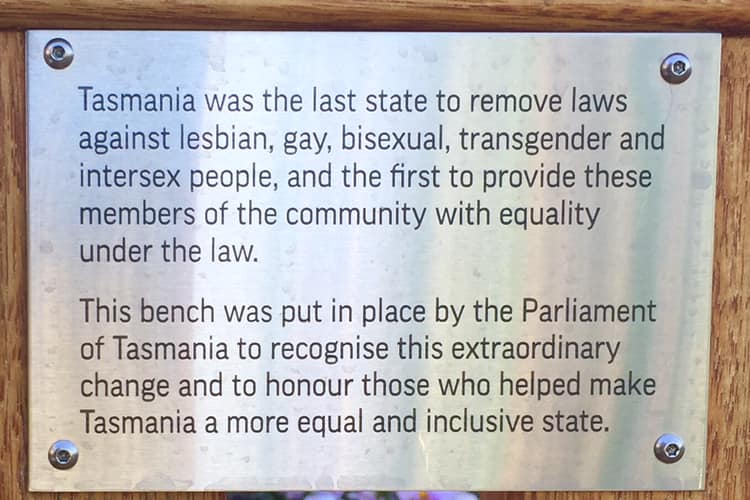
The plaque on the Equality Bench outside Parliament in Hobart. It was unveiled to commemorate the 30th anniversary of Equality Tasmanian in October 2018.
Featured image: The Leven Bridge in Ulverstone lit in rainbow colours by the Central Coast Council to mark Pride Week 2019.