Tas That Was
Tas That Was – the Hospital at Port Arthur
You mightn’t grumble about modern medical care when you find out what conditions were like at Port Arthur’s Hospital!

Port Arthur’s Hospital (located on the hill above the Penitentiary) was built out of sandstone and bricks between 1841 and 1842. It was designed by convict architect Henry Laing.
Layout
The Hospital contained an arcade and an open balcony where convalescing patients were allowed to walk. Busts of Hippocrates and Saint Luke sat atop the corner gables.
It had wards that could accommodate up to 80 convict patients. (Civilians were treated in their own homes.)
The Hospital also had a morgue, a storeroom, a kitchen, a wash house, and even a waste collection room!
Treatment
The Hospital was staffed by a doctor, who was aided by untrained convict orderlies.
Convicts themselves were treated for various illnesses and injuries at the Hospital. The most common illnesses were respiratory or rheumatic complaints, which were aggravated by Port Arthur’s damp climate. Injuries were frequent because the working conditions at the settlement were often hazardous.
Surgery was a painful experience during Port Arthur’s early years because chemical anaesthesia wasn’t practised in Tasmania until 1850. Patients had to endure the pain while being strapped to the operating table.
If you’re weak in the stomach, skip the rest of this paragraph; I’m going to tell a gruesome story. Convict Edward Howard tried to escape Port Arthur, but he was shot through the upper arm, the bullet smashing the bone. He was taken to the Hospital, where the doctor dislocated his shoulder and amputated his arm at the socket.
The doctor then cauterised the stub with a hot frying pan. Blimey!
Captain Charles O’Hara Booth, the then-commandant of Port Arthur, was present during the entire operation, and later wrote in his journal that Edward “underwent the operation most manfully and is doing well.”
Edward was sent back to work two weeks later as an example to other convicts.
Drugs were frequently administered without much knowledge of how they worked. There are many recorded cases of potent medicines (e.g. opium) being misprescribed to patients.
Nursing did not exist at Port Arthur’s Hospital until just before the prison closed. The convict orderlies would perform most of the tasks of today’s nurses, though rarely with sensitivity or application.
Autopsies
It was common for the Hospital’s doctor to perform autopsies on the bodies of dead convicts. He did this to establish the cause of death. The bodies were then rowed over to the Isle of the Dead, where they were buried.
After Port Arthur’s closure
The Hospital was abandoned after Port Arthur closed in 1877. It was eventually purchased by the Catholic Church, who converted it into a boys’ home.
A bushfire gutted the building in 1895. The outer walls remained strong and in good condition, though, so the Church claimed on their insurance and rebuilt the structure.
But it was gutted by another bushfire in 1897. The Church decided not to rebuild, and left the building in much the same condition that it appears today.
The ruin was stabilised during The Port Arthur Conservation and Development Project, and is accessible to people who visit Port Arthur.

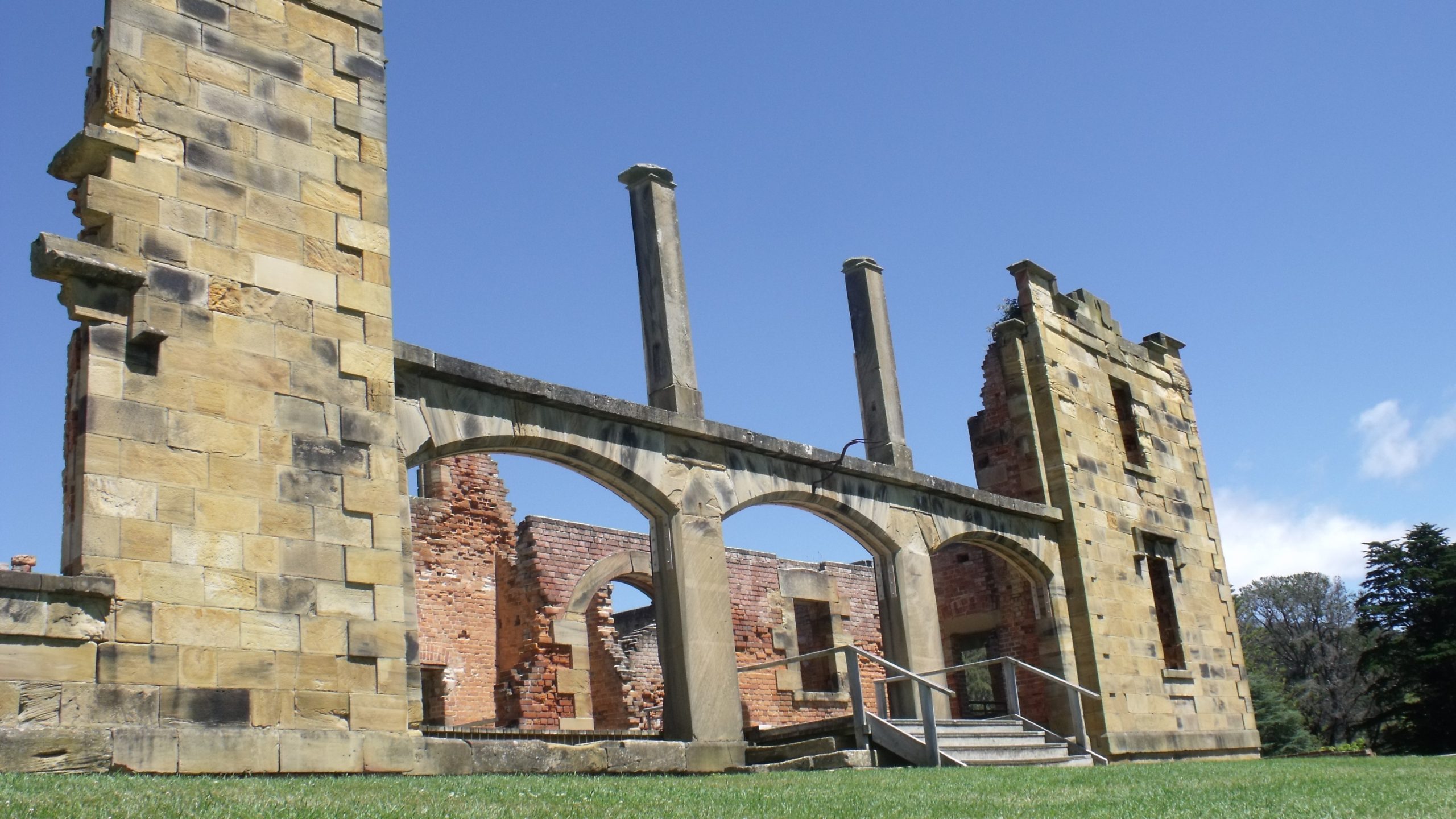
The Hospital today
Bibliography
- On The Convict Trail – The Hospital, Port Arthur.
- The Port Arthur website.
- A Short History Guide to Port Arthur, 1830-1877 (second edition) by Alex Graeme-Evans and Michael Ross.
- A Visitor’s Guide to Port Arthur and the Convict Systems by Geoff Lennox.
- Your Guide to Port Arthur.
Acknowledgement
Susan Hood, the manager of Port Arthur’s Resource Centre, kindly provided me with a transcript of Charles O’Hara Booth’s journal entry regarding Edward Howard. She also gave me useful information about Port Arthur’s Hospital.
* * * *
Tas That Was is a column that includes:
- anecdotes of life in Tasmania in the past;
- historical photographs of locations in Tasmania; and/or
- documentaries about locations in Tasmania.
If you have an anecdote or photograph you’d like to share with us, please send it to submit@tasmaniantimes.com.