Tasmanian Aborigines did not grow up speaking our language as a first language. As a consequence of the devastating impacts of invasion and colonisation on every aspect of our lives, we have had to undertake the long and difficult task of restoring our language to its spoken life.
Today, many Aboriginal people of all ages can now speak palawa kani, the language of Tasmanian Aborigines, and children learn it from an early age. The reach of palawa kani language teaching is very restricted by the lack of funding and has therefore been confined to the Aboriginal community.
Read how we, like many other indigenous people around the world, and using the same methods, have brought our language back to life; and of the challenges we continue to face. Part 1 of our two-part series on Tasmanian Aboriginal language today is written by the Anglo-Irish long term manager of the Tasmanian Aboriginal Centre’s language and history program.
The Tasmanian Aboriginal Centre is acknowledged both within and outside the Aboriginal community as the body with responsibility for Aboriginal language work, conducted by the palawa kani Language Program across the state since the early 1990s. The palawa kani Program was among the first in the country in which Aboriginal people learnt the necessary linguistic methods which have since enabled us to do all the retrieval work on Tasmanian Aboriginal language.
There are no living speakers of the original Tasmanian languages and spoken records of the original sounds are limited to a few sounds that can only just be heard when spoken by Fanny Cochrane Smith on the 1899 record on which she sang traditional songs.
Between 8 and 16 separate languages could have been spoken here originally; we will never really know but our preliminary research indicates 7 distinctive languages regions.
Some tribes had been wiped out by contact sicknesses even before full scale invasion and the languages continued to die away with the people.
Fortunately, remnants of many of those original languages were written down in wordlists by more than twenty different European recorders, starting from Cook’s visit in 1777 right through the colonial period. Most of these recorders were speakers of different regional dialects of English; another was a Scot, one a Danish, many were French.
Each of them attempted to reproduce the unfamiliar sounds they heard in the Aboriginal words through the spelling system of their own languages. Different recorders wrote different spellings for the same word, and individual recorders even wrote several different spellings for the same word, indicating they heard it on different occasions and from different Aboriginal speakers. Their different records also show frequent disagreement and confusion about the meanings of the words, and about the area of origin of either the word or its Aboriginal speaker, and often both.
some misunderstandings
Most tragic of all, there aren’t enough words or information recorded of any of the original languages to rebuild any one of them exactly as it was. As a result, palawa kani combines words retrieved from as many of the original languages as possible. This brings us to the first of several major misunderstandings.
Firstly, some people think if you select a word or words from a wordlist, which the recorders have said are from the same area, you have ‘Aboriginal words’ of a ‘local language’. But a word list, however well or poorly researched and compiled, is just that: a list of ‘words’, not a language.
Secondly, you need to look further than published books and compilations of wordlists to find evidence for languages no longer spoken. A wealth of manuscript material from the colonial period is amassed in libraries and other institutions both in Australia and overseas, and this primary source material contains the first-hand observer accounts necessary for the scholarship required to retrieve evidence of sleeping languages. Our language workers had to access those original sources through the old technology of microfiche – painstaking work indeed.
These primary source records, together with a very few later audio recordings of Tasmanian Aboriginal speech, and language remembered into the twentieth century, are the sources for palawa kani. We were able to collect over two hundred words, phrases and song fragments from the memories of over thirty Aboriginal people throughout the twentieth century. Many of these duplicate each other, across different families and time periods, and from both mainland Tasmania and the Bass Strait islands. People living today still sing songs they learned as children, which they have taught their own children, and these are recognisably anglicised versions of songs recorded from Aborigines in the 1830s.
The third – and most common – misunderstanding is that the spellings that appear in various lists of recordings of Aboriginal language are Aboriginal words. In fact, they are only approximations by those European scribes of many nationalities who tried to capture unfamiliar Aboriginal sounds in their own European spellings. Those spellings of words written by the recorders, and since published by Plomley and other historians and writers and which now appear everywhere – on websites, in museums and other interpretative displays – are not in themselves Aboriginal words.
Retrieving evidence of the original languages
Nonetheless, the recorders’ spellings are essential. Without them we do not have any representation of how our languages sounded, and what the words meant. It is possible to use those spellings (also called ‘recordings’) as a starting point for bringing back the words they represent to as close to their original sounds and correct meaning as is possible.
It is fortunate that there were so many different recorders of the original languages because this allows us to compare spellings and meanings. The palawa kani Language Program team recognised however that the value of any recording is only as credible as the person who wrote it down. One of the Program’s earliest tasks was to determine the most accurate, hence most reliable, recorders of the sounds and meanings. This enabled us to identify the strengths and weaknesses of individual recorders. These factors are taken into account with every word revived.
A linguistic research project undertaken by the palawa kani Language Program in the 1990s confirmed what sounds existed in the original languages, and an alphabet was custom designed to represent those sounds, in line with the decisions made by Aboriginal community members at large statewide meetings. To retrieve the authentic sounds of each individual word, those spellings from the recorders are analysed through a linguistic process called ‘reconstruction’.
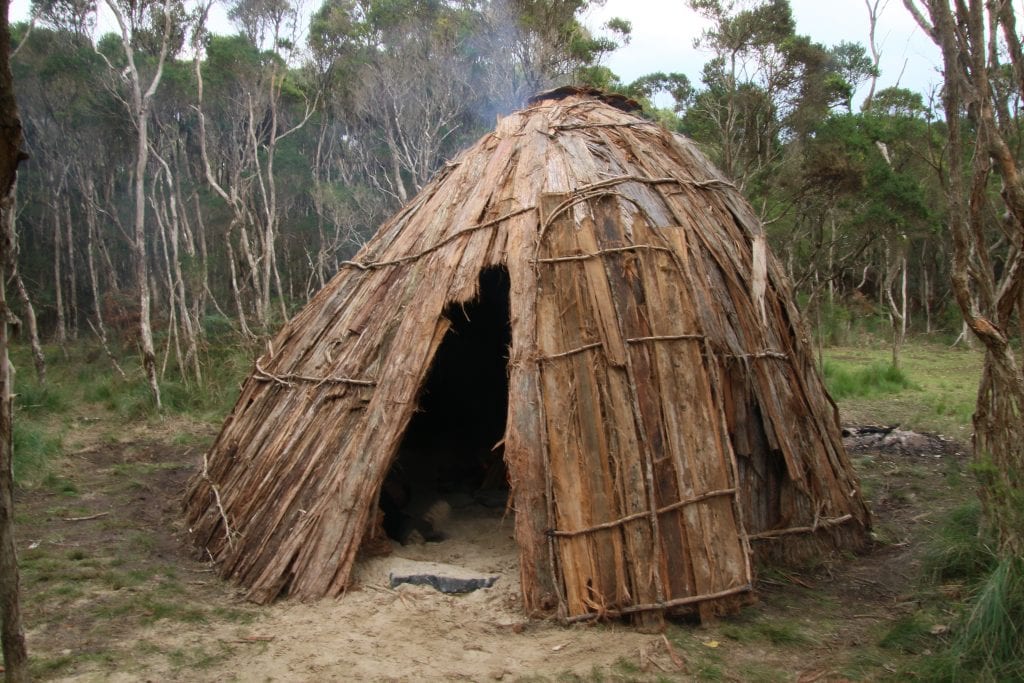
Image courtesy TAC.
‘Reconstruction’ is a linguistic term for a standard process used world-wide in the recovery of languages which are sleeping or no longer spoken; most of these are indigenous languages. Unfortunately this term is too easily misunderstood or wilfully misinterpreted. It does not mean ‘to construct’ a language, or ‘to create’ one – in the sense of just making things up from no evidence, or randomly selecting European spellings from wordlists, and claiming those words to be ‘language’. On the contrary, it is a rigorous process by which linguists and language workers recover the original sounds and meanings of the words of a language from all the recorded versions of the words.
The most likely sounds of each word are determined by comparing the spellings of all the recorded versions of that word. All the possible spellings are transcribed into the International Phonetic Alphabet (IPA), which contains symbols for every possible sound in human speech.
Through this analysis, we are able to determine as closely as possible the original sounds recorders tried to represent with their spellings.
Those sounds are then written in the palawa kani sound and spelling system.
The word’s meaning is worked out in a similar way, by comparing the translations given for all the recorded versions of that word and cross checking these where possible with the reliability of the recorder/s, the context of when, where and from whom the recording was made, the accuracy of the language region given by the recorder/s, other historical information related to the subject of that word, and cultural knowledge still held within the Aboriginal community.
palawa kani
Applying this methodical process to the evidence from all the historical sources gives us the best chance to revive authentic Tasmanian Aboriginal language, as close as possible to the way it sounded before contact with European or other languages. However, palawa kani is not exactly the same as any of the original Tasmanian Aboriginal languages.
Participants in community workshops of 1993 and 1994 understood that the remnants of each of the original languages were not enough to revive any single one of them, but that one language could be retrieved from the records of them all. This mirrored the way in which the families of the survivors of the invasion, from wherever they all now lived throughout Tasmania, had since coalesced into one statewide Aboriginal community; and the language remembered in families from both the Bass Strait Islands and the Huon areas also shows that a mix of words from several original languages had been used from at least the start of Robinson’s ‘Mission’ and then throughout the Wybalenna period.
Grammatical structure is an integral element of a functioning language and cannot be gleaned from isolated words from wordlists. It was believed in the early 1990s that the revived language would need to rely on grammatical features of the English language. This was the assessment of some earlier linguists who had assessed there was little or no evidence of original grammar, based on small samples of records in wordlists. Since that time, the painstaking examination, word by word, of the original languages for the first time ever, by the palawa kani Program, revealed clear evidence of consistent patterns of use and grammatical functions. These included ways to make plurals, word orders different to English, a range of suffixes to denote specific functions, borrowings, and adaptation of traditional words to talk about things newly introduced by Europeans.
An example of this is a phrase that is sometimes used as a ‘greeting’ – ‘yah! tahwattya’. The ‘yah’ part is indeed a greeting, spelt in palawa kani as ‘ya’ (hello). However, ‘tahwattya’ is a recorder’s English spelling of an Aboriginal word meaning ‘catarrh’ – a respiratory illness not common before invasion (spelt takwatja in palawa kani). All the five variants of this word were recorded by surgeon Joseph Milligan, at Wybalenna where the people were dying of these introduced illnesses. Two of his five spellings he translated as ‘woe’s me’; two others as ‘cough’ and ‘catarrh’; and one, with ‘yah’ attached, as ‘greeting’. Milligan is one of the most unreliable recorders of translations, and the comparative examination of his five recordings confirms this, as they show that what Aborigines were saying was something like, ‘Hello, I’m sick/feeling miserable’; and not ‘Hello, how are you?’
Annie Reynolds has evolved from graduate studies of Old Norse, Old English and Old Irish in Sydney and Adelaide to coordinating the work of the Tasmanian Aboriginal Centre’s palawa kaniLanguage program statewide since the mid 1990s. Within the TAC she also conducts historical research and writes and edits a variety of material, mostly for the Aboriginal community.
In Part 2 we describe the further work undertaken to retrieve the original names of geographical features and why the Tasmanian government changes to place naming are more about political posturing than honouring the lives and languages of our tribal ancestors. – Heather Sculthorpe, CEO, Tasmanian Aboriginal Centre.