Researchers at the University of Tasmania’s Menzies Institute for Medical Research and the School of Medicine have added an arsenal of new tools (see video below) to their repertoire for fighting the insidious Devil Facial Tumour Disease.
A paper published this week in Science Advances journal outlines new cost-effective technology that can be used for advanced immunology studies in Tasmanian devils.
Immunotherapy has transformed the way cancer is treated in the past decade, but little is known about its potential in other species. Lead author on the study, Dr Andrew Flies, said that around 40% of humans and Tasmanian devils develop cancer in their lifetime.
Tasmanian devils are also afflicted with two different transmissible cancers that have killed thousands of devils.
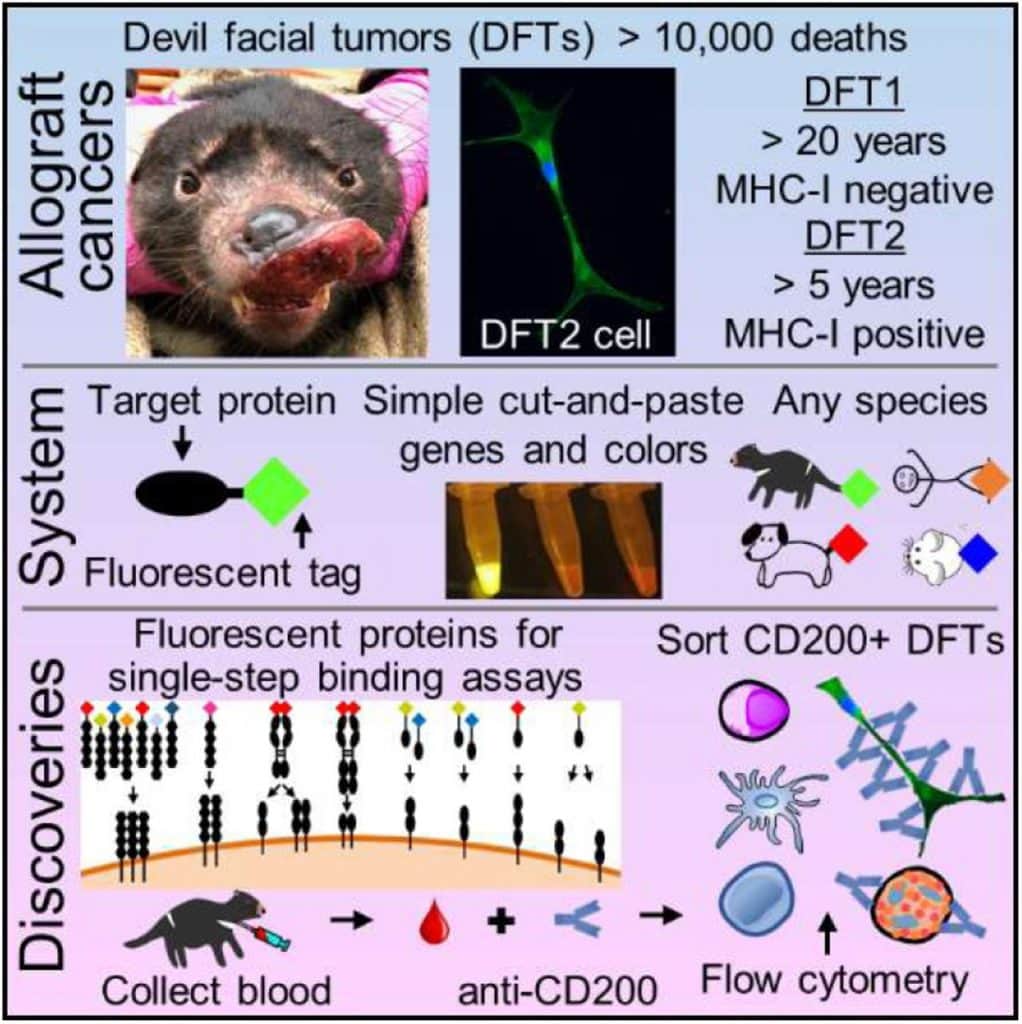
“We developed a simple cut-and-paste reagent development method that can be applied to any vertebrate species and show that immune pathways are conserved across 160 million years of evolution.”
“The evolutionarily conserved pathways suggest that naturally occurring cancers in devils and other species can serve as models for understanding cancer and immunological tolerance.”
This system was used to show that many key Tasmanian devil immune proteins look the same as they do in the human immune system.
We also showed that we could find tumour cells in blood, which could shed light on how cancer invades organs and kills devils.
The versatility of the system was demonstrated by replicating a nanobody (aka tiny antibody) that binds to a key human immune checkpoint protein, and thus demonstrated that the new system can be used for any animal species.
Director of the Menzies Institute for Medical Research, Distinguished Professor Alison Venn, said this research was vital for a Tasmanian icon.
“These new tools allow us to accelerate our devil immunology and vaccine research to help save the Tasmanian devil.”
DFTD was first described in 1996. In the subsequent decade the disease ravaged Tasmania’s wild devils. Field testing of the potential vaccine is being undertaken as a collaborative project between the Menzies Institute and the Save the Tasmanian Devil Program under the Wild Devil Recovery program, and aims to test the immunisation protocol as a tool in ensuring the devil’s long term survival in the wild.