Build a house for the homeless and at the same time inject some income into the community. Here’s how!
A homeless person does not generally pay rent and therefore does not receive Rent Assistance. With Rent Assistance of $139.60 per fortnight or $3629.60 per annum this means that a community having ten homeless people within their neighbourhood is missing out on $36296.00 each year.
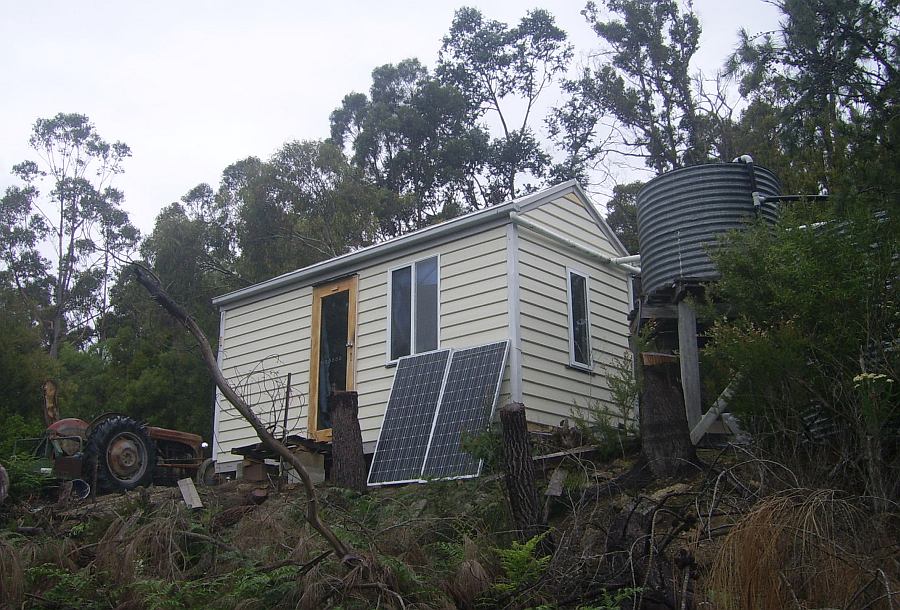
To tap into this source of income is not hard. If an amount of $6000.00 is invested (by either an individual or a community group) a transportable tiny house may be built (with readily available new building products). Recent history has shown that various governments and authorities are incapable or unwilling to provide affordable housing for the homeless.
It is probably time for the community to take action. Given that one of these tiny houses is ultimately capable of attracting income of $3629 per year then the capital cost is easily paid off in two years with interest.
As far as the actual construction is concerned, many Men’s Sheds – of which there are about 900 in the country – are quite capable of this. Alternatively Adult Education Courses (or U3A) could be run to assist homeless people with construction. There is also the option of private entrepreneurs looking for a profitable business. Building locally can make better use of local products and expertise.
Administration of the rental side of the project would be best suited to local not-for-profit community groups. In order to receive the maximum amount of Rent Assistance, a person has to pay $310.73 per fortnight rent. To make this affordable, in some cases the same community group may have to think of ways to usefully employ a homeless person up to an amount of $100 per fortnight (if required).
Where to put these houses we hear? The fact is homeless people are already sheltering somewhere. They are already making use of available spaces. Local communities and organisations often have access to spare land. In time, many of the tiny houses may end up in backyards.
Some of these houses may become the next pandemic isolation shelters. They can have their own power supply and composting toilet. They are easily transported on a normal car trailer (as a wide load) and rain water can be collected if desired.
After the pay-back period of two to three years, then it is up to the not-for-profit community group to decide if they want to pass ownership to the homeless person or not. Imagine the delight in a homeless person having their own tiny house!
The author, Tom, is a semi-retired hobby farmer from the north west coast, with an interest in social issues.
For comments, please add to our Housing the Homeless topic in the Forums.