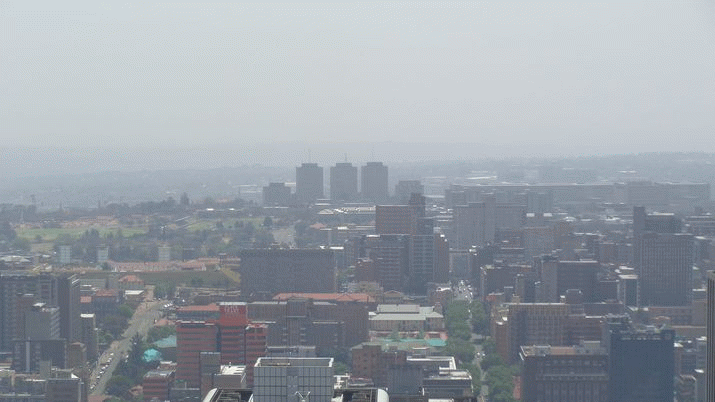
*Pic: Rckr88, Flickr who says: ‘Johannesburg Skyline. View from the 50th floor Observation Deck of Carlton Centre-Johannesburg, South Africa’
Don Knowler returned to Africa recently, more than 40 years after leaving his British homeland to seek adventure working for The Star in Johannesburg. As a reporter in the 1970s, Knowler covered the Soweto riots in 1976 and other events in the anti-apartheid struggle for a newspaper which opposed the South African Government’s policy of racial segregation. He was also chief of the Star’s bureau in Rhodesia during the last two years of the bush war which led to the black-ruled, independent Zimbabwe.
RIDING in a tourist bus a few months ago on the eve of the 40th anniversary of the Soweto anti-apartheid uprising in South Africa I found myself treated as a celebrity.
I had been in the township on the day of the riots in 1976, something the African-American visitors on the bus felt worthy of a photo taken with their mobile phones.
Despite being a witness to the momentous events that helped set white-ruled South Africa on the course to majority government, I had been determined to keep a low profile. My family warned me about grandstanding on the bus, boring not just them but others with my exploits as a young reporter in South Africa. This trip down memory lane, however, proved too much for my enthusiasm.
“And that’s Baragwanath Hospital, where the director put me out on the street,” I called out excitedly as the bus passed the mega-hospital, recalling the assignment on the first day of the riots — on this day, June 16, back in 1976 — to see whether any dead were being delivered there.
“You must have been in some danger,” one tourist, a teacher from Detroit, piped up, “I learned they killed some whites that day.”
“Rescued by a Zulu driver working for my paper,” I owned up. “And whisked away back to the safety of Joburg. That was the extent of it really”.
So, close to 40 years on, here I was on a hot African afternoon returning to the gold mining city and the events that had so shaped my life as a journalist, and as a person, all those years ago.
I had gone to Africa from Britain searching for adventure, and I found it on the streets of Johannesburg.
As a reporter on The Star — the biggest newspaper in the country and one which opposed the Afrikaner nationalist government’s policy of apartheid — I was on the frontline of the brutal events shaping the modern history of the country.
At the same time, though, I was one of the privileged few. I was white, in a minority wallowing in the fabulous wealth of this nation, who had the opulence and vibrancy of Johannesburg — the City of Gold — at their disposal.
I might not have been rich on a young reporter’s salary, but I lived like a Zulu king.
And the fact I worked for a liberal newspaper, and was on first-name terms with the Zulu drivers who took me out of town on country trips, assuaged any guilt I might have felt about living amid the injustice I saw all about me.
Now 40 years on, in the dusty streets of Soweto and amid the crumbling facade of Johannesburg’s once elegant city-centre buildings, I was trying to summon that guilt, especially after flying down to Cape Town to take the boat out to Robben Island, where Nelson Mandela spent 18 of his 27 years in prison.
But the guilt, the feeling of shame, would not come. I was recalling instead the city I had known and loved, the mainly white friends I had made, and the lifestyle I had enjoyed — not the cost to the people, the downtrodden African, Coloured and Indian people.
That was my prism, my perspective on my return and it is one I cannot escape. It is how I am compelled to view the new South Africa: the good and bad, warts and all.
To say I was disappointed on return is an understatement.
Having written about the black struggle for so many years — I became The Star’s correspondent in the last two years of the Rhodesian liberation war leading to the independent Zimbabwe — I had expected more from the new South Africa, as I had expected from the emergent Zimbabwe. I had hoped the wealth and affluence of the white suburbs of Johannesburg, and indeed South Africa, might have transferred to the black population in general. From what I could see the daily grind and struggle was much the same as during the evil days of apartheid.
I often went into Soweto and Alexandria, a satellite township providing maids and “garden boys” to the exclusive white suburbs of northern Johannesburg (a township where I saw protesters shot), and on arrival at Oliver Tambo Airport had anticipated them to be magically transformed at least into areas resembling the “upper class” black suburbs of Diepkloof and Orlando where black businessmen, soccer players and musicians working within the apartheid system had carved middle-class lives for themselves.
Instead, the red-brick matchbox homes of the rest of the sprawling Soweto township were still in place, but with shanty towns bordering them — home to poor people from the country seeking jobs in the city, to say nothing of the immigrants who have arrived in South Africa to escape poverty and wars in neighbouring nations.
The residents of Soweto might have been subjected to the pass laws, which restricted their movements (you had to have a job to secure the right to live in the city), but at least Soweto always appeared clean and orderly, if ridden by crime.
Like the Italian dictator Benito Mussolini, the apartheid government always made the trains run on time.
The greatest shock, however, was to see what had become of the Johannesburg city centre and, in the east of the country, the central district of the port city of Durban.
As commercial centres both these cities had died, to be replaced by gleaming satellite cities many kilometres distant. It appeared the whites had fled cities increasingly taken over by Africans, and had built their own rival metropolis out in the bush, Sandton in Johannesburg’s case, and, in Durban’s, Gateway, north along the Indian Ocean coast.
I’m not suggesting, though, that these are purely white parallel cities. A black elite has a presence there too along with, in Durban’s case, wealthy representatives of the nation’s considerable population of Indian descent.
These are the offices, and homes, of the beneficiaries of the end of apartheid. Africans with connections and, dare I say it, Africans who are the beneficiaries of the rampant corruption in the country. To measure the level of corruption, just read any of the South African newspapers, publications protected by a magnificent constitution that enshrines laws to protect individual rights and the public’s right to know.
Away from the glass and glitter of these new cities, and the high-class black prostitutes who ply their trade in the plush restaurants of Mandela Square in Sandton, the grinding poverty of most of the population is there to see.
Men and women endlessly push barrows retrieving glass and tin cans to sell for scrap, while on the Durban marina, on the once elegant Esplanade, scavengers making a living from recycled cardboard soak it in water so it will yield a greater weight when sold by the kilogram.
I had been warned not to drive in Johannesburg because of the incidence of carjacking — warnings from mainly South African exiles I was to find to be exaggerated and hysterical — but car journeys in Durban revealed a strange irony in the post-apartheid South Africa.
Among beggars at traffic lights, eliciting money before the lights changed, were whites along with the black paraplegics and blind, those whose privilege of simply having a white skin had been stripped from them. Without the featherbedding afforded whites — especially an Afrikaner underclass — some had fallen by the wayside.
My own white skin gave me memories of Johannesburg which black people of my generation could not possibly have — meeting other members of the press corps at the Guildhall Hotel where we dined on expensive South African pinotage wines from the Cape and crayfish and prawns shipped in from Mozambique; of dinner at the Three Ships restaurant in the towering Carlton Hotel, the biggest, most luxurious hotel on the continent; of being careful not to “bruise” the port when one of the executives of The Star invited me to lunch at the Rand Club, whose founders included Cecil Rhodes.
The Carlton Hotel has closed, its tower surrounded by barbed wire and the flag poles that flew the flags of the continent standing bare in the wind. The Rand Club has its doors bricked up — it has relocated to the northern suburbs along with the Johannesburg Stock Exchange — and the conviviality of the Guildhall pub and restaurant is no more. I had always hoped that, finally, I would get to drink there with my old African journalist buddies from The Star, something forbidden under the segregation lays of apartheid.
The once beautiful Johannesburg Post Office, built at a time when a mining camp was growing rapidly into a city which would eventually produce half the gold ever mined on the planet, is now a burned shell without a roof.
I feel a terrible sadness and melancholy as I ride the tourist bus through the city centre before going out to Soweto. There is solace, however. There is one vital difference on my first visit since my departure from South Africa in 1985.
At least the people I see on the streets now have their freedom, a freedom to run the country as they please.
Johannesburg also has a 21st century name bestowed on it by a new generation. In my day it was “Joburg” if you were white, ‘‘Egoli” if you were black (the Zulu name for gold). It’s now known as “Josie”.
Forty years on, I’ve also rebranded Johannesburg and all the memories it holds.
For me it’s The Lost City.
Former Mercury sub-editor Donald Knowler is an author based in Hobart. He worked as a journalist in London, Johannesburg and New York before washing up in Hobart. His favourite pub is the Hope and Anchor. It used to be Montgomery’s …
• John Martinkus in Comments: Excellent article Don. Shows the vagaries of history and the consequences. Particularly touched by the image of the poor white Boers begging at the crossroads. Reveals a post colonial legacy not many people understand on a personal level. Also your description of Johannesburg now shows how the black population has suffered both under the former regime and now. Thank you. Best