
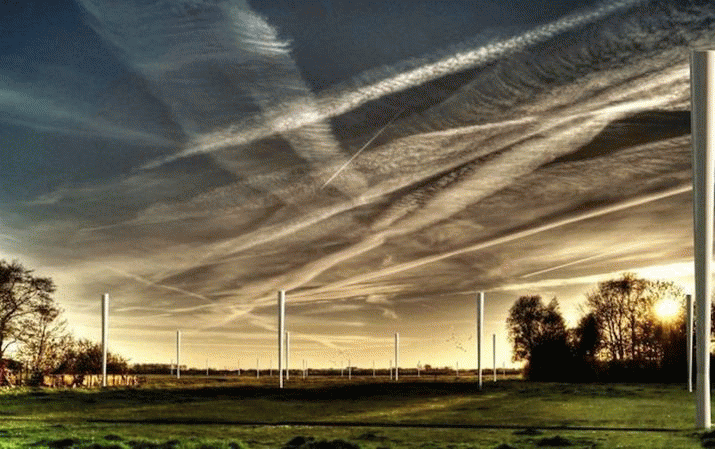
*Pic: A mock-up of Vortex bladless turbines in a field
Believe it or not Tony Abbott may have got something right when he claimed “wind turbines are ugly and noisy”. Of course such a provocative statement had little to do with any consideration towards the environment, and more to do with his support for the outdated fossil fuel industry.
True, giiant whirling wind turbines are more than just a blight on the landscape, they are noisy and do kill birds and bats They are also expensive to construct and require ongoing mechanical maintenance, yet they are still a significant improvement in regards to the dark-age of carbon burning /CO2 polluting energy producers of the past.
Like much of our emerging clean renewable energy development, we were bound to begin with the most primitive of forms such as the swirling blade driven wind turbine.
New innovations in wind energy technology are seeing the development of the Vortex bladeless generator. This is the pure form of wind energy development for the future that reaches far beyond mechanical driven engineering.
Spanish company Vortex Bladeless is one of the companies that is developing a bladeless, gearless and bearingless vertical wind turbine that will not only eliminate birds and bat related deaths, it will significantly reduce the manufacturing and maintenance costs associated with conventional wind power by around 50%.
Vortex Bladeless is designed to harness wind energy in an entirely different way to traditional turbines. Instead of using blades to capture the wind’s energy through a spinning motion, the Vortex uses what’s known as vorticity, an aerodynamic effect that happens when kinetic energy meets a solid structure, which produces a pattern of spinning vortices.
In prototype form, the turbine consists of a fiberglass carbon fiber cone that vibrates when wind hits it. At the base are rings of repelling magnets that pull in the opposite direction to which the wind is pushing.
Electricity is then produced via an alternator that harnesses the kinetic energy of the vibrations.
Whilst the Vortex prototypes currently do not produce as much energy as the conventional blade generators, they are far smaller in design, so most landscapes would be able to accommodate many more installations in situ, whilst lessening the present visual pollution factor of large bladed turbines structures.
There are still many unanswered questions about the ability of the Vortex design to perform across a broad range of wind conditions, but the fact that engineers and inventors across the world are exploring different ways to harness the wind’s energy is an encouraging sign that wind energy beholds a bright future.
With the current power supply crisis throughout Tasmania, we are likely to see more proposals for wind energy generation across the state that would lessen the reliability of Hydro-electric production. Tasmania, given sufficient rainfall, has the potential to be almost totally independent through its intergrated Hydro-electric power schemes, though decades of declining rainfall and intermittent drought has undermined the capacity of such a supply.
Given the unpredictable climatic conditions prevailing, then renewable energy through wind and solar voltaics is most likely to be the only form of efficient energy development in the forseeable future.
Until the Liberal government realize this then the ubiquitous diesel guzzling generators will be grinding on relentless until either there is monumental rainfalls in Western Tasmania or the state’s $ coffers plunge into insurmountable depths!