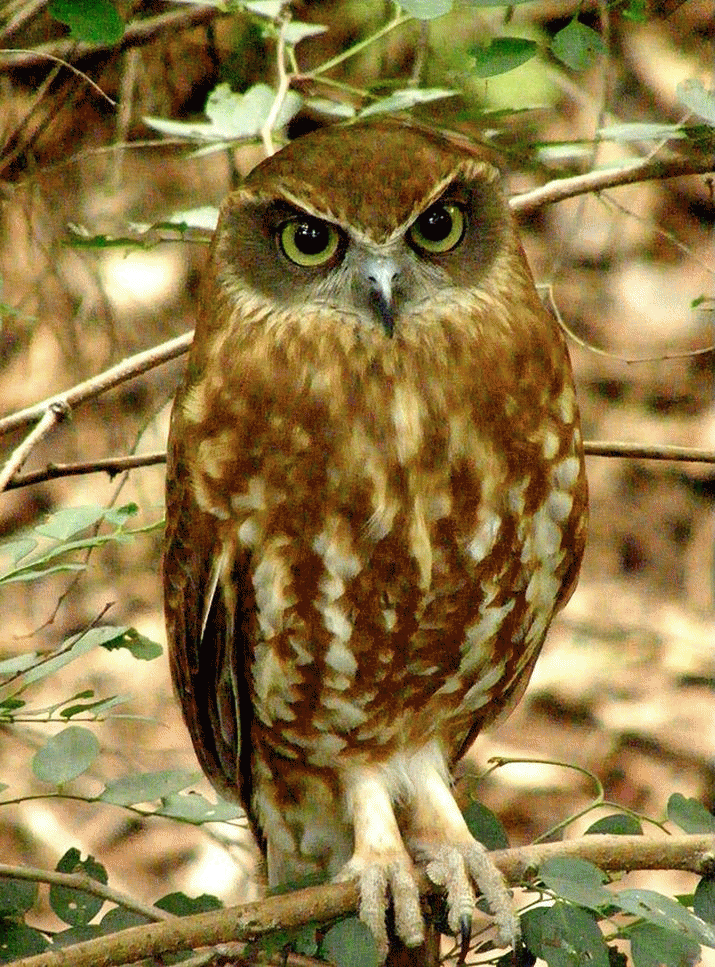
*Pic: of a Boobook Owl
After appearing on the Tasmanian Times for a year, this is the last extract from the diary Don Knowler compiled after daily rambles on Mount Welling during 2012 and 2013. The publication of the diary was prompted by the Respect the Mountain Forum at the Hobart Town Hall last year. In what promises to be a momentous year in the modern history of Kunanyi, Knowler hopes the diary has given the mountain and its wildlife its own voice …All Don’s Mother Mountain columns – and much more by this superb writer – can be found under the Category, Don Knowler, here
Summer’s long, slow fade was in motion, a week before the official start of autumn and I could feel and see it. The leaves appeared dusty and wan, the trees exhausted from the heavy industry of turning sun and water into oxygen, the lifeblood of all about me.
Young birds fluttered excitedly, compulsively through those very tarnished leaves, and their parents took a breather. Like the leaves, the once resplendent plumages of male birds were worn and tattered, iridescence bleached by the unrelenting, unforgiving summer sun. Young birds could now fend for themselves and soon migrants would follow their parents to the mainland, or lower ground in Tasmania.
The last days of summer were colder now with southerly winds, and everything with wings seemed in a hurry to get off the peak. Back again at Sphinx Rock next day, crescent honeyeaters and eastern spinebills flew the flight paths of the bats at night, avoiding the stark trees. The honeyeaters and spinebills, instead of cruising through and around the forest of skeletons like bats, took a straighter, faster course to lower elevations.
Above me, flying across the face of the Organ Pipes heading north, a swamp harrier flew on lazy wings. Summer over, a fill of lapwing chicks, and now new hunting grounds beckoned across Bass Strait.
I checked the silver banksias just above the Chalet to see if they were now in flower. They were and it was time to go in search of pygmy possums. I waited for nightfall, packed a torch and set up the summit road. Somewhere distant a boobook owl called as I shone my silver beam into the silver banksias, the sharp, serrated leaves of the illuminated tree cutting into the night. No possums, pygmy or otherwise coming and going, and I retreated after about 40 minutes, disappointed. What I did see, though, was a bat flitter through the snow gums and I decided at that moment not to return home, but to park at the Springs and walk back along the upper Lenah Valley track to Sphinx Rock.
Studying bats with bat expert Lisa Cawthen earlier in the year I had learned that Sphinx Rock was a bat hotspot. It was not as good as the best hotspot of all in the Hobart area, the Waterworks Reserve that combines favourite habitats of dry and wet woodlands, open glades and stretches of water to observe all eight of Tasmania’s commonly-seen bat species.
But Sphinx Rock would do for this bat safari, especially as I had been told that the sight of bats weaving in and out of the skeletal dead gums, their silhouettes clearly showing up against the background of Hobart city lights, was a sight to behold in summer.
The night, although in previous days the chill of autumn had almost imperceptibly begun to bite, was hot and humid, and flying insects were on the wing. It appeared a perfect opportunity to see bats and I was not to be disappointed.
Going out with Cawthen we had used bat detectors to identify different species because the calls of Tasmanian bats are inaudible to the human ear. The bat detector is a small device with a microphone designed to record and broadcast bat echo-location signals.
Sprinkled with stars …
It’s a cliché to state the sky as sprinkled with stars, but it was. Although there was a glow of light rising from the city, and rising from the Eastern Shore over the Derwent, it was still a spectacular sight. It was a cliché of a night, with another boobok owl calling, but close this time.
And through the ghostly dead gums, stark black in sinister form, spread out before and below me, the bats flitted, turning and banking and swooping as fantails do on high summer days. Something bigger flew among them for a brief moment, a frogmouth on the wing, and then the mountain’s second owl species started up, the frightening, screaming call of the masked owl, to give a macabre voice to the sinister tree shapes.
I had waited for hours, waiting like the bats, the frogmouths, and the owls for the city to sleep. The longer I lingered the less frightening the mountain at night became for this city diurnal animal.
Looking at the stars, twinkling and pulsing, some tinged red and amber like Mars, I was thinking of the months I had devoted to my diary, striving to give the mountain and all who live there their own voice. And I am thinking that in the way a year is meaningless in the history of the mountain, so is my own life of a little less than 70 years.
A man who has spent his life in the newspaper trade does not talk of posterity in the context of their work. The sort of “creative” or “artistic” work I did – and still do to a degree – still ends up as wrapping paper for fish and chips the next day, as the saying goes.
Looking at the stars, however, and trying to figure out which ones might be long dead, and which ones alive, I hope that my diary will survive, not just as a record of a year in the life of the mountain – however inconsequential that might be – but a statement that I, along with the black-headed honeyeaters, the platypus and the antechinus, was here.
When I’m gone, perhaps like the dead star of a million light years past, my own light will carry on …
I’m in the Cascade Hotel, not quite tired and emotional but getting that way.
On my way to work each day I always looked for the mountain. I found it at the corner of Elboden and Macquarie Streets, looming large and imposing over the suburb of South Hobart. For 10 years I looked for the mountain and gauged its moods: dark and sullen some days, sunny and bright on others. Sometimes it hid behind clouds, its mood so sombre it didn’t want to be seen. On others it so craved to be noticed it wore a blanket of snow.
For 10 years I gazed up at the mountain, or, on its sombre days, tried to coax it out from behind the clouds. Rain or mist, snow and sunshine, I wanted to be up on the mountain, drawn to its brooding, silent beauty.
Work got in the way. I’d curse all the way down Macquarie Street on my walk to the central business district of Hobart, complaining I’d rather be up there on the slopes, or wandering in the mountain’s forests. And on the way home in the early evening, with Mount Wellington in purple shadow after the sun had set, I’d know that another day in its life had passed, without me.
Then came the day I was free to wander and climb the mountain whenever I wanted, and leave South Hobart and the city behind. They say beware of getting what you wish for … but I never looked back.