*Pic: A black-headed honeyeater
The “Respect the Mountain” forum ( here, here, and here ) at the Hobart Town Hall earlier this year prompted Don Knowler to return to a diary he compiled after daily rambles on Mt Wellington during the previous year. In what promises to be a momentous year in the modern history of Kunanyi, the weekly diary gives the mountain and its wildlife its own voice. All Don’s Mother Mountain columns – and much more by this superb writer – can be found under the Category, Don Knowler, here
“Race to the top” screamed a Mercury headline in the third week of the new calendar year. The newspaper reported in its introduction to the story that “cable car proponents have steamrolled opposition to development on Mount Wellington, releasing their wish list for a visitor centre at the pinnacle”.
The story carried an artist’s impression of the Mount Wellington Cable Car visitor centre, a futuristic, largely glass building skirted by a wooden walkway giving views over the city.
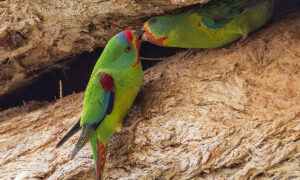
Five hundred and twenty metres below the summit a pair of striated pardalotes had found what appeared a safe and secure site to raise their young. In the early spring they scouted the Springs below the summit and happened on a wall of sandstone. This had been carefully laid by track-makers to shore up a bank on the Ice House Track, possibly a century earlier.
Unlike the situation at the Waterworks Reserve where the visiting pardalotes nest in the cracks of sandstone walls, the pardalotes of the mountain choose traditional sites of tree hollows but this wall had proved irresistible to the migrants.
I had watched the pardalotes from early spring, coming and going to the cavity at first with nesting material, then the male took food to the female incubating eggs before, after two weeks, they both were visiting to feed young.
Three youngsters had been produced, sent on their way finally to contemplate their first flight over Bass Strait, before the parents determined there was time for a second brood.
This was obviously well on its way. I saw the female of the species early in January bringing food to the nest but when I returned on the morning of the Pinnacle visitor centre story there was menace in the air.
The male bird was twittering frantically, fluttering over the sandstone wall cavity as I approached. As I moved closer there appeared an odd shape attached to the sandstone wall, black and moving and appearing to titch a tail. I was looking at the rear end of a tiger snake, the upper end obviously buried in a maze of tunnels and cavities obscured by the outer wall. The tunnels must have run deep because only the end of the snake, about 10 centimetres, was visible.
I wrestled with the idea of giving the pardalotes a helping hand, not necessarily killing the snake but giving it a prod so that it pulled its head out of the hole, and went on its way. Killing it would have been the only option if I was save the pardalotes, because, after being scared off, the snake would have returned. It had the scent of pardalote young on its tongue, and I had experience of the relentless hunt for pardalotes carried out by the tiger snakes of the Waterworks Reserve. In Spring they patrol the gassy tops of the reservoir walls there, sniffing out young in the cavity nests, and sniffing out the eggs and young of masked lapwings on the open grasslands.
I watched the snake for about 20 minutes, straining and pushing its body to get right inside the cracks. It appeared a fair-sized snake and it was obviously too big to reach the nest. It strained, withdrawing at one point to change the angle of attack, all the while gripping its lower body against the rough surface of the wall. Finally, the snake – a good metre in length – gave up the hunt and slowly edged its way to the top of the wall where it sat for a while, pondering its next move. Tongue flicking, tasting the air, the snake finally rolled its head over its curled body and then straightened out to vanish into the kangaroo grass.
The twittering had stopped, and the male pardalote flew rapidly to the hole to check on the fate of his mate and young. He flew away just as rapidly and I watched him dashing through the upper canopy of an urn gum. Soon he was back, with a beak full of insects, and all was at peace in the pardalote world.
Large flocks of silvereyes, adults and young from this year’s nesting season, swarmed across the mountain, often joined by fantails. You didn’t need to see the tiny silvereyes in flight to know they were about. The thick, tightly-packed bushes of the sheltered wet areas of the mountain heaved and swayed with their movement, as though buffeted by winds. Then one, two and three silvereyes would poke their heads out of the foliage, look ahead and be off. They were followed by a cloud of feathery shapes to the next clump of think forest. The sheer number of the these birds disturbed flying insects in the foliage, giving the fantails an easy meal. The silvereye surge also attracted black-headed honeyeaters, who called their piping, irregular song as they joined the avian circus moving across the eastern face of the mountain.
The smoke from forest fires still hung in the air, and across the far horizon it formed layer upon layer of ash and soot in different shades of brown and grey, much like a cliff of compacted sandstone and mudstone. The Mercury reported myriad fires across the state and one giving concern was centred on the town of Molesworth, behind the mountain to the north, burning out of control and easing around the bone-dry eastern slopes. In Fern Tree there was nervous talk of this consuming the township itself. Fires raging through dry eucalypt came generally in 40-year cycles, and Mount Wellington was awaiting its turn.
Silver banksia had broken into flower on the lower slopes, and I set out to check the banksia “forest” at the chalet. If it was in flower, I’d return that evening with a spotlight to try and spot pygmy possums.
Rain halted me, though, that night at the Springs. And I was not disappointed . I shared the relief of the people down in Fern Tree. If heavy enough, the rains would dampen the fire at Molesworth and spare them any more anguish, because many in the community still carried memories of the 1967 fires which caused great damage there.
Still raining next day. And I donned a rain-roof coat, drove to the mountain to walk around the circuit linking the two Springs sites, which forms a circular drive off the Pinnacle Road. I wanted to smell the rain, that sweet, heavy odour that rises as steam off hot tarmacadum. The steam swirled and coursed ahead of me, never rising a handful of centimetres off the road. A mini-rainbow formed and through it buzzed a dragonfly.
Leaving the Springs to return home, picking up speed on the descent down the mountain, I heard a sharp smack on the windscreen and then saw what looked like a strong-billed honeyeater tumbling away to my right. Rapidly braking, I glanced in my rear-view mirror and could see a bungle of feathers by the roadside. The bird was not moving. I parked the car quickly and hurried back along the road. As I reached the honeyeater it was now sitting upright, clearly alive, if a little stunned. The honeyeater – I could not determine whether it was a male or female – was not trying to fly at all, merely blinking and moving its head from side to side. It looked as though it was concussed and I decided to take the honeyeater back to the car, place it in the darkness and quiet of the glove compartment and drive it to a vet I knew who specialises in the care and rehabilitation of wildlife.
Around me in the woody teatree bushes hemming the road I could hear other strong-billed honeyeaters twittering nervously, one or two in a small flock fluttering close to assess the fate of one of their own.
I held the injured honeyeater in the open palm of my hand as if to reassure the other clan members that, literally, the bird was in good hands. I was to be its protector and when he or she was well I would bring the bird back to this very spot, and release it.
There was no need. The honeyeater suddenly raised its head, stretched its wings and lifted from my hand, flying into the teatrees, to the welcome of the flock. As I watched it vanish into the woods, I pondered the event that brought us together, the circumstances, the simple twist of fate Bob Dylan sings of. Folk music, or Dylan’s blues, it’s usually about human interaction; I was thinking strong-billed honeyeater and how we had both come to be in this place at this time. Travellers on the same remarkable journey, mine a little longer I know, but a journey all the same in which the beginning is known, the end a mystery. Two creatures on earth bound together by this thing we both know as life.
I’m thinking these things when I return to my car, turn on the stereo and Bob Dylan is singing, when we were born in time