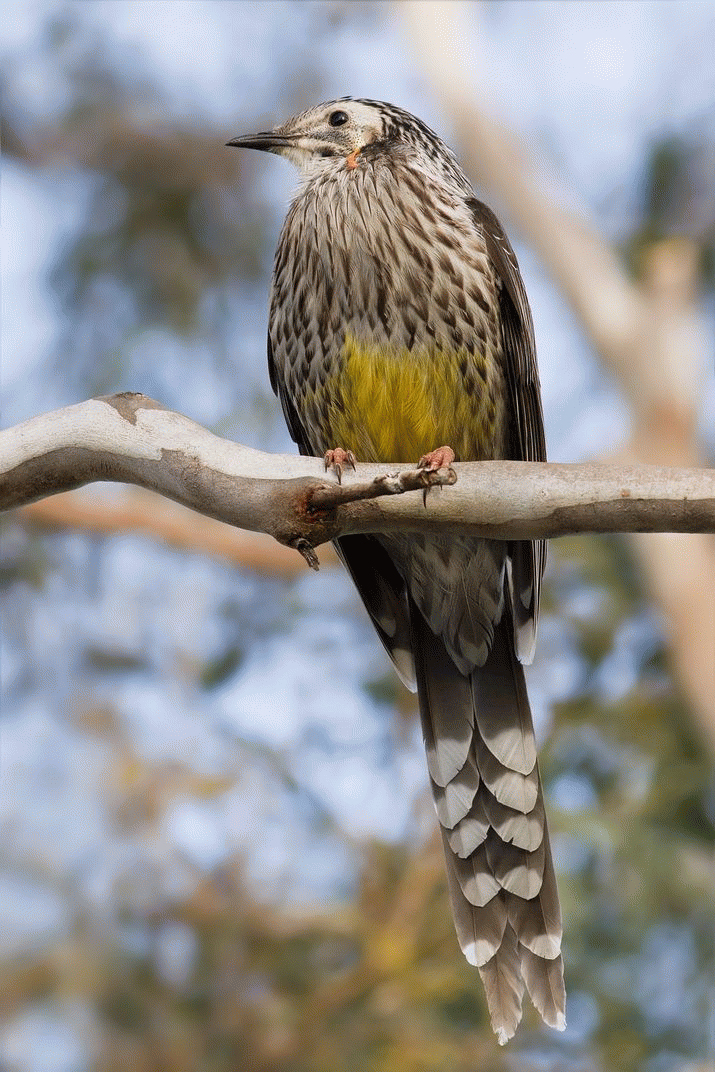
*Pic: Yellow wattlebird, from Wikipedia. Says Donzo: “The ‘song’ is described in one of my bird books as like someone retching, or throwing up. Strange way to describe birdsong but the description is remarkably apt; a call to take you back to the night before, and regret, and alcoholic remorse.”
The “Respect the Mountain” forum ( here, here, and here ) at the Hobart Town Hall earlier this year prompted Don Knowler to return to a diary he compiled after daily rambles on Mt Wellington during the previous year. In what promises to be a momentous year in the modern history of Kunanyi, the weekly diary gives the mountain and its wildlife its own voice. All Don’s Mother Mountain columns – and much more by this superb writer – can be found under the Category, Don Knowler, here
The call of the yellow wattlebird was not what I wanted to hear. I had a hangover, and it rang through my head. It’s one of those calls that’s grating; a raucous, guttural sound, brutal to the ear. Thankfully it’s not that common on the mountain, at least on the higher slopes, but on this morning it had to intrude. Damn that bird.
The “song” is described in one of my bird books as like someone retching, or throwing up. Strange way to describe birdsong but the description is remarkably apt; a call to take you back to the night before, and regret, and alcoholic remorse.
I had sought a kind of refuge on the mountain after sinking one too many pints of Cascade Pale Ale, drinking with my mate Lindsay Tuffin along the Salamanca Strip in town the previous evening. The fresh, bracing mountain air was just what I needed and walking along the first part of the Fingerpost Track towards the turn-off to O’Gradys Falls I thought I had put the worst of my hangover, and the sickness I felt deep in my stomach, behind me. Then the wattlebirds reminded me of my over-indulgence, and the toll it had obviously taken on my mood and body. I reached for my water bottle.
The yellow wattlebirds I curse at these times, but they are among the most exciting and remarkable of birds, especially has they belong to only one place on earth – Tasmania. They are the largest of the honeyeater family and, as their name suggests, they display yellow wattles below their beaks. The wattles are so long they dangle in the breeze and look like earrings. With slightly hooked beak, and inquisitive cold stare, and the wattlebirds appear curiously Victorian, like ageing dowagers captured in a caricature. They also carry themselves in the trees in a formal, upright pose. On the wing they fly in slow, ponderous but powerful flight. Because they are large birds – about the size of a currawong – and exist mainly on a pollen and nectar diet, they require vast amounts of food for energy. This makes them aggressive and protective of their food supply and they will defend a favourite flowering gun against all comers.
The honeyeater that added to my hangover pain laid possession to a large blue gum in white flower, cursing and then chasing off black-headed and yellow-throated honeyeaters.
Summer time kicked in at the start of the second week of October. The extra hour of daylight in the early evening gave me to chance to scout out more nest sites. I didn’t have to look far, finding a Bassian thrush declaring a territory with song on the upper Radford Truck about a quarter of a kilometre from the Springs.
Climbing ever higher on a beautiful spring day, with mist clearing from the mountain to reveal the sun on the Organ Pipes, I came across a singing male thrush close to a giant silver wattle which had toppled over in high winds a year previously. The tree had already collected coating of moss and the clay soils of the lower mountain still clung to its roots, half of which had been flung into the air when the tree tumbled, obviously under great force.
These roots pointed skyward in a spoked pattern, thick at first and then thinning to an array of straggly shapes, like crooked fingers.
The Bassian thrush sang lustily. It’s not a song I hear often, unlike the introduced blackbird, a family member which can be heard at all times – even at night – in the suburbs bordering the mountain, and in some cases on the mountain itself where it is believed to be pushing out the Bassian thrush from some of its range.
The Bassian thrush is clearly a shyer bird, a bird of the shadows, and eschews gardens and lawns but it has a similar melodic song to the blackbird, but it is less strident and far-carrying. While the blackbird is noted for the range of its song, with repetition and phrasing that at times can resemble the musical sounds humans make, the Bassian thrush song contains a minimum of notes. The song is a series of thin whistles, not repeated in a kind of chorus, or rhythm as in the blackbird’s case.
I was excited to find the singing male, clearly marking out a territory and possibly trying to find a mate, but I could not see a female in the vicinity.
In the spring hunt for nests it is important to locate the territories of singing males early. A songster will not only point to a territory, but point to a male displaying to find a female, and finally the pair of birds coming together to nest.
The singing is at its most strident at this early stage and tends to die down once the breeding season is well under way, a nest built and finally eggs laid, incubated and nestlings produced.
Vulnerable to attack by predators
Once the female is incubating eggs in the nest, she is very vulnerable to attack by predators and the male must curb his urge to sing, for fear of betraying the nesting site. Males might continue to sing territorial songs, but they do this well away from the nest, giving no clue to its location. This way predators are put off the scent, as are keen naturalists keen to find nests.
I returned to the Bassian thrush territory next day and was delighted to find a female, listening intently to the male’s tune. The fallen silver wattle, with its tangle of roots, would make an ideal thrush nesting site and I was confident it would be used for this purpose.
A wider search for the nesting territories of mountain birds not only revealed nests. Scanning the forests I could also identify trees, shrubs and orchids coming into flower. A scan for a potential fantail’s nests brought a delicate climbing plant, mountain clematis into view, the tangled writhing shoots of one plant attached to a waratah. The clematis displayed pale, delicate white flowers. The plant is dubbed “bride’s veil” in some quarters; to me the long narrow petals, with a yellow stamen at their heart, reminded me of propellers on an aircraft of the pre-jet age.
On drier sections of the mountain forest daisybush, dusty daisybush and prickly beauty brought an array of subtle colour to the vibrant greens of the landscape.
I was still hunting for swift parrots, this time checking out flowering blue gums near the fire trail off the Finger Post Track. Again I drew a blank, but my efforts were rewarded by the sight of a female scarlet robin collecting nesting material. I could not determine where she had flown, carrying a trail of dried grass. Another nest revealed itself, however. High in a glue gum I could see a female grey currawong sitting on a nest of sticks and dried grass.
Spring also heralded the start of orchid season on the mountain and, along with nests and flowering plants, I started to seek out orchids in the leaf litter on the lower slopes. In past years their fragile beauty would have gone unnoticed, but signing up for an orchid walk at the Waterworks Reserve the previous spring opened my eyes to these jewels in the undergrowth, as stunning and exciting as the discovery of another forgotten piece of the remarkable wildlife jigsaw, fungi.
I found the first of my orchids of the spring: a species with the common name of wax-lip or parson-in-the pulpit. The orchid is the largest and most spectacular of Tasmania’s species, with five large purple petals, and a small white and purple lip at its centre.
A keen and sober eye is needed to spot orchids. There is not much to these tiny plants except for the flower, atop a single, thin stem. In the parson’s case, they only have one green leaf perfectly camouflaged against the forest floor.
Halted the breeding frenzy
Despite a longer day pointing to summer, and warmer temperatures, south-westerly winds brought a cold snap which halted the breeding frenzy in its tracks, or appeared to do so. The birds were refusing to sing one morning but still I saw birds flying to and fro, some carrying grass and spiders webs.
I was tempted to turn back from the mountain, a cloud nestled on the summit that promised rain or even a dusting of snow, but before succumbing to the promise of a warm log fire at home, I went for one more sortie to an area that promised an elusive grey fantail’s nest.
And at last, after hunting for two weeks or so, I found one. I had in fact been scouting a clump of waratahs to guarantee that I would be on hand to admire them in bloom when they flowered in early summer. The red blooms of the waratah, shaped like an open fist holding the flames of a fire, are considered the most beautiful on the mountain, but a trip to higher peaks is usually required to find them.
Turning into what I call “Waratah Corner” on a fire trail that runs parallel to the Silver Falls Track, I heard the sweet, descending twitter of a male gray fantail. The song is a familiar one in woodland and forest right though the year but it is often sung on the wing, sometimes from the upper-most reaches of the gum canopy. This time, though, the song appeared anchored to one spot.
I scanned the waratahs and the flowering satinwood and stinkwood on the fire trail and suddenly the grey fantail came into sight. He was lost in his twitter, throwing back his head as he sang. The male sported mating plumage, blue-grey steely feathers on his wings and back, with a beige face lined with fine charcoal markings, that appear to give the male birds eye shadow and eyebrows.
The fantails also display spider-web-fine feathers around the beak, like whiskers.
A female was close to the singing male and it was clear that, out of all the males singing on the southern slopes of the mountain, the female had made her choice of partner for the summer.
Before I found the time to climb Mount Wellington virtually every day, the Waterworks Reserve was my stamping ground at least four times a week, my barometer of the seasons.
After seeing the fantail, and planning a return visit in coming days to locate the pair’s nest, I called in at the reserve on my way home.
Spring had truly arrived there. The blanket bush was in bright yellow flower and swallows hawked insects, fan-tailed and shining bronze-cuckoos called, and the song of the striated pardalotes could be heard from the sandstone culverts, where pardalotes visited with nesting material, and at one nest, with food, which could either have been for a sitting female, or for early young.
And for the first time since the start of nature’s year, there were no hoary-headed grebes on the twin reservoirs of the reserve. In fine breeding plumage, they had migrated to marshland breeding sites, on lagoon and lake, along Tasmania’s great estuaries.