The Annual Hobart National Trust Antique Fair will be held at Runnymede, 61 Bay Road, Newtown from Friday 17th – Sunday 19th October between 10am – 5pm.
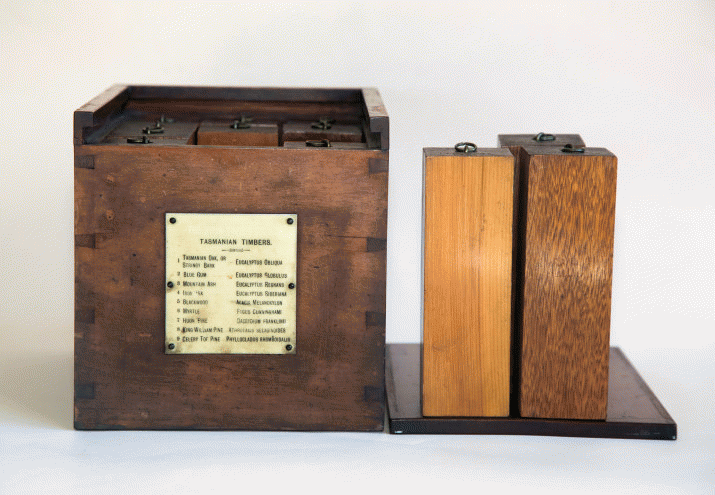
At the Fair I will be exhibiting this rare box of Tasmanian specimen timbers produced circa 1912 by the Huon Timber Company Limited of London and Hobart.
How could this be?
At the turn of the 19th century Robert Affleck Robertson, a Canadian-born Hobart timber merchant, known in Geeveston as ‘Flat Earth Robertson’ chose the Huon for a proposed future timber extraction operation; it being close to both the virgin native forest and deep water at Shipwrights Point. His main competition was the family firm of John and Osborne Geeves employing 26 people with a lease over 1659 hectares of Crown Land, a firm with whom he was later to merge.
In June 1901 entrepreneur Robertson was in Glasgow to float his Tasmanian timber scheme to the Scots, based on a proposed 21-year lease to be gifted by the Tasmanian Government over an area of 8,903 hectares in the Arve and Kermandie valleys. He persuaded a group of ‘respectable, prominent and conservative men of business’ to subscribe 100,000 pounds to further his proposed Huon special timbers business and the Huon Timber Company of Glasgow, and a registered office at 14 St Vincent Place, was born.
Forty miles of 3-foot gauge railway was constructed into the virgin forest to extract the best logs using cable logging between standing trees and at its peak the company employed 170 Tasmanians, building 20 houses for those who came from outside the district.
As usual with Tasmanian timber companies Huon Timber performed badly and in 1908 Henry Jones & Co replaced Robertson as the local manager. This firm was no more successful and in 1911 the company was sold for less than a third of the money put up by the Scots to an English Syndicate with offices in Pinners Hall in the City of London, a company which managed to lose even more money.
In 1921 under new European ownership the third incarnation of the company managed, in one contract, to sell a 1 million cu feet of hardwood through the new owners in Antwerp. Even this was not enough to combat high wages and conditions in Tasmania as the Americans flooded the Australian market with cheap imports from the West Coast. As a result in 1920 the new company began to sell assets and downsize its staff, for it had never made a profit or paid a dividend. The Huon Timber Co Ltd was finally wound up in 1929 with losses of more than a quarter of a million pounds accumulated in only 25 years.
All this was nearly 100 years ago and yet the shysters, hucksters and carpet baggers still sniff the wind in Tasmania regarding our remaining forests, looking for that quick quid at the expense of the unsuspecting sucker.
The current sucker is the Australian taxpayer, forced by third-rate complicit Pollies to bear the enormous losses as incurred by the Tasmanian forest industry in an effort to buy their votes.
Some things never change!