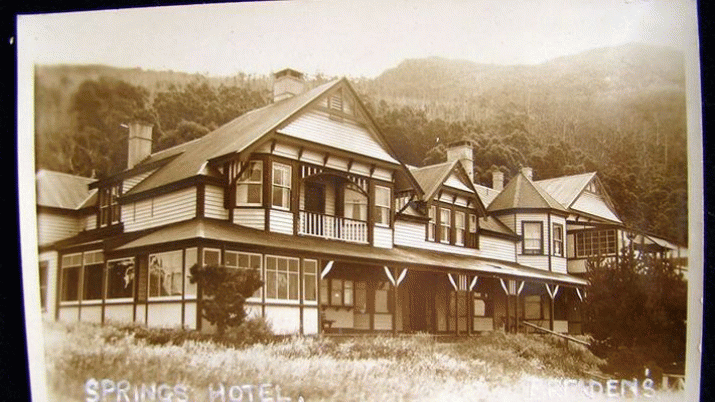
*Pic: The way we were … The Springs … and below the Tawny Frogmouth which sends Donzo aflutter …
The “Respect the Mountain” forum ( here, here, and here ) at the Hobart Town Hall earlier this year prompted Don Knowler to return to a diary he compiled after daily rambles on Mt Wellington during the previous year. In what promises to be a momentous year in the modern history of Kunanyi, the weekly diary gives the mountain and its wildlife its own voice. All Don’s Mother Mountain columns – and much more by this superb writer – can be found under the Category, Don Knowler, here

The race to conquer Mount Wellington was on, with plans for the cable car reviving a long-dormant scheme to develop the Springs below the summit.
The Springs complex had once been home to a wooden hotel built in a Tyrolean style that was destroyed during the Tasmanian bushfires of 1967.
Although development at the summit was firmly banned, the Mount Wellington Management Trust had given the go-ahead more than a decade previously for a restaurant and visitor centre to be built on the site, albeit in a modern style.
Architect Robert Morris-Nunn, who was leading the development, had drawn up plans and found an investor, although the investor had subsequently pulled out because he had other projects on the go in the city.
With support for a cable car growing in recent weeks, Morris-Nunn entered the fray, saying the Spring development made more sense both in terms of cost and the impact it would have on the mountain.
Morris-Nunn, according to the Mercury, was firm in his view that a cable car was not needed.
“Mount Wellington is this interesting, fascinating, changing place, with different vegetation, different historic and archaeologically interesting things all the way up,” he was quoited as saying. “So why would you want to get in a little box at the bottom and go all the way to the barren top?”
The Springs site covers two areas a few hundred metres apart. Their confused and ramshackle nature, incorporating flat grassed areas that once housed the hotel and its grounds and rainforest forever trying to reclaim open space, gives it diverse habitats that are good not just for birds but mammals. If wallabies and pademelons, potoroos and bandicoots are to be seen easily, this is the place. And a track that links the two sites, climbing through tunnels of satinwood and stinkwood, is rich in both mammals and deep-forest birds.
The wider site mixes both wet and dry forest on various trails out of it. The tight rainforest around the Springs soon gives way in some directions to scattered dry forest and in these I searched out tawny frogmouths. I surmised that the grassy areas at the Springs might provide suitable hunting grounds for frogmouths at night and so there was a good chance of finding them roosting on the bare branches of nearby gums by day. I searched long and hard for frogmouths and drew a blank so after a month I tried another area of the mountain where I was told frogmouths could be found.
The tawny frogmouth is one of nature’s most mysterious and exciting birds and the thought of them always sends me aflutter.
I often tell the story of first seeing them at the Bronx Zoo in New York and being totally spellbound by these curious birds. I later saw them often when I lived in Queensland but they always prove elusive in Tasmania. I can only assume they are more common in Queensland, where the flying insects they feed on are also more prevalent, and in Tasmania they present a far more rare quarry for the bird-watcher.
During the winter I had heard of a spot where they had been seen regularly in the past and I decided one afternoon to go in search of them there. The location given was the upper Pipeline Track just beyond Fern Tree where it diverges from another trail that leads towards the mountain summit, the Silver Falls Track.
I’ve only known tawny frogmouths from dry woodland – including where I hear them near my home in the Waterworks Valley – and when I reached the spot given it didn’t look like the sort of place I thought you would find them. This was wet schlerophyl, rain dripping from the leaves of sassafras and fern after a morning of rain. I may not be an expert on tawny frogmouths and their habitat but all my birding instincts told I would find them here.
I pressed on along the Pipeline track where it hugs the lower slopes of the range spreading south, and looked to distant shafts of light that invaded the confines of the track 100 metres or so in the distance, where it opened up and penetrated more open country.
All the way I searched the lower limbs of the trees looking for the hunched, crouched shapes of the frogmouths, which blend so superbly with their environment that they often cannot be seen, even to eagle-eyed birders.
I had learned in Queensland that tawny frogmouths often perch by day where rough, flaky older bark merges with the smooth surfaces of new growth, about midway up smaller trees and I scanned each tree that showed signs of frogmouth roosting sites.
I was disappointed, however, and soon ran out of potential sites when the Pipeline Track suddenly opened into a residential area, not quite suburb because the homes were scatted through the woods, but residential all the same.
Living in Hobart and its environments you learn not to draw a sharp distinction between totally wild and residential areas because wildlife often bridges the two, making the city one of the most prolific for wildlife in the country.
Instead of scanning the forests for birds I cast my eye across the front and back lawns to see what other species might be about in more open areas, having given up on the frogmouths.
A female superb fairy-wren scampered across a lawn, followed by another. And then a male came into a view, a striking, shimmering bird still in its resplendent summer breeding plumage.
It’s only the older males that retain their good summer looks – males six years old or older – and because fairy-wren life expectancy hardly exceeds these limits, these birds appear fairly rare in winter. The young males, meantime, moult to a grey-brown plumage likes females, but still retain traces of their bright-blue tales.
I had set out to find the exotic, tawny frogmouths, and here I was looking at a fairy-wren, a bird I can see any day in my own garden. But on a winter’s afternoon with the chill of the night about to bite, there’s nothing like the sight of a blue wren in summer plumage, shimmering in iridescent shades of blue to bring summer to a dull, overcast winter’s day.
Two days after my abortive frogmouth hunt, a full moon had risen, sparkling on the frosty pavement at my destination that night, the home of a wildlife carer who was preparing to release the last of the frogmouths he had rehabilitated over the summer months. I had constantly failed to find frogmouths in the wild and I consoled myself by seeing them over the summer in the care of a man who also loved them, and dedicated a far measure of his life to rescuing those that came to grief in man’s world, rehabilitating them wherever possible and returning them to the wild. Most injured frogmouths had been found in the foothills of the mountain and the carer waited for a full moon before the release, as he always did, to aid the frogmouths in their hunt for insects of their first night of freedom. And he said he’d be lonely without his birds.