Huon Valley Guessing Games
Mayor Robert Armstrong, elected this month to the Tasmanian Legislative Council, has warned the citizens of the Huon Valley that, if he so wishes, he “can stand for mayor again”.
Armstrong, it is understood, has legal advice that tells him the Local Government Act 1993 would allow him to stand again even though he is now an MLC. The authority seems to lie in the June 20, 2013, amendments to Schedule 5, Clause 3(1) of the act — amendments that require close reading, and, even then, the tortuous text leaves the mind boggling. It seems, however, that at least one lawyer thinks he/she knows what it means.
The mayor’s revelation that he believes he could legally stand again — he didn’t say he would! — came in his answer to a question from the public at council’s meeting last Wednesday evening (May 15). The question, posed by Cygnet ratepayer Helen Murnane, read thus:
In 2011, you campaigned on a platform of being a full-time mayor for the Huon Valley. This year, you campaigned on a platform of being a full-time LegCo member. Now we are told that you are doing both jobs. Can you give us voters an assurance that you are doing both jobs full time? If so, what arrangements have you in place should a clash of HVC/LegCo commitments occur? Do you feel that your “honesty, integrity and commitment” pledge in your LegCo campaign is in any way compromised?
So smoothly delivered was Armstrong’s answer, one might imagine he had advance notice of the question. Well, you really never know who’s listening these days. Whether he had or not, the free-flowing delivery of his reply seems to confirm that he is benefiting from the public-speaking tutoring that rumour suggests he has been getting.
Armstrong, in his reply, said he didn’t feel his pledge had been compromised: “No I don’t . . . I was elected by the people of the Huon Valley to see my term out . . .”
Anyone interested in Huon Valley politics must be well aware that Armstrong intends to stay on as mayor until his term expires in October (when all nine councillors’ terms will expire and elections will be held for all council positions, including those of mayor and deputy mayor).
Word went out in Cygnet on the LegCo polling day (May 3) — after someone said he heard someone say something to someone in the Red Velvet Lounge — that Armstrong would not be stepping down immediately as mayor if he got elected to LegCo. Armstrong confirmed this as fact soon after his election became official, when he said council had legal advice that it was OK for him to stay on as mayor. My layman’s assessment of the law tells me council’s advice is sound.
It was Armstrong’s next statement that raised eyebrows — well, mine anyway: “I can stand for mayor again . . . ,” he declared. In the doldrumic air of the council chamber, not even a slightest stirring, not even among the usual pitiful few in the public gallery (four this time, all from Cygnet, including me).
Yet the implications of the mayor’s assertion must surely have exercised the minds of at least one or two in the room, especially of those with an eye to spending more years as councillors, perhaps even as mayor. Everyone present had heard the mayor suggesting that he was confident that he could do both jobs — as MLC and mayor — seemingly indefinitely; and that this would not compromise his “honesty, integrity, commitment” pledge.
Next day, I took another look at the act, especially those June 2013 amendments. Section 270, which covers eligibility to nominate as a councillor, seems to have nothing in it that would prevent a local government councillor who is also an MLC from renominating as a councillor, or for competing for a mayoral position.
So, on to ‘Schedule 5, Clause 3 — Vacation of Office’. This was amended on June 20 last year, by the insertion of two new paragraphs — (ea) and (eb).
Readers should wade through the intricacies of Clause 3 in its entirety, so that they can draw their own conclusions as to whether Armstrong can — as he says he can — “stand for mayor again” in October. I’m not certain, but I think he can — though conditions apply.
Clause 3, amended, now reads:
Vacation of office
1. The office of a councillor becomes vacant if the councillor — (a) dies; or (b) resigns; or (c) is absent without leave from 3 consecutive ordinary meetings of the council; or (d) is removed or dismissed from office under this Act; or (e) becomes a paid employee of the council; or (ea) is, on the day on which he or she begins to hold that office, a member of the Legislative Council, or the House of Assembly, and is such a member for 30 days continuously during that term of office of the councillor; or (eb) becomes, after the day on which he or she begins to hold that office, a member of the Legislative Council, or the House of Assembly, and is such a member for 12 months continuously during that term of office as a councillor; or (f) is no longer eligible to nominate as a candidate under section 270.
2. If the general manager becomes aware of a vacancy, the general manager is to notify the Electoral Commissioner.
I know, it’s the usual legal gobbledygook from which lawyers are able weave counter arguments from identical material. Much of Tasmania’s law seems to be written to ensure that, when the moment is opportune, it is vulnerable to abuse. How otherwise could this state, for nearly two centuries, have been so crooked and inept in its governance, and its corporate monsters so controlling of each government?
(Maybe there is a lawyer out there, practised in reading and interpreting legislation, who is happy to provide a pro bono explanation of what Schedule 5 means for an MLC who is also a sitting councillor, perhaps even a mayor.)
To me, the words in Schedule 5 look very much as if they are flexible enough to allow a sitting MLC to nominate as a candidate for the position of councillor or mayor. The catch is, I believe, that, within 30 days, a successful campaigner for councillor office would have to decide whether to give up the LegCo seat or the position as councillor.
The law, as I read it, does not allow both jobs to be kept for more than 30 days after a council election. And, whichever position is vacated — as LegCo member or mayor — a by-election would be required to fill it. (In the case of a councillor vacating a seat, I believe a count-back is allowable, as was the case when independent Peter Pepper resigned from HVC last year and independent Amy Robertson took his place.)
My instinct is that Mayor Armstrong was having fun with us last Wednesday evening when he said, “I can stand for mayor again”. I don’t think he will, mainly because such a move would not stand well with his pre-LegCo election pledge of “honesty, integrity, commitment” and other assurances in his campaign material.
Another reason is that an MLC’s package — near-$120,000 in salary, $15,000 a year in vehicle allowance, and near-$40,000 a year electorate allowance (all up more than $170,000), plus other perks — is much more attractive than the mayor’s package — near-$60,000 (including car).
As one voter said to me this week, “It might be legal, but it isn’t moral” — but I wasn’t sure whether he was talking about the packages or something else.
Armstrong has presided as mayor for more than 13 years at Huon Valley Council, a body that has an earned reputation for secrecy, and is renowned for persistent leaks that suggest low staff morale. Council, never very good at communicating with its constituency, in the past two years has moved to a position of even less consultation by abandoning its annual five public forums, and disbanding its five township committees. It has replaced these two avenues of public access with a few pages of flim-flam “consultation strategy” backed by no observable evidence of implementation.
In the Cygnet and Channel Classifieds last week (May 15), one of its columnists, John Fleming II (a pen-name), offered congratulations to Armstrong on “your well-deserved and deeply earned election”.
That’s not what Cygnet voters indicated at the May 3 LegCo poll. First-preference votes show that Armstrong, in his home town of Cygnet, won only 269 of 1490 formal votes cast; and that he ran third behind Liz Smith (457 first preferences) and Pavel Ruzicka (271). In other words, Armstrong was the first choice of only 18% of Cygnet voters ( see http://www.tec.tas.gov.au/LegislativeCouncilElections_2014/Results_Huon.html ).
Was his poor showing in Cygnet partly a consequence of all the things the mayor and his voting bloc have done contrary to the majority will of the township? Council actions in Cygnet that have earned it a lot of criticism include: the over-engineered car park on Catholic Church land; the incongruous new public toilets in Mary Street; the ill-designed new car park behind the Town Hall; the temporary “disabled” bus shelter on the east (far) side of the new car park; the slippery red pavement pavers all down the main street; two township plans (the imaginative one that was vetoed on spurious grounds of cost in 2004, and the modified plan that was adopted in 2010, and then virtually ignored when council bulldozed ahead, after only token public consultation, with construction of the Town Hall car park) . . . The list goes on.
And council’s wider performance down the years may also have worked against Armstrong in Cygnet. Examples: council’s cash reserves fell by more than 50% between 2008 and the end of 2012-013, when they stood at about $6 million. Of course, a lot of the fall was the result of the loss of $4 million of public money through reckless investment in collateral debt obligations (revealed at the end of 2008). The rest of the diminution of cash reserves is possibly a consequence of the mayor’s desire to brag each year that HVC’s rates rise less than neighbouring Kingborough Council’s.
Overall, HVC really does not have much to brag about. It does as well, or as badly, as any other Tasmanian council in the basic services expected of councils. Lots of concrete has been poured (especially into vastly over-engineered car parks); lots of road metal has been spread around (but road-mending is not among its fortes); and lots of un-needed (largely unsold) subdivisions have been approved . . .
For a mayor who constantly talks “jobs”, it is odd that Armstrong has never given even in-principle support to the visionary Franklin Working Waterfront Association’s plan to create about 40 new jobs for the valley over the next few years by reviving the wooden-boat building industry in the valley.
And no one who cares about the Huon Valley is ever going to forget, or forgive, the shock dawn demolition — under police guard — of the football club rooms at Franklin in March 2009 ( http://oldtt.pixelkey.biz/index.php?/article/outrage-at-franklin/ and http://oldtt.pixelkey.biz/index.php?/article/deat-in-the-morning/ ).
And where was council when the historic Egg Island canal was under threat of damage from water-pipe laying in early 2010, and, later, from cable-laying activities? Always missing in action. Only a sterling effort by local and other conservationists managed to minimise the damage — and to win heritage listing for Australia’s oldest working canal.
In the Huon Valley News of April 30 last, Armstrong pledged: If elected, I will be a strong, true independent voice for the electorate and will continue to make myself available to the community as your full-time Legislative Council Member for Huon. At about the same time, he said something similar in the Classifieds.
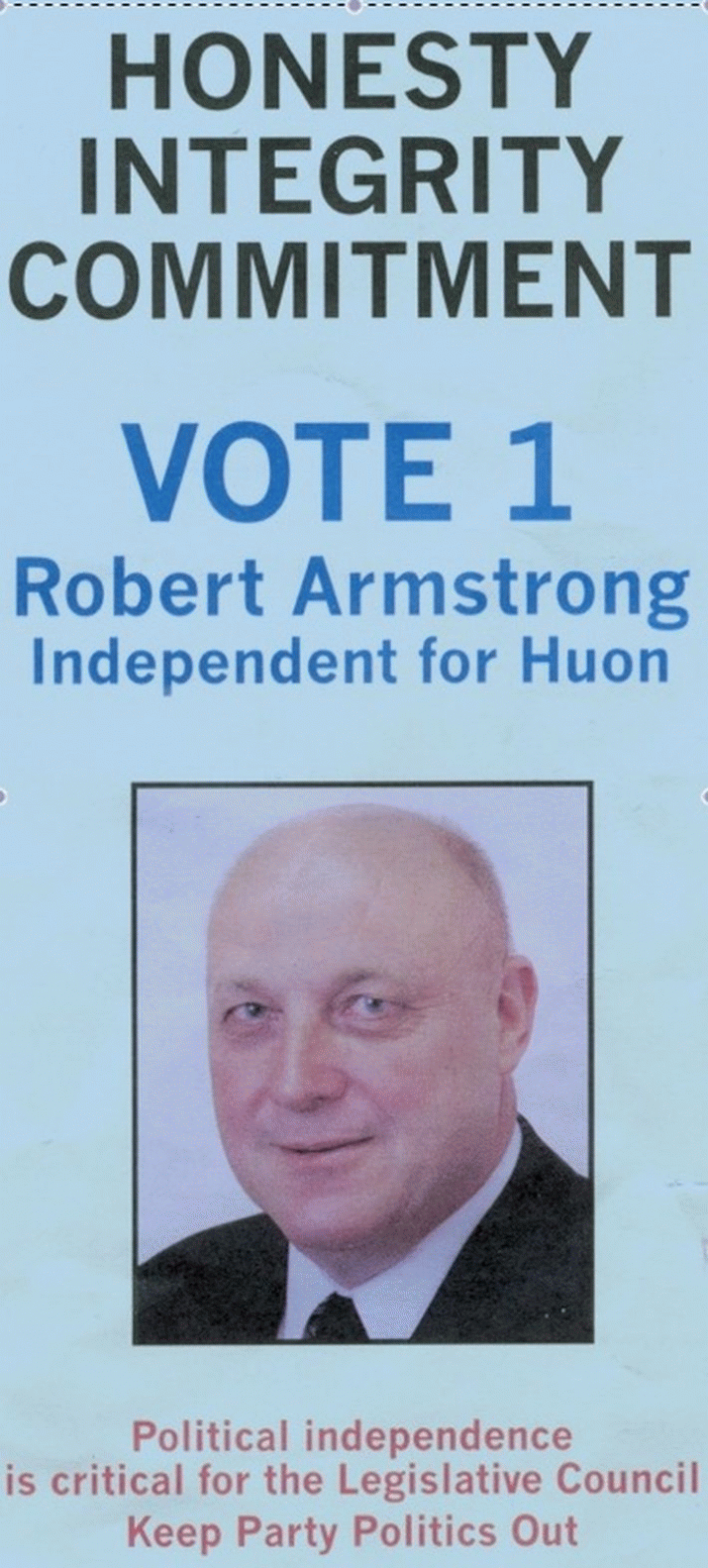
In his campaign brochure, headed “HONESTY INTEGRITY COMMITMENT” (the brochure’s capitals), Armstrong said he had had “a wide and varied working life with the Hydro Electric Commission [no mention of doing what], Mines Department [no mention of doing what] and as a successful small business owner [no mention of doing what] for over thirteen years at Cygnet”.
I have no information to offer on the first two sets of parentheses, but I can for the third. Armstrong, by his own claim a “successful small business owner”, was running the then Green Inn. I have no evidence as to the quality of his fast-food preparations. Me? I’d certainly regard myself as “successful” if people liked my fish-and-chips and hamburgers.
Armstrong failed to mention in his campaign material that, after his Green Inn venture, he was employed as a real-estate salesman by Cygnet realtor TPR. It was a position that caused him to frequently absent himself from the room when council was acting as a planning authority. His professional career in real estate seemed to come to a quiet end a while back: one day he was there among the mug shots in TPR advertisements — and then he wasn’t.
What is fact today is that the people of the Huon (Valley and Division) have twice elected a man who is now being paid at a rate of more than $200,000 a year, via salaries and car and electorate allowances, as both an elected mayor and as an elected member of the Legislative Council. Both jobs, his campaign materials assured us, he would do full time.
Ah well, that’s democracy! I think Churchill said something about it being the best of the worst.
Really, nothing should surprise us poor Australian serfs any more. Through the middle years of the 20th century, we plebs managed to throw off many of our remnant feudal shackles. But, towards the end of the century, and into the 21st, they have been being slipped back onto us — by mining and land-developer lobbies, the finance industry, big corporates in general, and by successive governments from the days of Hawke, through Keating, Howard, Rudd, Gillard, Rudd again, to the Abbott nightmare of today.
Most of us, having already been brainwashed into mindless consumerism, are now well on the way to being brainwashed into meekly believing that what politicians do to us is for our own good.
And, when weasel words flood from the forked tongue of the nation’s highest elected officer, why should we expect anything credible to flow from the lips of politicians at any other level of government? Semantics, and politicians saying one thing but meaning another, seem now to be art forms, and the order of our days.
There is, of course, an occasional exception to the rule. Among a few that come to mind are Labor’s Barry Jones and the Greens’ Bob Brown. I do recall one Liberal, but I can’t remember his name — and he’s long dead.
Now, well into the 21st century, all of us Australians have to face up to one very evident fact: at all levels of governance throughout our fair land, pitifully inept political mobs are calling the shots. — Bob Hawkins
I know, I know, I’ve prattled on, yet again. As I’ve said before, I’m not writing so much for readers of today as for historians long hence who might be interested in a bit of balance to the reportage (or lack of it) of the Huon Valley’s print media in the early 21st century. And I can’t think of a better place to store my jottings for posterity than on oldtt.pixelkey.biz. Thank you, Lindsay.
• Bob Hawkins, in Comments: #s 5& 7: I had the pleasure of meeting Rodney Dillon for the first time during the LegCo campaign. His views on both the world of Huon and the wider world, of which he knows plenty, were like a breath of fresh air in an election contest in which the ultimate winner campaigned on a platform of “honesty, integrity, commitment” — yet said nothing of substance. My only ever conversation with Mayor Robert Armstrong was a couple of years ago at a meeting of the (now-defunct) Cygnet Township Committee, when he told me that the meeting was “confidential” and that I would have to leave. The topic was something like “historic-building signage”! Another member of the public had already done as he was told. I refused to leave. Armstrong humphed off, saying he would put it to the committee as to whether I should stop or go. The committee allowed me to stay.