The “Respect the Mountain” forum ( here, here, and here ) at the Hobart Town Hall last month prompted Don Knowler to return to a diary he compiled after daily rambles on Mt Wellington during the previous year. In what promises to be a momentous year in the modern history of Kunanyi, the weekly diary gives the mountain and its wildlife its own voice.
Cool and clear in the fourth week of autumn and from Sphinx Rock I looked across the waters of the Derwent to Lauderdale and the mudflats there sparkling in the early morning sunshine.
It was the start of the northern migration of shorebirds and I was thinking I should not be on the mountain at all. I should have been checking saltmarsh and mudflat for waders I would not see again until the early summer. Some of them I might not see at all because each year fewer and fewer shorebirds are returning to Tasmania at the far limit of their migratory range from their breeding grounds on the other side of the world, some within the Arctic Circle in Russia and Alaska.
I was thinking of bar-tailed godwits and red-necked stints – two of the species making the 25,000km round-trip each year – out there on the sparkling mudflats, in the far distance, when something unusual caught my eye.
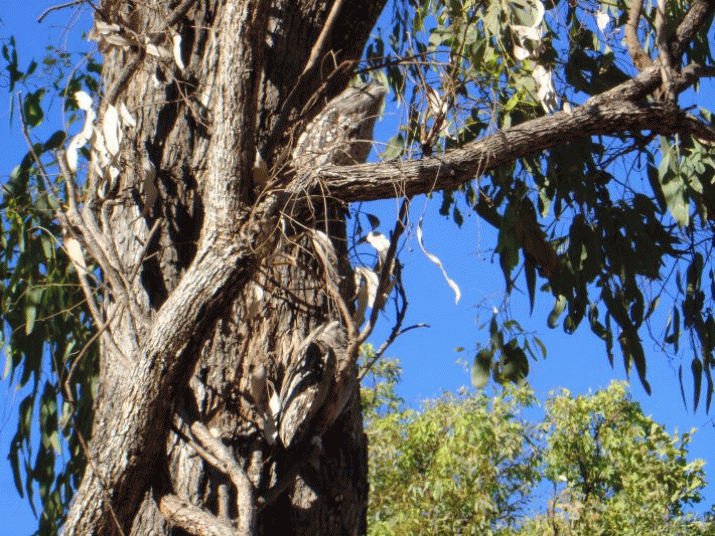
Peering through the scattered yellow gums to view Ralphs Bay and Lauderdale beyond I noticed an unfamiliar rounded shape at the point where a thick bough left the trunk of one of the eucalypts.
I thought at first it might be an unusual growth, notch or knot, but something about the shape suggested it didn’t belong to the tree even though it was the same mottled grey colour of the tree’s bark.
I focused my binoculars on the shape, straining my eyes for a full minute or two, when suddenly the rounded shape blinked. I had in my sights a juvenile tawny frogmouth, the first I had found on the mountain.
Standard fare on my favourite mountain track, the birds I saw and studied most, had been the flame robins I had spotted on the first day of the southern calendar year running from June 2012 to 2013 and now I could no longer find them. They had retreated to lower ground or left Tasmania altogether on a northern migration that takes them over Bass Strait.
I had a replacement species, however, which would keep me occupied during the autumn and winter. I had found a tawny frogmouth and from experience of tawnies in other areas of Tasmania and in Queensland I knew that frogmouths were generally sedentary and did not move to far from their home locations.
I had intended to head to Lauderdale next day to find waders. I always try to keep a record of numbers to aid wider study of their movements. The lure of seeing frogmouths, however, proved too strong. They might be relatively common but because of their superb camouflage, which allows them to merge with branch and trunk, they are difficult to find even within known territories.
The low morning sun picked out the columns of the Organ Pipes above me, and the yellow gums below, as I hurried along the Upper Lenah Valley track to find the frogmouth nestling again. Thankfully it was still in place, a little easier to recognise now possibly because I knew its shape and what to look for. Focusing binoculars on it, I could now saw the thin platform of sticks underneath it which formed the nest.
I soon saw another frogmouth, which I presumed to be the mother, on an adjacent branch. Then a surprise. The branch holding the baby frogmouth actually contained another frogmouth, lost in the contours and texture of the bark.
It was the most remarkable example of frogmouth camouflage I had ever seen.
If I hadn’t focused my binocular on the branch I would never have spotted the bird. Frogmouths might be described as “tawny” but they are in fact a light, ash-grey colour, with the plumage flecked with charcoal and tawny. The eyes are a beautiful orange colour but you rarely see this buy day; they are always hidden under those spider-web eye-lids.
The third frogmouth was pressed close to a horizontal branch, instead of the more common frogmouth practice of standing erect as if to resemble a mini-branch diverging from a thicker bough.
The frogmouth’s plumage matched the gnarled grey of the bark perfectly and the tawny flecks on the birds’ primary wing feathers folded over its back picked up streaks of maroon colouring on the underside of the branch. The bird was an exact mirror of the underside of the bough, making them both appear as one.
I didn’t need the absence of flame robins that day to tell me the seasons were changing. Yellow-throated honeyeaters might still chase each other excitedly through the treetops, and grey fantails join me on my hikes as they did in summer, but when I got home I found it necessary to light the first fire of the year.
Before the week was out, and the first month of autumn had ended, I pulled myself away from the mountain and went on a hunt for waders.
Migratory shorebirds are suffering catastrophic decline in numbers, mainly because of vanishing habitat on their stop-over point along their migration route, the South Asian-Australasian Flyway. They are also under pressure on Australian and New Zealand wetlands where they seek sanctuary from the northern winter.
At Lauderdale I was successful in fining the largest and most dramatic of the migratory waders, bar-tailed godwits and eastern curlews, that were once common on the Southern Tasmanian wetlands.
Tired of the wader hunt, I soon found myself training my binoculars on a Mount Wellington bathed in sunshine on the other side of the Derwent. I had travelled 30 kilometres to seek out birds not of woods but the seashore, but the mountain was in still in my sights, both metaphorically and literally.
Mother Mountain is the last significant feature on the migrant shorebirds’ journey south and I wondered if it guided them, they knew they had reached their destination when they saw it after the 12,000km southward flight, the godwits known to do a 8000km leg without touching ground.
Later I searched for more waders at Gould Lagoons, still in sight of the mountain, to the north and drew a blank for any wader species at all, resident or migratory but there was reward in finding rare waterfowl there, freckled ducks.
It was later reported that the ducks, only seen in Tasmania on a handful of occasions previously, were escaping drought on the mainland.
With the heat and humidity of summer now a memory, the skies were clear at night and sprinkled with stars. Standing on my deck after returning from Goulds Lagoon I gazed up at the Southern Cross and a near full moon, and thought of all the birds, songsters and waders, making the trek north, and I wished them well, with the stars guiding their way.