Over the course of 4 days in late April this year, Southern Waste Solution (SWS) released almost 70,000 litres of heavy metal contaminated stormwater directly into the Carlton River Tributary (CRT).
The first series of discharges occurred over the 22nd and 23rd of April, a subsequent series of discharges occurred a couple of days later on the 26th and 29th.
On the 26th of April the water in the secondary stormwater pond that was pumped directly into the CRT contained approximately 30 times the ecologically safe level of Cadmium and 11.5 times the safe level of Lead.
These heavily contaminated waters were diluted by a factor of 10 utilising water from the primary stormwater pond during the discharge process. The subsequent attenuated mix was then tested to satisfy the EPA. Not surprisingly, these samples showed Lead at 4times safe levels and Cadmium at 7.5 times safe levels.
In what amounts to a textbook example of corporate spin and yet another example of the totally ineffective EPA, SWS subsequently released a statement titled ‘ Environmental report gives all clear after extreme rainfall event’ . The statement contains the following critical points;
1. The report revealed no adverse environmental impacts
2. The rainfall event was a 1 in 2000 year event, and
3. The EPA set stringent conditions on the discharge
A brief analysis of the report and water testing results conducted by consultancy, Ecosure, reveals the hollow rhetoric of the statement released by CEO of SWS, Christine Bell on Monday 17th June.
Each of the above points will be addressed below;
1. Testing conducted, and the subsequent report written by Ecosure was not a report on the ‘Environmental Impacts’ of the discharge event, rather it is simply an overview of the water quality testing that occurred at the time of the discharge event. As stated previously, these discharges contained significantly elevated concentrations of a range of heavy metals and other contaminants, most notably Lead and Cadmium. The environmental impacts of these heavy metals discharged into the CRT would require a detailed study over a long time frame that tested these heavy metals, amongst other contaminants, through such end point parameters as the food chain as heavy metals commonly bio-accumulate and bio-magnify in the environment. The report makes the statement that ‘adverse environmental impacts from the discharges are unlikely to have occurred.’ However, this is nothing more than supposition and certainly does not warrant the suggestion that;
‘Environmental report gives all clear after extreme rainfall event’ ( TT here ), if we are to value rigorous science and analysis at all.
The report authors document that on the 29th of April discharges had to cease prematurely due to unacceptably environmentally dangerous contamination entering the CRT during real time sampling, with electrical conductivity (a measure of overall charged ions, generally salts and metals) of the post discharge CRT reaching over double its normal value (max. 4740 uS/cm), a potentially species threatening event for the localised environment at the point of discharge and beyond.
What is most alarming for those of us that value transparency is the lack of acknowledgement in the report to the fact that the post discharge samples used to determine water quality had been attenuated by inflow from the primary stormwater pond.
Critically, while this makes for far better test results if you are SWS, because each sample in time and space is diluted by a factor of 10, it doesn’t diminish the fact that in relation to Lead and Cadmium, waters contaminated by a factor of 5* greater than these results, were released into the CRT.
Put another way, the total amount of heavy metals discharged into the CRT was the same whether diluted at the point of discharge or otherwise. While diluting this heavily contaminated storm water helps mitigate against acute toxicity in the CRT, it can do little to mitigate against the ultimate accumulation and reconcentration of heavy metal contaminants into the CRT as they precipitate and filter out of the water flows.
2. On the 9th of April this year the local weather station at Copping recorded 102.6mm of rain within a 24hr period. This inundation led to the stormwater collection ponds at the Copping Landfill site, operated by Southern Waste Solutions (SWS), reaching maximum capacity. Some 13 days later, SWS had no other option than to commence releasing contaminated water into the sites adjacent tributary which feeds into the Carlton River just a few hundred metres from the point of discharge.
Far from being a 1 in 2000 year event, as portrayed by SWS CEO, Christine Bell, the rainfall event in early April has been replicated on multiple occasions since rainfall measurement at Copping commenced on the 1st December 1966. As recently as the 5th of June, 2009 the Copping weather station recorded 134.8mm within 24 hrs. Infact, rainfall events over 100mm/24hrs has been recorded on 6 separate occasions since records began in 1966. Furthermore, there has been 13 rainfall events of over 80mm/24hrs in the same period. In one recent notable event, 147mm fell in Copping in less than 48hrs in 2011.
Clearly, based on Bureau of Meteorology data, rainfall events of the same or greater magnitude that occurred in early April this year, are a once in a decade event if not actually more frequent.
3. The report by Ecosure outlines what appears to be the 4 most salient conditions placed upon it by the EPA, namely that; i) discharge not exceed 10% of the CRT flow, ii) at least once a day samples be taken from above, below and at the point of discharge iii) photographic evidence of sampling be taken and iv) a report be compiled subsequent to the above three conditions. Hardly the ‘stringent’ conditions referred to by the SWS statement. What is most revealing about the way the EPA discharges its duties is to ask, was there any public notice to landholders downstream of the SWS landfill site as to the planned discharge and the potential for it to impact on the water quality of downstream users?
4. Furthermore, this event had caught SWS on the hop. Scrambling to deal with its full stormwater ponds and the potential of overflow, SWS advertised in the Mercuryclassifieds on the 27th April for interested parties to tender for water quality testing, yet it would seem they had already engaged Ecosure prior to this date and the advertisement was simply to satisfy a statutory requirement after the fact. Tellingly, the advertisement reads ‘Neither the lowest nor any tender will necessarily be accepted’. A full 13 days passed before SWS was in a position to undertake a controlled discharge, a time frame that could have been disastrous for the CRT and its downstream environment had another significant rainfall event occurred in the interim. As part of the reports’ conclusion the author states;
‘It is clear that where the emergency discharge of stormwater is required, it is best done when flows within the CRT are high, and dilution is maximised. This requires a rapid response by both landfill management and the regulatory agency. And hence a detailed contingency plan that contains specified triggers and response actions to various foreseeable natural events such as floods and bush fires.’
Previously the community had been assured by both SWS and the EPA that such contingency plans had been developed. It should not, therefore, be a surprise to anyone that a large portion of the community does not trust SWS nor the EPA. This whole sorry episode underlines what opponents to SWS toxic waste dump have been saying all along. The Copping landfill is poorly sited and is a constant threat to the health of the greater Carlton River, its surrounding environment and the local communities. The operators of the landfill, SWS are prone to gross mismanagement of their obligations to the environment and the local community. They treat the local residents with contempt when what is patently a clear example of site failure, i.e. the requirement to pump contaminated water directly into the CRT, is converted into an exercise of contemptuous spin.
Lastly, and perhaps most importantly, this cautionary tale of what residents of the Southern Beaches can continue to expect, shines a light on the apparent ineptitude of the EPA who are serial offenders when it comes to the discharging if their duties in protecting the Tasmanian environment.
It should not be forgotten that they approved the original landfill at this site, they subsequently approved it for a toxic waste dump because it was expedient to do so, then when it comes to managing the risks the site presents, they have no formal arrangement with the operators to effectively and efficiently deal with an emergency situation.
Unfortunately, if or when such an arrangement is now developed in the wake of this sorry episode it will undoubtedly involve the cunning plan of discharging excess contaminated stormwater into the Carlton River Tributary.
*It would seem that while the discharge waters had been diluted by a multiple of 10 on the 26th of April, the concentration of some heavy metals remained diminished only by a multiple of approximately 5, indicating that the diluting water was also contaminated.
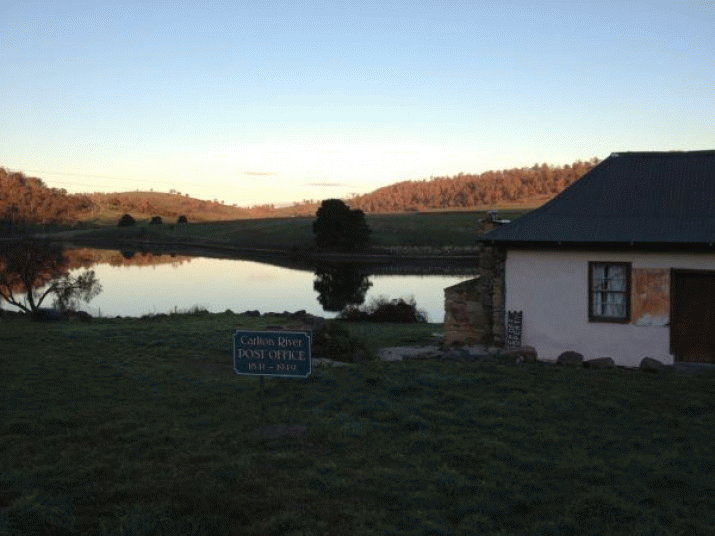
*Pic: The oldest standing post office building in Australia sits on the Carlton River. This is part of the built and natural heritage that residents value so deeply.
• Terry James, in Comments: Shonky Waste Solutions is owned by four local councils so we know for sure that they have our best interests at heart. The EPA is an instrument of government so we know that there is no conflict of interest. We must learn to trust, implicitly, those who rule over us. Remember that as worker ants we have a duty to obey, consume, be silent, die. If we are poisoned along the way then that’s the price we (as low socioeconomic fringe dwellers) must pay for progress.
• Southern Beaches Conservation Society, Dump The Toxic Dump: Rain caused a toxic spill Independent consultancy Ecosure, hired by SWS, tested the Carlton River water 10
metres downstream from the overflow. The results are alarming, with above recommended levels of; Nitrogen, Ammonia, Nitrate as N, Cadmium, Copper, Nickel, Lead, Zinc. SWS also told us the rainfall that caused this overflow was a 1 in 2000 year event. But a quick search on the Bureau of Meteorology website reveals records have only been kept for 47 years and this type of rainfall event has happened 6 times since then.
• Christine Bell, SWS, in Comments: The facts are …
• Shane Humpherys, in Comments: And so the spin continues …