‘In formulating any philosophy,” the amateur philosopher Woody Allen once observed, “the first consideration must always be: What can we know? That is, what can we be sure we know, or sure that we know we knew it, if indeed it is at all knowable. Or have we simply forgotten it and are too embarrassed to say anything?”
Philosophers have always been the butt of jokes, as the intellectual historian James Miller reminds us in “Examined Lives,” his earnest, wistful collection of biographical sketches of a dozen pre-eminent “lovers of wisdom,” from Socrates to Nietzsche. Since ancient times, members of this peculiar guild have been famed for their impracticality and otherworldliness. According to legend, the first philosopher, Thales of Miletus (in the sixth century B.C.), was so intent on observing the stars that, while walking one night, he fell into a ditch. An old woman taunted him: “How can you expect to know all about the heavens, Thales, when you cannot even see what is just before your feet.” Some two millennia later, my own father could be heard to mutter similar things while I spent the better part of my 20s reading old philosophy books that bore no obvious relation to earning a living.
But Mr. Miller’s aim is not to rehearse the many ways in which philosophy has provided its own comic fodder. He sets aside the epistemological obsessions that, since the Enlightenment, have led philosophers to question the very possibility of knowing anything with certainty. As Mr. Miller emphasizes, the philosopher was not always a university type, a professor writing obscure books filled with technical jargon. Philosophy began, in its Greek original, as a way of life—a demanding personal regimen. Philosophers were gurus, and their deepest insights were available only to disciples who possessed the character to resist common pleasures.
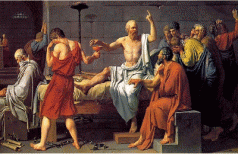
This tradition has to do, above all, with the long shadow cast by Socrates—or at least by the presentation of Socrates in the bewitching dialogues of his great student, Plato. In these endlessly rich dramatized discussions, we encounter Socrates as a self-described gadfly, questioning all comers in the marketplace about the best way to live. In the most famous of the dialogues, the “Apology,” which concerns his trial and death sentence in Athens for “corrupting the young,” Socrates emerges as a figure of near mythic integrity. As Mr. Miller writes: “He is prepared to die rather than renounce his beliefs. Serene in his willingness to sacrifice himself, he will give up living in order to prove his unswerving commitment to his transcendental project, his unending search for wisdom.”
Struggling with this formidable legacy took …