The Gunns Ltd/joint foreign owned pulp mill is proposed for Long Reach in the Tamar Valley. Both locals and visitors agree that the Tamar Valley, including Long Reach and the Rowella peninsula on the opposing banks is an area of stunning beauty.
The Tamar Valley is home to Tasmania’s second largest city Launceston and has a population of 100,000 people. Government and Gunns frequently use the phrase ‘the Bell Bay pulp mill’ which is mischievously employed to give the impression the mill would be sited in George Town’s Bell Bay industrial estate. However any registered map shows that mill is proposed for Long Reach, a narrowing of the Tamar River about 10km south of the Bell Bay estate.
Long Reach is on the eastern bank of the Tamar River approximately 35 km north of Launceston (HERE), adjacent to the two Gunns Tamar woodchip mills. Gunns already own two woodchip processing facilities on the proposed mill site which interestingly Gunns always refer to by its correct name – the Gunns Long Reach woodchip mill.
Long Reach is a former nature reserve and haven for nationally listed species like the green and gold frog, and Tasmanian Wedge Tail eagle, provided a natural buffer from industry until former Premier Paul Lennon, and his Labor Government removed its reserve status when it introduced fast-tracked legislation to approve the controversial pulp mill project.
Despite Gunns’ attempts to make over its image the company continues in its attempts to mislead investors and the general public about the nature of the area where the mill is proposed. Yet the cold hard reality for the people of the Tamar Valley and the residents of Rowella remain.
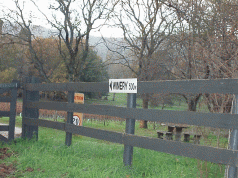
Gunns, against the wishes of the majority of Australians want to build one of the largest Kraft pulp mills ever built less than 800 meters from working vineyards, farms, organic producers and people’s homes on the western shore of the Tamar River. Locals refer to this area as the ‘Sacrifice Zone’.
Indeed, the Long Reach pulp mill site’s closest neighbours are the vineyards, farmers, fishermen, organic producers, aqua culturists, lavender farmers and residents who live directly opposite on the banks of the West Tamar on the magnificent Rowella peninsula. The stunning residential hamlets of Rowella, Kayena, Richmond Hill, Bonnie Beach, Sidmouth, Deviot and Batman Bridge are all in fact closer to the proposed mill site than the Bell Bay industrial area.
Residents, businesses and the region in general face very serious and very real public and environmental health risks as well as certain social and economic loss if the mill is built. With the noise, odour, light and massive emissions from the smoke stack whose girth at the base is a large as the Myers building in Launceston it will be extremely difficult for people to continue to reside in this area. Millions of dollars of business and real estate value will undoubtably be wiped out and based on the impacts of similar sized pulp mills around the world it is arguable that the area will be uninhabitable to residents.
To this day neither Gunns or the Tasmanian government have conducted an independent cost or risk analysis of the pulp mill’s impacts on the Tamar Valley.
Today it almost certain that Gunns will never achieve a social license for this project and many observers believe that the only reason Gunns still persist after five fruitless years searching for an investor is because they cannot afford to write the project off.
A perverse basis for the project to proceed.
If the project does proceed we only need look to the social unrest caused by unpopular Botnia Pulp Mill at Freya Bentos on the Argentine/Uruguay border (HERE) to see what will unfold in the Tamar Valley.

Late last year Premier David Bartlett spoke at the National Press Club in Canberra.
When Premier Bartlett finally mentioned the unpopular Pulp Mill in his Press Club speech he did so as an afterthought with a dutiful plug at the end of a 40-minute speech. To say the Premier looked uncomfortable talking about the divisive and controversial pulp mill in front of a cynical national press would be an understatement.
Mr. Bartlett segued from a lengthy eulogy about Tasmania’s future techno revolution to his short pulp mill reference with what is now a standard Bartlett anecdote about the mobile phone company Nokia.
…….“Most of you in the room today will have a mobile phone, if it’s not an I phone or a blackberry its probably a Nokia, and for many Australians, you wouldn’t know but Nokia began life as Forestry Company. That’s how it made its wealth before it branched out…Now we have older industries…or should I say traditional industries in Tasmania like forestry……… we are talking here about a very technologically advanced mill, meeting the strictest environmental standards anywhere the world. It too will provide opportunities for innovation and the effective use of new generation technologies”.
It’s not difficult to imagine how the Nokia anecdote has found its way into the Premier’s repertoire.
However, hitching Gunns’ pulp mill to the rising star of ‘new generation technologies’ came across as lame and contrived. Attempting to link the Gunns Pulp Mill to Tasmania’s future new world of IT and speedy communications is extremely tenuous and at worst makes the Premier look suspiciously like another in a long line of Tasmanian Premiers who have one compartment for good governance and good sense and another for the powerful Tasmanian logging industry.
Many Tamar Valley locals fear that whilst Gunns’ Pulp Mill will benefit its distant shareholders, the quiet, clever and diverse community who have managed to live harmoniously for generations with the local environment will be left to pick up the pieces as the Gunns Pulp Mill business fails.
There are indeed many precedents of this occurring in many countries all over the world.
Indeed, it will be of little consolation if the pulp mill does go belly up and the Tamar Valley is left with a Gunns mobile phone shop and a $3 billion hi-tech squat for the homeless.
At that stage there will be little recourse for compensation. Gunns, unlike existing locally owned businesses, will not be directly accountable to locals, rather protected from them by law.

If celebrated local chef – 2003 Tasmanian young achiever award winner – Daniel Alps can no longer serve the freshest, cleanest seafood and organic vegies because he can no longer afford to buy, or indeed to source them locally then the young people he employs from local towns like Exeter and Legana will be laid off.
If this occurs will the Bartlett Government be forthcoming with a bailout package?
Likewise local family business Miller’s Orchard was established in the 1930s and employ up to 60 full-time workers with a large percentage of their produce destined for the export market including France, Holland, Taiwan and Italy. Millers’ produce is more expensive than many of its competitors but it maintains its market because of the quality of the produce and the perception that it comes from a clean and pristine environment. Millers may well lose their export markets as their buyers worry about the damaged Tasmanian Brand and the impacts of pollution on the produce.
The continuing effect of the Gunns Pulp Mill on public life in Tasmania will be one of division. Terrible division.
Supporting the project stopped being clever long ago. Most Tasmanians have already worked this out.
The kindest thing to do for the Island of Tasmania would be for the Bartlett Government to disconnect itself form the proposed Tamar Valley pulp mill and reconnect to its line in the sand. Until the Bartlett Government does so, the Gunns Pulp Mill will continue to be a millstone around their necks, as it locks Tasmania into a future so irreconcilably at odds with Premier Bartlett’s vision for the state, as outlined in his speech to the Press Club.
“Tasmania’s future does not lie in the massive bulk exports of raw materials, it lies in low volume high quality, high value exports. To do that we need to re-think our logistics, transport systems that are low emissions intelligent systems…It’s about our skills sector, science, and innovative agribusiness. It’s about transforming our logistics into smart, low emission transport systems, and drawing more people to visit our State through our growing food and wine tourism sector. That is a clever Tasmania in action” (Premier David Bartlett, October 2009).
Original article with full links and pictures on Rick Pilkington’s Blog, HERE