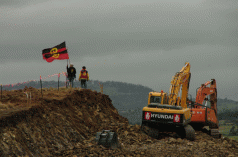
World archaelogical interest is on Tasmania following the exciting Brighton finds of Aboriginal artefacts that may be as old as 40,000 years. As this raises the prospect that we might have the oldest remains of human habitation in the Southern Hemisphere this discovery is of international significance.
That the finds are in the path of the controversial Brighton bypass road adds a big political headache for whoever is in power at the end of this month.
For this discovery gives rise to major questions – firstly, how these artefacts will be immediately protected due to the bypass, and, equally important, just what’s happening on improving legislative enforcement for safeguarding our Aboriginal relics in future. And that’s important because the Brighton finds present the tantalising possibility of others buried there and elsewhere.
Leaving aside the Brighton (or rather the River Jordan levee) relics for the moment, the issue of improved legislation is one of disappointment – it’s long overdue.
As is the case with our new Cultural Heritage Act (for built heritage) being updated (See In heritage we rust: HERE) so too has improving the Aboriginal Relics Act become a drawn-out process.
The existing Act is from 1975. A website trawling for Government information shows that while this Act was supposed to provide blanket protection for Aboriginal objects and sites created before 1876, there was little uniformity in enforcement and no recognition of recent and continuing Aboriginal heritage.
The necessity of a periodic review of the Act saw this done in 1998, but it didn’t result in new legislation then, although it was said to have helped “qualify the concerns of stakeholders”.
Jump forward to a Government announcement in June, 2005, of what was to be the new Tasmanian Aboriginal Heritage Legislation. But again, another gap and then came information that “consultation and research” were continuing, to prepare a draft parliamentary Bill, with the aim of having this out for public consultation last year.
I’m unable to determine exactly what stage it’s at now, although I know Will Hodgman has promised to expedite it should he get into power come March 20. He has observed that back in 1998 David Llewellyn had been quick to point out how “desperately in need of reform” this Act was – “and yet,” said Will, “almost 12 years on, and with an election not far away, the Government has demonstrated its inability to deliver.”
We also need to read how the relevant section of the Department of Primary Industries, Parks, Water and Environment regards the importance of relics. Its website informs us Tasmanian Aborigines have “lived on the island for at least 35,000 years” (and that will need an updating).
“Aboriginal heritage is an immensely valuable part of Tasmania’s history and a vital element in the lives of today’s Aboriginal community. Its heritage has many forms – some instantly recognisable, much of it harder to see. Many of these examples of Aboriginal heritage can be protected and managed by improved legislation.”
Quite so, but unanswered is: when?
Which gets me back to Brighton. With the discovery I noted the quick reported response of Norm McIlfatrick, as secretary of the Infrastructure, Energy and Resources Department, of plans for an elevated bridge spanning the relics site as protection (possibly costing $15 million, adding to the already expensive bypass construction).
What further caught my attention was him saying “we believe we can take a management plan to Environment Minister Michelle O’Byrne to protect the levee and allow the bypass to go ahead.” There is, of course, the little matter of the Government being in caretaker mode, and thus no action, and said minister may not be there with the portfolio in a few days.
Besides the Aboriginal community rejects the bridge proposal and contends the only answer is a complete diversion of the bypass.
Footnote: the writer has no political affiliation whatsoever, be that party of otherwise, and has no intention of having one.