THE dressed-up sustainability certification that is the Australian Forestry Standard (AFS) seems to be coming unstitched for the main players in the Tasmanian forest industry.
The Australian Forest Standard is one of the national forest certification schemes accredited by an international forest certification umbrella scheme, PEFC (Program for the Endorsement of Forest Certification schemes). This and other forest certification schemes use brand logos to reassure consumers that products they are buying are from ‘sustainable forests’.
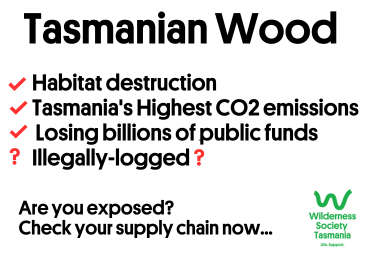
However, ongoing oldgrowth forest destruction, out of control landclearing for plantation establishment, continued use of 1080 poison on private land, climate-changing regeneration burns and inadequate community consultation are driving international condemnation of Tasmanian forestry practices.
A recent international report has compared Tasmanian logging practices with those of the most notorious of developing countries. Burma, Indonesia, Cameroon, the Philippines, Russia and Tasmania all feature as case studies where logging is legal, but far from sustainable.
International legal experts have condemned Gunns and their legal action to sue conservationists for $6.8 million as “an attack on basic civil liberties, in particular freedom of speech and freedom of assembly”. 109 UK politicians have signed onto a motion describing the legal action as an attempt “to stifle legitimate public protest through aggressive and questionable legal proceedings”.
Heads in the sand
The actions of the logging industry, both in the forest and in the courts, is not going un-noticed. While political and business leaders in Australia continue to bury their heads in the sand, it is refreshing to realise that leaders in the international arena will not ignore it. Instead they act in an attempts to do something about it.
In recent weeks a UK Government committee (CPET Review Committee) declared that the Australian Forest Standard does not meet the criteria set for its endorsement of Forest Certification schemes. This week, the news broke that the Belgium Government has placed the Australian Forest Standard on a B list of forest product providers eligible for Government procurement contracts. This ranks the AFS behind many other wood producers and certification schemes.
The head-in-the-sand attitude of the Federal Government and industry leaders and their repeated denials of a problem is selling Australia short. These European governments are sending a clear message that our logging practices are unsustainable and that the Australian Forest Standard, far from being ‘world’s best practice’ is in fact second-rate.
The Wilderness Society congratulates the governments of both European countries for taking the steps to encourage Tasmania’s logging industry down the path towards environmental and social responsibility.
Worldwide there is an increasing demand for forest products that come from environmentally responsible suppliers. Australia has a golden economic opportunity to reform its forestry practices and tap into that global market. In Tasmania, the logging industry is currently spending over $250 million of taxpayer money. Much of this money is given with the expectation that it assists a transition away from logging oldgrowth forests. It should be invested in securing this golden opportunity.
Instead, logging has intensified in many areas and some of this money is being spent to build brand new roads into previously untouched areas of oldgrowth forests. It is being spent on further landclearing and plantation establishment. It is being spent on the establishment of a native forests-fed, polluting pulp mill that will entrench the status quo and lock Tasmania into 30 years of high-volume, low-value woodchipping of a precious public resource.
None of these investments represent a positive step forward or good use of public money.
Vica Bayley
The Wilderness Society
meanwhile: Protester claims tree-sit record