First published July 21
Southwood (or Reliance Forest) Fibre’s bid to bring foreign woodchip carriers to Strathblane and the biosecurity risks for Port Esperance and adjoining waterways …
In mid-November last year, Southwood Fibre announced itself and its proposal to export 800,000 tonnes “smartfibre” (aka woodchips) per year from a loading facility at Strathblane, near Dover in southern Tasmania.
http://www.abc.net.au/news/2017-11-15/proposal-to-export-woodchip-from-southern-tasmania/9152282
Southwood Fibre has stated they expect each visiting ship to take around 45,000 green metric tonnes of woodchips. By my calculation, this represents about 18-20 international vessels per year, approx. one ship every 2-3 weeks spending 3-4, possibly 5 days loading woodchips each visit.

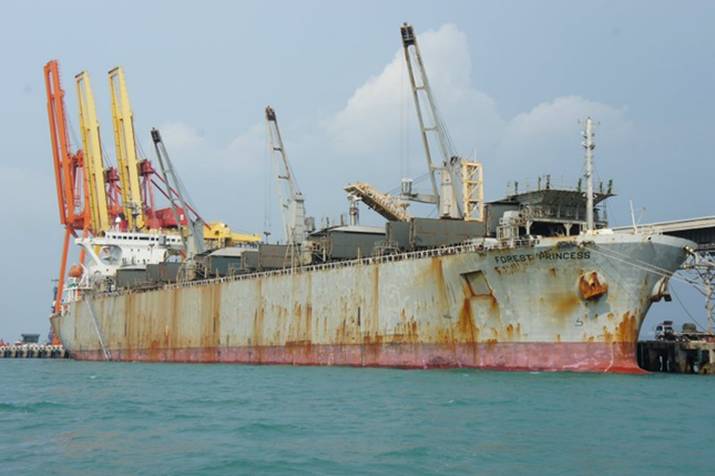
The 199m Forest Princess: a 51,000 DWT woodchip carrier, which Southwood Fibre said was typical of the kind of bulk carrier which would come to Dover.
Source: http://www.abc.net.au/news/2018-05-24/forest-princess-woodchip-bulk-carrier/9793172

Massive woodchip carriers, such as the Forest Princess, require 4-5 tugs to berth. From their own website Southwood Fibre describe ships of around 45,000 DWT up to 240 metres in length.
See: News and Information: Key Concerns: https://www.southwoodfibre.net/key-concerns.html
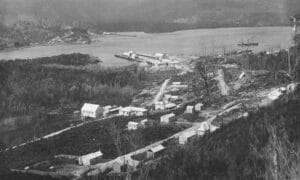
During their one and only information sharing session at Dover School in early December last year, the representatives for Southwood Fibre announced a partnership with Singapore-based China Navigation Company, now branded as SWIRE SHIPPING. Many of their ships are twice the size and tonnage of the woodchip vessels that went to Triabunna; 8-10 times the size of the apple “boats” that came to Port Huon (including the 6000 to 7000 tonnes Port Line ships that swallowed the entire wharf).

Photo source: https://porthuon.com/
From their website, the SWIRE SHIPPING bulk carrier vessels all have DWT (Deadweight Tonnages) of 38,000 to 40,000, with Drafts of 10.5-10.7m, e.g., the 180m long Wuchang with DWT: 39,128, draft of 10.5m, five cargo holds and a total carrying capacity of 49,000m3. Given its Draft, this vessel would be berthing in the middle of Tassal’s smolt lease.

Following the recent purchase agreement announced by Reliance Forest Fibre, it is unclear whether they will take over the woodchip export proposal from Southwood Fibre.
See: http://www.abc.net.au/news/2018-07-16/reliance-invests-further-into-forestry/9995856
Either way, the outlook looks bleak for the marine environment at Port Esperance, adjoining waterways and the lucrative aquaculture industry. The potential risks or threats to the marine environment and aquaculture are mainly threefold: from cargo hold ballast water, the hull-clinging (or hull-fouling) marine organisms (various plant or animal species) and ships’ bilge water. Other sources of potential infection from biofouling include the lowering of a ships’ anchor and discharge of anchor wash waters. Many of these organisms will be quite small; some will be just visible to the naked eye, but others will be virtually invisible, (only seen with a microscope).
Large ocean going bulk cargo vessels need to carry ballast water in their empty cargo holds to maintain stability and “trim”, especially necessary while in exposed open waters, albeit sometimes heavy seas.
On arrival at the loading facility or the port (perhaps shortly before), the large amount of ballast water must be discharged rapidly in readiness for loading. Ballast water may contain oil, bacteria, algae or other marine plants, plus marine organisms including the egg, embryo or immature larval stage of marine invertebrates … often taken on board in international waters. Ballast water taken from one ecological zone (e.g, South China Sea), then discharged it into another (e.g, Tasmanian ports or loading facilities) can introduce invasive species. Bio-invasion is one of the four greatest threats facing the world’s oceans today.
The waters of Port Esperance where the woodchip loading facility is proposed, will provide a natural medium for the introduction of invasive marine pests to establish. It just so happens that the bay of Port Esperance surrounded by Strathblane and Dover, is home to several forms of well-established aquaculture: mainly oyster and mussel farming, plus the lucrative Tasmanian salmon industry. Over 50 species of exotic marine plant and animal species are already recorded in southeast Tasmania, including the North Pacific Sea Star … arriving as larvae in ballast waters discharged by Japanese ships, no doubt including the woodchip bulk carriers at Triabunna.
Southwood Fibre say they will monitor ballast water exchange (or treatment) by checking the ship master’s logbook on behalf of AQIS officials. Question: how will they do this prior to a ship’s arrival?
International cargo ships are required to prevent the transfer of invasive nasties from foreign waters. The international protocols for ballast water management are set by IMO (International maritime Organisation) and the equivalent countries’ (i.e., Australian) legislation; however, these provisions are woefully inadequate, often not followed correctly and sometimes avoided. There are three separate Acts of Parliament or Determinations governing the regulation and monitoring of ships’ ballast water in Australia. Australian Ballast Water Management Requirements Version 7 (2017), Biosecurity Act 2015; Biosecurity (Ballast Water and Other Measures) Amendment Act 2017; and the Biosecurity (Ballast Water & Sediment) Determination 2017.
The most common technique is to undertake an exchange of ballast waters in the oceans of the countries where the cargo ships are headed. Under our legislation, this is referred to as Regulation D1 (Exchange Standard). When ships are steaming through extremely rough or heavy seas, they are often unable to do a ballast exchange until reaching sheltered waters, sometimes not until close to, or actually at the port of call. A new Regulation (D‐2 Treatment Discharge Standard) now applies to new shipping vessels constructed on or after 8th September 2017. Treatment methods include UV disinfection and chlorination to remove, kill and/or inactivate organisms prior to ballast water discharge. Ships constructed before September 2017 – around 60,000 cargo ships worldwide – need to comply with Regulation D‐2 by either first or second five‐year IOPP (International Oil Pollution Prevention) certificate renewal-survey. The final date for this process is not until 8th September 2024.
Hull-fouling plant matter and marine organisms such as barnacles, starfish or even shellfish attach themselves to ships’ hulls. Plants can be dislodged at any time simply due to sea swell and similarly animal species can and will jump ship, so to speak, at any given time in another part of the world … in rough weather and stormy seas or in calm weather without sea swells during cargo loading operations.
During cargo-loading operations, bilge water is often discharged to maintain the ship’s “trim”, i.e., keep it on an even keel. (Since a ship is supported by fluid pressure, it will incline in any direction according to the position of the weights placed in the ships’ hold.) The major use of a ship’s bilge system is for clearing water and oil, which accumulates in machinery space bilges. Residual ballast water in ships’ holds sometimes ends up in the bilge system, together with the wash water when holds are cleaned. Located at the bottom of a ship, bilges also collect leaked sea water, shipped water and gravitating water from ships’ deck including displaced anchor wash. It is a separate system to ballast water. Bilge water contains oil, plus chemicals – cleaning agents, emulsifiers, solvents or surfactants. It may also contain invasive marine species. Discharge of bilge water containing oil and chemicals close to shore is prohibited; but it occurs.
The lowering of a bio-fouled ships’ anchor as it ties up alongside a loading facility or wharf, can be another source of invasive plant or animal species. Although a ships’ anchor chain is generally washed while departing a previous port of call, some invasive species may persist from prior biofouling.

Following her reading of Southwood Fibre’s marine ecological survey, Dr Pat Hutchings offered the following comments. Dr. Hutchings is Senior Fellow (and past Senior Principal Research Scientist), Australian Museum Research Institute.
In her own words Pat describes herself as “…a benthic [sea floor] ecologist who has worked on introduced marine species for over 30 years and have served on the national ballast water committee and published extensively on ballast water introductions.
“I have read this report and I would suggest that it represents an inadequate survey on the potential impacts of the proposed loading facility in Strathblane, Tasmania. The proposed loading facility will allow regular visits by large vessels to take on board locally supplied woodchips, while foreign ballast water is discharged into these enclosed waters, close to an aquaculture facility.
“The survey fails to take into account that while vessels are being loaded their motors will be running continuously to allow the ballast water to be discharged, which will increase turbidity in the surrounding areas and impact on nearby benthic communities. Non-native marine species are known to be introduced by both ballast water and hull fouling, and some are classified as major economic pests including those which severely impact on aquaculture facilities. Each ship has the potential to introduce such species. No consideration is given to the bathymetry [sea water depth] in the area and the width of navigation channels in an area noted for its regular severe storms.”
Tassal have already issued a statement that the current proposal was incompatible with their leases, and that the facility would pose a health risk to their farmed salmon. The process of berthing one of these massive ships would be potentially detrimental for both the salmon and shellfish farmers alike. Considering the depth of draft of many of the proposed bulk cargo vessels, it’s likely that seabed dredging will be required. The lifting of flocculant clays from the sea floor together with silts would be problematic for all marine leases, let alone the turbidity that dredging would create.
*Arthur Clarke describes himself as a semi-retired biologist/ cave ecologist and former Honorary Research Associate in the School of Zoology at UTAS, with a work history of 23 years in the stevedoring industry, starting in the early 1970s loading “apple boats” at Port Huon. During the off season, Arthur had several stints as a labourer with Forestry Tasmania and the Esperance Council. Following the closure of Port Huon in 1986, Arthur commenced duties as a waterside worker on the docks in Hobart, later becoming the working Port Secretary for the Waterside Workers Federation/ Maritime Union of Australia. In this latter role he was the Hobart delegate and inspector for the International Transport Federation during the “Ships of Shame” saga. After taking a redundancy in 1996, he completed a part-time BSc at the University of Tasmania, with triple majors in Geology, Geomorphology and Zoology, then continued with post-graduate studies completing an MSc thesis in Zoology at UTAS in 2006.
• Sarah Courtney, Guy Barnett: Statement on Southwood Fibre
• ABC: Southwood Fibre abandons plan to build woodchip mill, port near Dover