Bevilacqua: Three strikes on mill pollution
Cameron Hindrum
I am often heartened by the musings of noble and clever chaps such as Saul Eslake, who have touted the idea of a creative economy. Why is that it we must forego innovation for the sake of the quick fix? Why must funding to education, to health, to affordable housing, suffer so that we can have the myriad benefits of a Pulp Mill Task Force — the real contribution of which, by the way, has been pretty minimal if not downright abysmal? Why, finally, must we risk the quality of our lifestyle (which is at the end of the day the envy of many) for the sake of a few jobs and the almighty dollar?
THE decision by Gunns Ltd to withdraw from the RPDC process might not have come as a surprise to some people, but it has created a new dimension to the Pulp Mill issue which in turn could make the future of this project even more precarious than it might already have been.
It is therefore timely to synthesise exactly why this proposed isn’t really such a crash hot idea. Although I am sure there are many more (and I encourage TTers to contribute their own at will) I have compiled the following list of Ten Good Reasons in an effort to keep the valid arguments in opposition to this development in clear and present focus — without hyperbole, perhaps not without the odd dash of cynicism or humour.
1. It will be in entirely the wrong location.
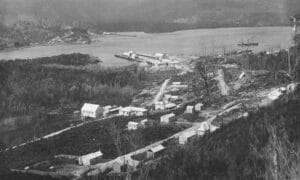
Many thanks to Dr Warwick Raverty for this one. It may follow that there is no ‘right’ location for a pulp mill, but surely the banks of a populated river close to recreational fishing grounds, with effluent pumped into Bass Strait where it not flush easily, renders Longreach completely unacceptable.
There is also the small matter of the on-site storage of tens of kilograms of chlorine gas, which again has only been bought to my attention by Dr Raverty. (For daring to share such information with the general public, the good Dr has of course been thoroughly vilified by the Vested Interests Cheer Squad, who hopefully will get sued for their efforts. Yay.) If we consider the worst case scenario, in the event of an accident this gas could create a death zone incorporating many of the small population centres at the mouth of the Tamar River.
And there’s also that pesky inversion layer. Fumes emitted by the mill may be trapped in the airshed over the Tamar River valley for days. Perhaps the $870 the Premier said every Tasmanian household would get if the mill goes ahead can be spent on breathing masks and asthma testing kits.
2. It will create vast, if not unsustainable, increases in traffic.
A report completed by Keith Midson for GHD Pty Ltd at the request of the RPDC calculated that the pulp mill will require an extra 164 log trucks to travel down Wellington Street, Launceston, every day; an extra 763 a day on the East Tamar highway, and an extra 122 along Macquarie Street in Hobart (Mercury, Sat. 31/3).
As the main arterial routes through their respective cities, Macquaurie and Wellington Streets are already considerably dense traffic zones. The addition of extra traffic as suggested by this report will increase congestion, create less safe driving conditions and potentially generate increased statistics in fatal road traffic accidents. The alternative transport method, rail, is not feasible without considerable spending ($30m, according to the same Mercury report) on upgrades to railway routes and bridges.
Don’t expect any of this to come to light in the Premier’s “robust” assessment process of the mill proposal, by the way; it may be one of those areas where the government investigates ‘benefits’ of the mill proposal, rather than the slightly more demanding and potentially inconvenient ‘impacts’.
3. What will be in the mill effluent?
According to the Gunns hype, not much — ‘less organochlorines than a glass of red wine’ as the company has reported in one or the other of its various forms of advertorial propaganda.
If the mill is to produce its own chlorine dioxide, however, then its effluent will in fact contain enough toxic organochlorines to breach the Stockholm Convention on persistent organic pollutants, which alone (and in theory) should be enough to get the mill canned by federal parliament.*
Again according to Dr Raverty, ‘No other pulp mill in the world uses the process Gunns proposes.’ (The Mercury, 25/3/2007).
Let’s not kid ourselves about this issue, Dear Readers. Dioxins are highly toxic, highly persistent, and the mill will apparently dump about 140 tonnes of dioxin-bearing effluent into Bass Strait a year. They are included in the Stockholm Convention for their propensity to accumulate in the fatty tissue — fish, humans, Liberal voters — of any creature that consumes them. For some curious reason, and despite some hard scientific facts to the contrary the draft IIS submitted to the RPDC by Gunns seems to conclude that dioxins are nothing to worry about. (Tip of the hat to Jon Sumby for this info; read more here:
http://oldtt.pixelkey.biz/index.php/weblog/comments/six-reasons-why-the-draft-iis-sucks/ )
*Of course, that is providing Gunns Ltd ever gets around to referring the project to the Federal Government. According to today’s Mercury it is still waiting for their letter, which he requested urgently about a week ago. What ever could the company be waiting for, one wonders … ?
4. Jobs, jobs and more jobs! Or not.
One of the big promises attached to this mill is that of economic benefit, the most tangible plank of which is the creation of jobs. The PR for the mill is throwing out some pretty big numbers: according to a full page placed by the CFMEU Forestry and Finishing Division in the state’s newspapers, the mill will “generate 3400 direct and indirect jobs throughout the state during the building phase; employ 2500 people during peak construction; and 1600 jobs across Tasmania once fully operational”.
Rubbish.
The construction of the mill will indeed generate work for local builders, but construction for the mill has already been tendered out to an Austrian company, Andritz — before the project is approved, which in itself is mighty suspicious — and how many Austrians will therefore be flown in to work on the project, to the detriment of our own very talented chippies? (And by the way, does the CFMEU know about this work being outsourced offshore?)
A mill of a similar size to that proposed for Longreach — in Valdivia, Chile — employs about 320 people if memory serves. The vast majority of these are not locals.
The mantra that often accompanies this argument for the mill is that jobs must be kept in the state — for our future, for our sons and daughters. Why? Is our future really so desperate that we have to condemn our children to stay?
I’ll encourage my children to get the hell off this island as soon as they can. We live on a tiny speck on the bottom of the planet. Life is most likely happening in lots of places elsewhere.
5.Turning back the clock
Terry Martin (Bless Him) made several excellent points during his speech to the Legislative Council, ( I will therefore be voting against this mill ) but the one that is relevant here is that this mill as proposed represents a return to the cargo cult mentality; we have access to a resource, we must exploit the hell out of it, and bugger the consequences.
We have been through this with mining, with the dam-building years, and now with woodchips. Why do we continue to worship a resource-based economy? The King River on the West Coast is dead, thanks to the Mt Lyell mine; Lake Pedder destroyed much virgin forest, including (again if memory serves) a rare inland beach. This point is developed further in No. 10, but on the face of it the government’s rabid support for this project seems — as Terry Martin has also said — to suggest something of a lack of vision on the part of the government.
6. Water, water everywhere
This should be what our American cousins call a ‘no brainer’. On the face of things, this mill proposal should fall over on two apparently simple premises: that it will contribute significantly to global warming, and that it will consume enormous quantities of water — 26 billion litres a year, to be precise.
Launceston has (as yet) escaped the water restrictions in place in some parts of the state, and most of the major mainland cities. It defies logic that in drought conditions, when we have recently seen an outbreak of toxic algae in the Trevallyn Dam due in part to a lack of flow into the catchment, a project requiring such vast amounts of water could be approved.
This is not to mention the additional cost and infrastructure required to pump the water from the Trevallyn Power Station 55-odd kilometres down to the mill site. And of course, the mill will not reuse its water; every litre pumped in will get pumped out again as effluent, with the aforementioned dioxins and organochlorines added, into the waters of Bass Strait — where, due to slow flushing times in the proposed effluent outfall area, it will stay for much longer, much longer, than you’ve probably been lead to believe.
7. Australia is a signatory to the Stockholm Convention.
As mentioned, this Convention regulates the emission of persistent organic pollutants (POPs) and the mill as proposed is likely to breach such emission limits as detailed in No. 3. Ideally, this should mean that the Federal Government has no choice but to disallow the mill proposal, but unfortunately we can’t talk in ‘ideal’ terms when it comes to the pulp mill.
If you believe Federal Environment Minister Malcolm Turnbull should veto the mill on this basis, please contact him to let him know:
The mill as proposed would also seem to be highly dubious with respect to the Equator Principles, to which both ANZ and Westpac have signed up. Since they seem to have everything else prepared for the commencement of construction, I am sure that the Gunns Brains Trust also have finance organised, although it is probably not through either of these institutions. Is the source of finance Australian? If not, who will actually own and operate the mill in the event that it is approved and built (by an Austrian company)?
8. Why is the proponent dragging its feet?
Gunns Ltd has been confidently identified as the reason for delays in the RPDC process over Christmas and into February this year; yet they cited the lack of a timeline as the core reason for withdrawing from that process.
(The company also cited the dubious figure of $10 million a month that delays were costing it; this is not supported by a moment’s reflection on the fact that to date, at best, they have spent about $30 million on the mill proposal, which has been on the cards since 2003.)
If the company is so committed to this project going ahead in Tasmania, why haven’t they cooperated more readily? Why, as mentioned, is Malcolm Turnbull still waiting for their letter of referral?
I might suggest that these delays are partly due to real concerns — viable concerns — regarding serious problems with the mill proposal, with respect to emission limits, odour control, transport, etc. The company is about to embark on a major propaganda campaign in our daily newspapers — one ad a day for about three weeks — which will spell out the facts (apparently). All very well, but Malcolm Turnbull won’t give a rat’s. The independent consultant* won’t give a rat’s. Just what is it that Gunns is so desperate to establish, that we haven’t already heard? If money is an issue for this project, why is Gunns spending the equivalent budget of a small third world country on this nonsense?
And will the source of these “facts” be the 7500 page draft IIS, the credibility of which has been heavily questioned by Beca AMEC, the company contracted by the RPDC to assess it? Which leads me to …
9.This mill may not be robustly assessed under the new parliamentary process.
There are two reasons for this: time, and the taint of collusion.
The Pulp Mill Assessment Bill 2007 gives the consultant hired to do so five weeks to research and prepare a report on the mill proposal for presentation to parliament. That’s five weeks to read the Draft IIS (at 7500 pages, I hope ‘Insomnia’ is one of the selection criteria for the position), or at least cover the pertinent emission and effluent issues, as well as address the issue of the mill’s proposed location, and THEN draft and present a report that adequately addresses these issues. The science is complex, the issues are complex, and five weeks is a simply ludicrous timeframe in which to address them adequately.
There is also the rumour that lawyers for Gunns have been heard to express displeasure (of the ‘Over our Dead Body’ kind) at the possibility of Beca AMEC being appointed as the independent consultant. One suspects this is because this company has soundly trashed the Draft IIS in reports already received by the RPDC before Gunns withdrew.
Any suggestion that Gunns employees or its representatives are ANYWHERE NEAR the appointment process should be sufficient grounds to have the parliamentary process scrapped and sent back to square one, wherever the hell that is.
Either of these should suggest that the Premier’s favourite song about how robust this process will be is waaaay off key.
Finally:
10. This project represents a catastrophic failure of the imagination.
A pulp mill was soundly rejected by the Tasmanian population in 1989 and it is difficult to consider why Tasmania is so desperately in need of one now.
For the reasons articulated in No. 5, it is very difficult to understand why we should (as I believe the venerable Terry Martin said in his speech the other day) put all of our eggs in one basket. (What happens if the basket is then dropped?)
I am often heartened by the musings of noble and clever chaps such as Saul Eslake, who have touted the idea of a creative economy. Why is that it we must forego innovation for the sake of the quick fix? Why must funding to education, to health, to affordable housing, suffer so that we can have the myriad benefits of a Pulp Mill Task Force — the real contribution of which, by the way, has been pretty minimal if not downright abysmal? Why, finally, must we risk the quality of our lifestyle (which is at the end of the day the envy of many) for the sake of a few jobs and the almighty dollar?
These are rhetorical questions, which is perhaps just as well, as genuine answers are evasive.
Over to you, TTers.
Cameron Hindrum lives and works in Launceston. He is officially as mad as hell and he’s not going to take it any more. You have been warned.
Bevilacqua: Three strikes on mill pollution
Extracts:
GUNNS Limited’s latest pulp mill proposal fails to meet at least three official air pollution guidelines.
It also fails to address the Australian Medical Association’s concerns about ultra-fine particle pollution, known as PM2.5.
And Gunns consultants say modelling predictions of the pulp mill’s impact on Tamar Valley air were made with incomplete or inaccurate data. As a result, the modelling sometimes predicts air pollution will be lower with a pulp mill than without.
Expert witness statements and reports in Gunns’ supplementary information were supplied to the Resource Planning and Development Commission last month.
It shows the Tamar Valley pulp mill proposal:
Fails to meet RPDC guidelines for in-stack emissions of oxides of nitrogen (NOx), which irritate asthma, cause smog and contribute to acid rain.
Fails to meet RPDC and Department of Tourism, Arts and Environment guidelines for sulphur compounds (TRS) at ground level at the mill site and nearby surrounds, which contribute to odour and can have health and environmental impacts.
Fails to meet international engineering standards for its main chimney, which is far shorter than required by US Environmental Protection Agency standards.
Fails to include the potential impact of ultra fine PM2.5 particle pollution.
Knocks back suggestions from RPDC expert consultants to use different technologies to tackle air pollution problems on the grounds they add cost to the project and create new pollution issues.
Disputes expert opinion of RPDC consultants, including pulp mill consultancy Beca Amec.
Independent experts — including the CSIRO, Beca Amec, Uniquest and RPDC pulp and paper research scientist Warwick Raverty — were to assess the updated information.