

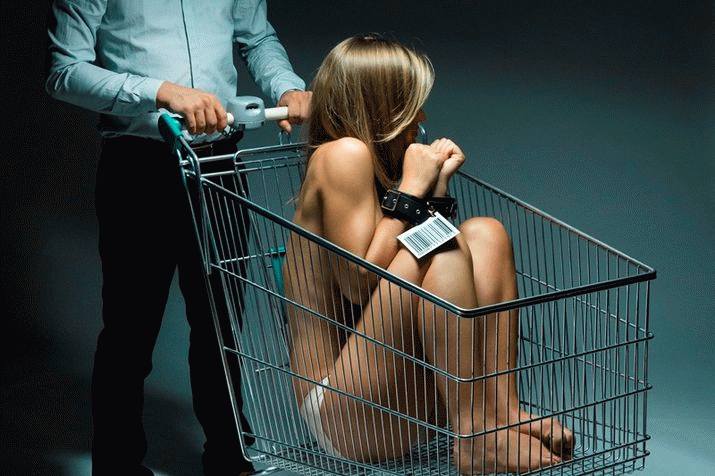
*Pic: Image from HERE
Simone Watson is a sex trade survivor – a woman who has known the coercion and cruelty that dominates the lives of most prostituted persons. On Friday, Simone will be delivering an address at Parliament House in Hobart. At a time when violence against women is being publicly recognised as a longstanding blight on society, Simone will speak of the physical and emotional violence endured by women in prostitution.
The buying and selling of sex is something most of us do not want to think or speak about. We know it happens – we know women and girls, and boys, are trafficked in huge numbers worldwide to feed the sex trade’s insatiable demand for fresh ‘meat’. We can express horror at their plight – even contribute to organisations that work to contain the apparently uncontainable – but we don’t want to now the details.
We don’t want to know the pain suffered by women and girls forced to have sex – often unprotected and aggressive – in order to survive, because they have no other option. Our desire to ‘fit in’ with modern, progressive, liberal, ‘sex-positive’ social attitudes persuades us to adopt the mantra of the sex trade lobby – ‘sex work’ is a choice, a job like any other, and empowering for those women who participate.
We take the image of the ‘happy hooker’ put forward by a tiny minority of ‘sex workers’, and those who profit from the sex trade, as gospel, because we don’t want to acknowledge the truth – lest we be called ‘prude’ or ‘wowser’.
That truth, as Simone will explain, is that the overwhelming majority of women (and men) in prostitution want nothing more than to leave. They are in ‘the life’ because they are poor, they lack education, and support services are grossly inadequate. Many have a violent, coercive male partner. Like women trapped in violent domestic relationships, they turn to alcohol and drugs to cope, and with their personal integrity eroded and their sense of self slowly obliterated, they find it more and more difficult to leave.
All women are entitled to a life free of violence, to a sound education, and to real choice about their life’s course. But most importantly, they are entitled to sovereign ownership of their bodies.
Some women may give entry to their bodies, for money, and find it untroubling, but most in the sex trade do not. The voices of those who have escaped the sex trade are now becoming louder and more focused worlwide. They speak of the harms suffered, and the struggles endured in rebuilding their lives – they are physically and emotionally damaged, but determined to bring the world’s attention to the momentous assault on women’s rights being perpetrated by sex trade advocates.
Those who profit from prostitution – the johns, the pimps and the brothel owners, and a few complicit ‘sex workers’ – routinely vilify sex trade survivors. As Simone writes, ‘they boast banners of “whore” and “slut” and carry a red umbrella and scowl at those of use who do not embrace these colonising terms. We’re called “whorephobic”. Those suffering PTSD or physical disabilities and with almost zero employment opportunites are “selfish, uptight, despicable and non-feminist”. Victims and survivors of prostitution are monsters who want to spoil the fun for the rest’.
The number of persons working in prostitution is notoriously difficult to determine, but a 2008 study by the Australian Institute of Family Studies estimated there are about 20 000 ‘sex workers’ operating in Australia at any one time, the majority of whom are women or girls.
That’s around 20 000 female persons whose bodies are being used, usually several times a day, for the sexual gratification of a series of men. How can a group of 20, or 50, or even 100 so-called ‘empowered’ sex workers be representative of the 20 000? How can they genuinely claim to speak for them, and why do we accept their status as the voice of ‘sex workers’?
Further, many of those currently working in the Australian sex trade are Asian women with poor language skills, indebted for thousands of dollars to those who ‘sponsored’ their move to Australia.
As much as we are aware of the growing problem of sex trafficking in Australia, do we stop to consider the lives of the individuals involved? Or would we rather not offend our sensitivities with thoughts of tiny Asian women living in virtual imprisonment and catering to the porn-fuelled demands of their male ‘clients’?
If you’re a woman, and if you’ve ever had sex, you know how physically insulting and emotionally degrading the lives of the prostituted must be. You know, if you look closely at the synergies at play in their lives, and in your own lives and in society at large, that all the indignities suffered by women – prostitution, domestic violence, and the inequities they experience in the workplace – are built on a foundation of gender inequity.
The sex trade would not exist without male demand, but men are rarely mentioned in any discussion of prostitution, beyond a rudimentary acknowledgement that they must have sex. It is expected that women will satisfy their needs – as wives and girlfriends, or through prostitution, or they will take it by means of rape.
It’s a universally accepted idiosyncratic male need, and those who question it – particularly those who have seen the worst of it in the sex trade and speak out against its consequences for women – are treated by many as social pariahs.
The sex trade worldwide is advocating for full decriminalisation of prostitution, and it now has the support of prominent human rights organisation, Amnesty International. For Amnesty, it is a simplistic approach which fails, as many of us do, to think carefully about what prostitution means at the individual level – physical violence, health risks, and the need to dissociate from the repeated invasion of your physical person.
For the sex trade profiteers, and the men who buy sex, decriminalisation is an opportunity to prosper financially, and exploit women with impunity.
Simone will speak about an alternative approach to legislation that criminalises only the buyers of sex, and those who procure and profit from the sale of sex – the Nordic Model. Nordic Model laws originated in Sweden in 1998 as part of a broader approach to legislation that supports gender equality. Those who sell sex are not criminals; rather, they are offered support to leave prostitution.
New Zealand has a fully decriminalised sex trade and is often presented by sex trade promoters as a model of the benefits of decriminalisation. And most of us accept it without question. We accept talk of ‘sex workers’ having the same rights as other workers without questioning the nature of the ‘work’ they do.
But we all know you can’t make a silk purse from a sow’s ear. No matter how much prostitution is dressed up with talk of ‘rights’ and ‘choice’ and ‘agency’, it’s still one person (usually a man) paying another person (usually a woman) for whatever sexual gratification he desires.
As a woman currently working in prostitution in New Zealand says, ‘the sex is unwanted but we need the money, so men can exploit this imbalance of power and our economic need for their own sexual greed, and pimps can capitalise on the transaction further exploiting us for their financial greed so they can get rich while we only survive’.
These are the voices we should be hearing.
Simone Watson will be presenting her talk titled ‘Sex Trade Survivor Pushes for Rethink on Prostitution Laws’ on Friday 1 April between 10.00 am and 12.00 pm in the Reception room at Parliament House, Hobart. This is a public event.
• An edited version of this story published also as Mercury Talking Point HERE
Bronwyn Williams is a Masters candidate in Journalism, Media and Communications at the University of Tasmania. She has worked previously as a lawyer and community support worker advocating for women in domestic violence.











