

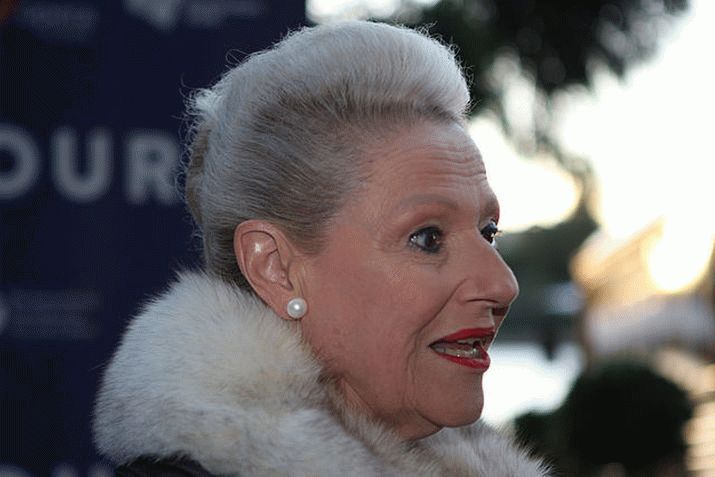
WE’VE heard plenty about politicians abusing “entitlements”, with the Bronwyn saga providing satirical comment to keep us outraged and amused for weeks.
The PM has promised yet another review, this time a “root and branch review”. But there’s a related issue that needs review and it’s far more important — political funding, donations and disclosure.
Despite claiming to support democracy, governments of both persuasions seem reluctant to make changes in this area despite detrimental effects that unlimited election spending and undisclosed donations have on democracy, without even mentioning the potential for corruption.
With state and federal governments unwilling to change the law and knowing that many candidates want more transparency, Funding and Disclosure (Inc) launched a pilot project prior to the Tasmanian local government elections in 2014. We developed a website to allow candidates to voluntarily disclose donations in real time. Most didn’t take up the offer despite media promotion. We copped abuse from candidates who accused us of interfering with the electoral system.
We demonstrated how easily and inexpensively it can be done. The many candidates who did disclose donations showed their commitment to transparency and may have benefited from this. One is now in one of the most powerful positions in the state.
It seems likely our action and the media coverage was a catalyst. At long last the Local Government Association of Tasmania is considering this, acknowledging it’s inconsistent for Tasmania to be the only state with no requirement for local government candidates to disclose who funded their campaign. They committed to developing a policy and “have had preliminary discussions”. The wheels turn slowly.
A legislative council committee is considering issues about the Tasmanian Electoral Commission. Many submissions addressed election funding, donations and disclosure. There seems to be consensus the system is open to abuse at local and state levels.
The submission from the Liberal Party, however, states they will not support “changes to donation, spending or disclosure laws which would inevitably lead to litigation — a very unhealthy development for our democracy.” It’s a valid point. It is a difficult area to regulate. It’s all very well introducing laws and regulations but how are they policed? What if an overseas supporter runs a campaign funded and organised outside Australia? What if donations are handed over in a “brown paper bag”?
Just because a law is difficult to police does not mean it should not exist. Income tax laws don’t completely eliminate the cash economy but if you get caught, you can be prosecuted. How healthy is it for democracy for candidates to be able to legally accept donations of any amount from anyone, with no disclosure requirement? This is a recipe for corruption.
Local government is where most politicians “cut their teeth” and councillors make decisions worth millions of dollars to developers and ratepayers. Who knows who they might be beholden to?
Funding & Disclosure was formed to lobby for greater transparency. There is no excuse for keeping donations hidden and no longer an impediment to real-time disclosure. Political donations above about $100 from an individual or entity should be made directly to an Electoral Fund Authority.
When the donation is transferred to the intended recipient, details would be published online in real time. Any other donations would be illegal. This would probably be administered by the Electoral Commission.
Election spending should be capped. There is an “arms race” in spending and if it’s allowed to escalate we will find ourselves with a US-type system where politicians “buy” into power.
You could say Clive Palmer demonstrated we’re already there, but it is still possible to mount a campaign in opposition. If campaign spending increases unabated, a time will come when only the extremely wealthy or connected will wield power.
Major political parties drag their heels on reform in this area. It took Choppergate to force them into a review of their “entitlements” and it will be up to us in the electorate to make this into another issue that just won’t go away.
Pat Synge is public officer for Funding & Disclosure (Inc): http://www.fundinganddisclosure.org.au/











